

No justice, no peace
An event marking 50 years of settlements is overshadowed by the Supreme Court’s decision to not send a judge, with the bench seen as both villain and hero
 Add ToI as a Preferred Source on Google
Joshua Davidovich is The Times of Israel's Deputy Editor

This likely isn’t how settler leaders imagined the cherry on top of their 50 years of settlement celebration would go. The day after a highly anticipated event meant to celebrate 50 years of settlement, papers make the event look less like fireworks and more like a box of duds, with pictures of empty seats and stories of an unenthusiastic crowd, boycotts from some respected Israeli figures and yet another notch against the settlements in the international arena.
Even Israel Hayom is focused on who didn’t show up to the ceremony, namely any Supreme Court justice, and its top headline, a play on the name of Supreme Court President Miriam Naor making her name sound like “unenlightened,” makes plain that the paper has no intention of not taking sides.
Likewise, Yedioth Ahronoth’s main headline regards a seven-year-old rape case, which could be a seen a subtle way of joining those staying away from the political event, flipping the government the bird by showing it that even a relatively minor story is more important.
Nonetheless, the ceremony does lead the paper’s inside pages, though it’s hardly rah-rah, mostly thanks to a crowd that couldn’t seem to care less about the occasion.
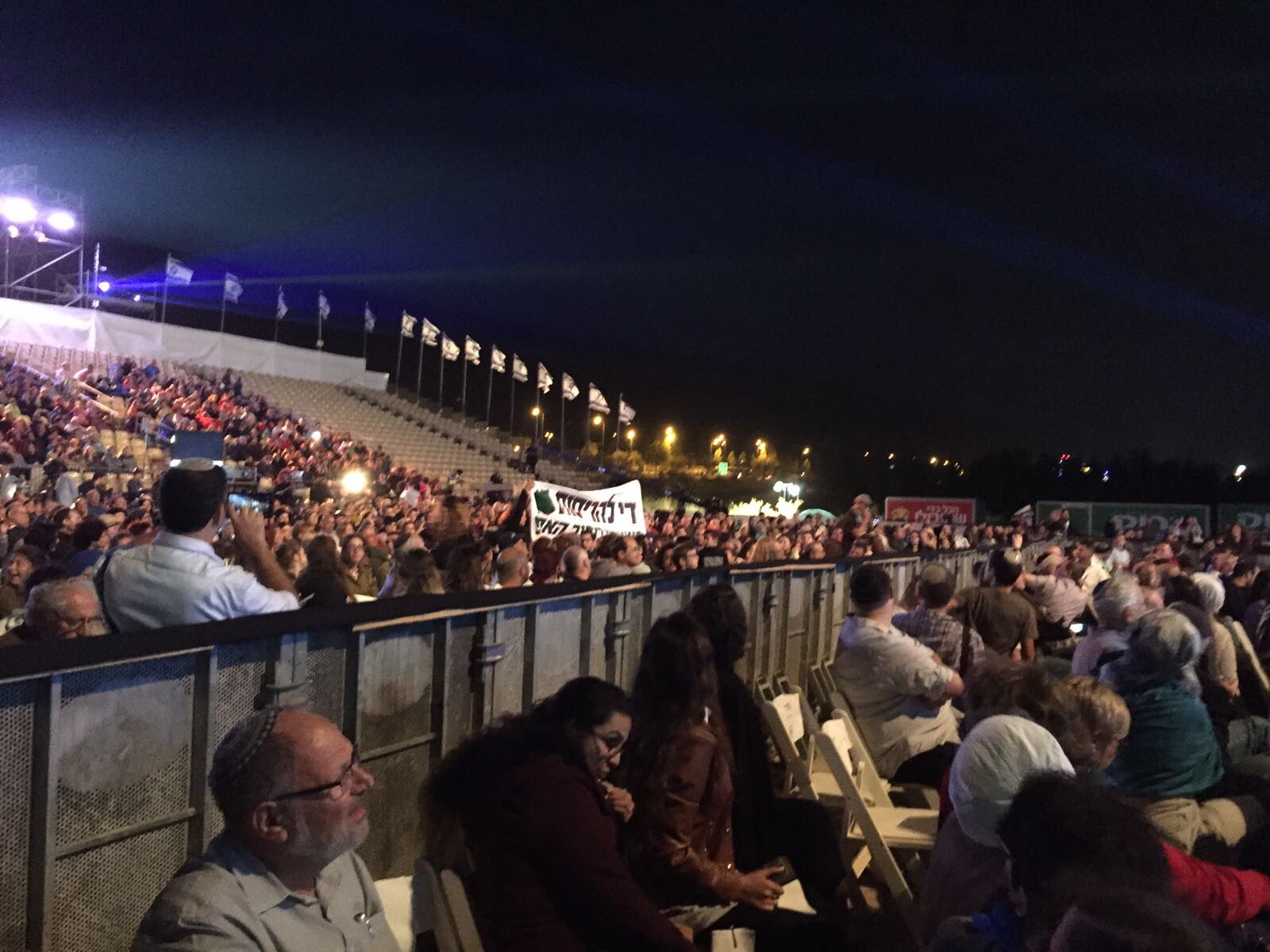
“They were cold, passive, on the verge of hostile. It’s hard to understand why, whether it’s because of the chilly weather, or perhaps after 50 years they have become complacent, or maybe they had a hard time believing the campaign pitches they hear from the stage,” Nahum Barnea writes in Yedioth, describing a large temporary amphitheater with sections bereft of people. “They expected that this government, the most right-wing ever, would build on every hill, take over every parcel, authorize every outpost. It’s not happening. Thus there were some who demonstrated outside and some with their feet.”
Likewise Haaretz’s top picture is Netanyahu speaking on a large stage, but the accompanying stories detail everything going wrong with both the ceremony and the settlements in general. The paper’s top story reports that the UN has sent a note to some 150 companies operating in the settlements or East Jerusalem warning them they could be blacklisted, with a number of companies saying they will just pull out of Israel altogether and avoid the hassle.
“These companies just can’t make the distinction between Israel and the settlements and are ending their operations all together,” a senior Israeli official is quoted saying. “Foreign companies will not invest in something that reeks of political problems – this could snowball.”
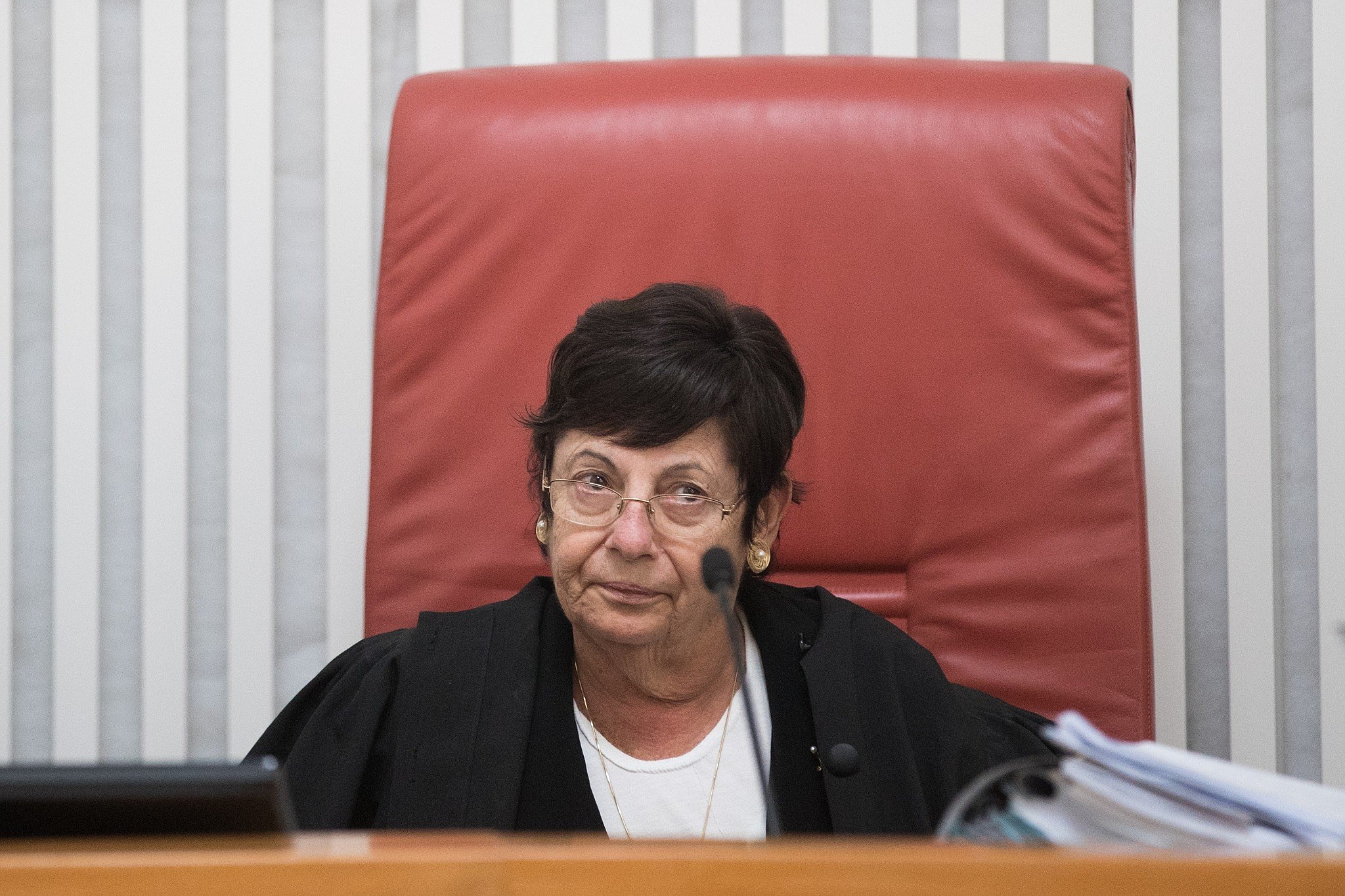
The paper’s other main story is ostensibly about the ceremony, but leads off with Naor’s boycott, not because she necessarily has beef with the settlements, but because she opposes what is seen as the political nature of the event.
“Before the ceremony, Naor explained that she would not send a judge because the event was too one-sided and controversial,” the paper reports.
The broadsheet’s lead editorial backs Naor and takes aim at the settlement enterprise, killing two birds with one stone.
“It was a ceremony that had nothing to do with nonpartisan governance, and was rather a clearly political ceremony that officially changes the nature of the territories to being liberated ones,” the editorial reads. “Expecting the Supreme Court to send a representative to an event celebrating the state’s biggest legal calamity was ridiculous in the first place. The real question is not why the judicial branch did not participate in an event marking 50 years of the settlement enterprise, but why the State of Israel wasn’t too embarrassed to hold such an event.”
In Israel Hayom, there’s also no question, with Naor being obviously in the wrong, at least according to a column by Dror Eydar plastered across the front page.
“Naor’s decision was seriously wrong, because she mainly hurt the standing and authority of the Supreme Court. She proved to everyone the decades-old claim about the court being hijacked by a small group that places itself above the lawmakers with the claim that they are the responsible adults compared to the losers who were elected to the Knesset, and so they — who were not elected by the public — are fit to lead the country,” he writes. “I saw myself a politician from the left say that he prefers the High Court’s rule because ‘look who is in the Knesset.’ His words were a paraphrase of a personal quip made by a justice to somebody visiting the court, who criticized the judicial imperialism in principle, but ‘looks at who they elected.’”
It’s not just that things looked less than great for the Israelis, but they also looked downright peachy for the Palestinians, with headlines of Netanyahu relaying that Trump told him not to be piggish about settlement, as well as “Palestine” getting membership in Interpol.
Yedioth calls the Interpol decision a diplomatic achievement for Ramallah, and columnist Tovah Tzimuki draws a link between the international justice system and the hubbub over the High Court boycotting the settlement ceremony, saying it is actually the High Court’s willingness to operate in the West Bank that has saved Israel from the sort of international sanctions that could end the settlement enterprise.
“Since the International Criminal Court in The Hague was set up, the High Court has acted as body armor for Israel against claims by countries and international rights groups of war crimes against the Palestinians. How? Thanks to the principle in the ICC by which if a person was already dealt with in an Israeli court, they are supposed to reject the case. And this is based on the Israeli court system being trustworthy, professional and honest,” she writes. “So next time ministers on the right and their lackeys make claims against the Supreme Court, they should remember that one of the main reasons Israel is not internationally isolated is thanks to [the court].”
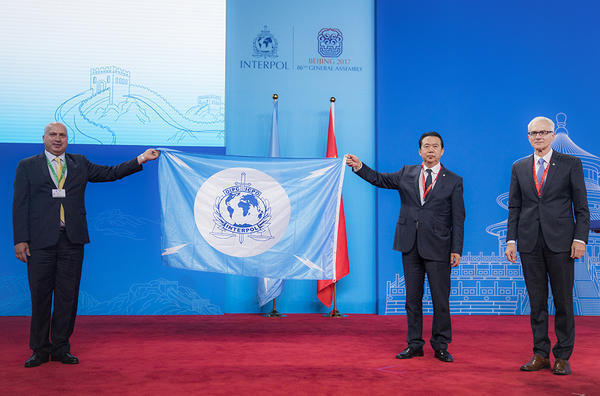
As for Interpol’s decision to let the Palestinians in the door, Israel Hayom columnist Yaron Bloom is both angry and nonplussed.
“It is not certain how much the Palestinian Authority will use the capabilities of the organization, but it is certainly another difficult, complex and miserable decision by the organization’s member states. How cynical can the world be? How is there no correlation made between terrorist attacks in the West and the involvement of Palestinians in terror and/or incitement to terrorism? When will enlightened countries wake up and realize that a finger raised [in a vote] can be a significant move and not only symbolic?”






The Times of Israel Community.