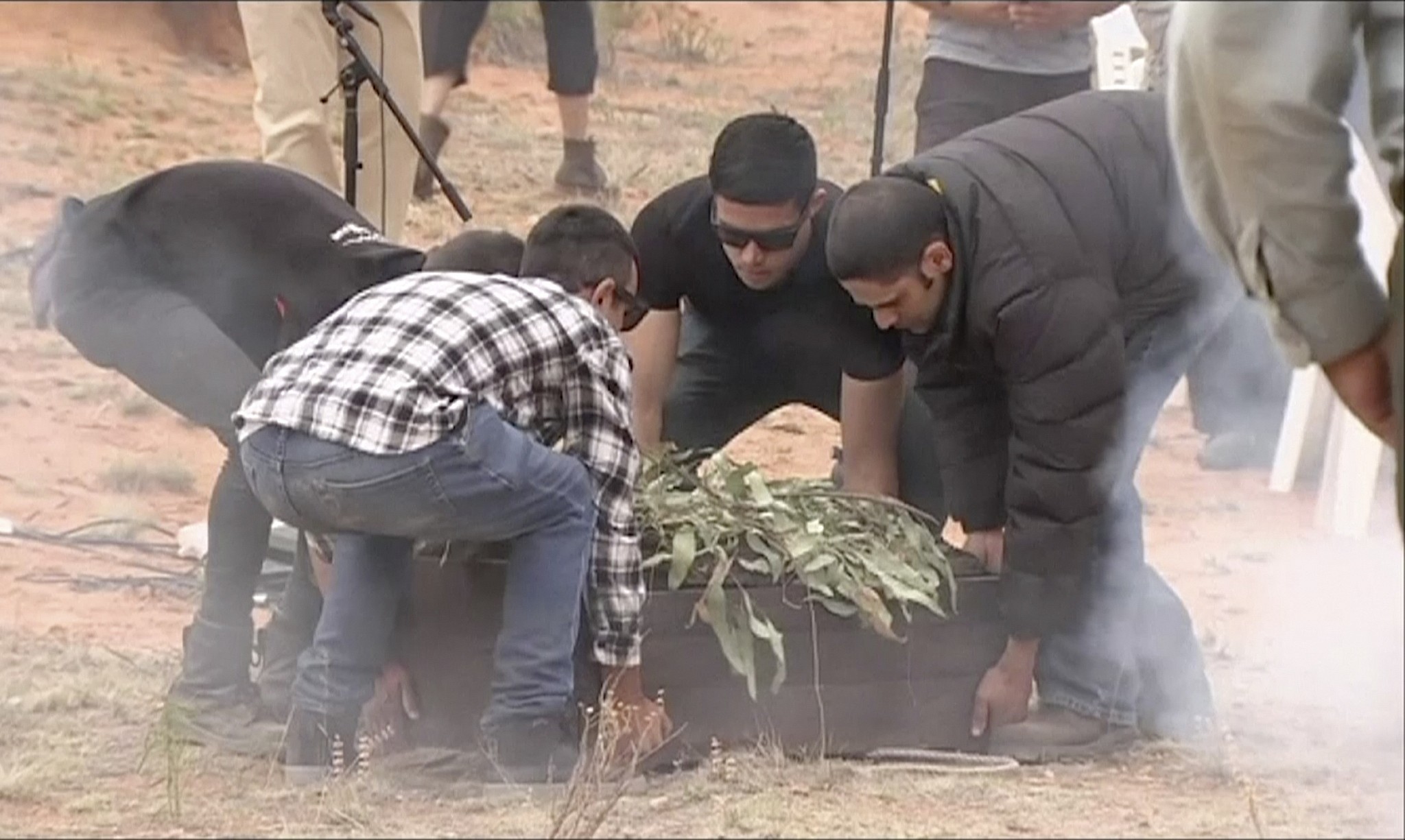
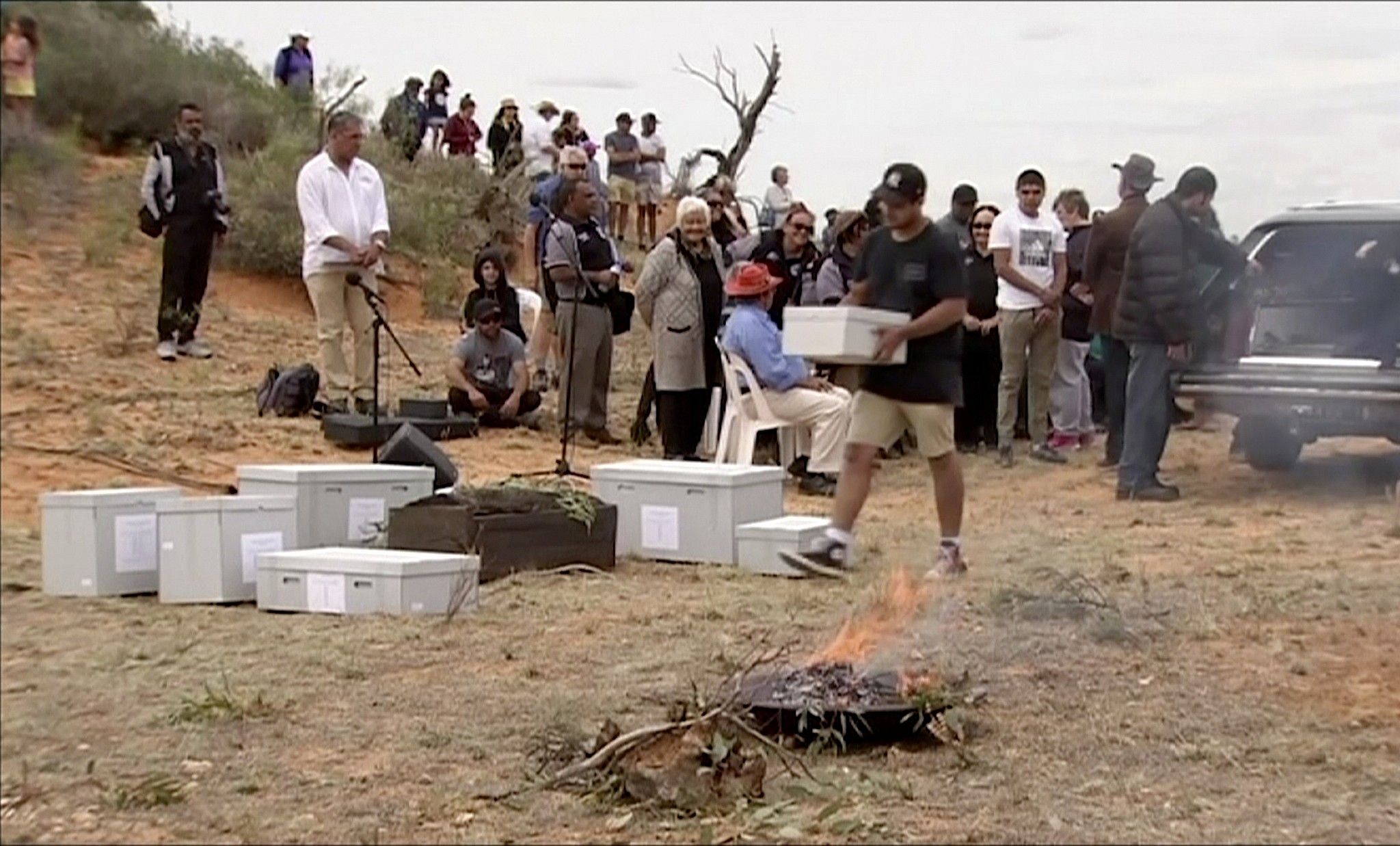
In this image made from video, the remains of the 42,000-year-old "Mungo Man" are unloaded and placed on the ground during a traditional ceremony in Lake Mungo, Australia, Friday, Nov. 17, 2017. (Australian Broadcasting Corporation via AP)
LAKE MUNGO, Australia — The oldest human remains found in Australia were on Friday returned to the Outback desert that he roamed some 42,000 years ago in a ceremony celebrated by traditional owners.
The ice age Aborigine was dubbed Mungo Man after the dry salt Lake Mungo where he was found in 1974 in remote New South Wales state 750 kilometers (470 miles) west of Sydney.
He was studied in the national capital Canberra at the Australian National University, which handed him back to traditional owners two years ago and formally apologized for the pain caused by his removal.
Local Aborigines burned eucalyptus leaves in a traditional smoking ceremony to welcome the black hearse that carried his remains in a coffin.
In this image made from video, the remains of the 42,000-year-old “Mungo Man” are unloaded and placed on the ground during a traditional ceremony in Lake Mungo, Australia, Friday, Nov. 17, 2017. (Australian Broadcasting Corporation via AP)
An Ngiyampaa tribal elder, who identified herself as Aunty Joan, told reporters: “I’m so glad he is back, to put him in his resting place.”
Get The Times of Israel's Daily Editionby email and never miss our top stories
“His spirit will be relieved and then he will be released when we put him back in the ground to his place where he came from,” said Aunty Patsy, an elder of the Mutthi Mutthi tribe.
State Heritage Minister Gabrielle Upton said indigenous people had been instrumental in bringing Mungo Man back to where he was laid to rest around 42,000 years ago with his hands crossed over his lap and his body sprinkled with ochre. He had reached the relatively old age of 50 before he died and, based on the care taken in his burial, appears to have been mourned by those he left behind.
Advertisement
Help us report truthfully on social media
As a multimedia journalist, my job is to take the quality, fact-based journalism produced by The Times of Israel newsroom and make it accessible across every platform — from Instagram posts to podcasts to short-form videos.
This is how many, especially young people, consume news these days. But misinformation is rampant on social media. Our team at ToI produces accurate, responsible short-form reporting on Israel and the Jewish world.
If you believe in the importance of factual social media journalism, please consider joining our reader support group, The Times of Israel Community. Your financial support is essential to sustain responsible multimedia reporting.
We’re really pleased that you’ve read X Times of Israel articles in the past month.
That’s why we started the Times of Israel - to provide discerning readers like you with must-read coverage of Israel and the Jewish world.
So now we have a request. Unlike other news outlets, we haven’t put up a paywall. But as the journalism we do is costly, we invite readers for whom The Times of Israel has become important to help support our work by joining The Times of Israel Community.
For as little as $6 a month you can help support our quality journalism while enjoying The Times of Israel AD-FREE, as well as accessing exclusive content available only to Times of Israel Community members.
Thank you, David Horovitz, Founding Editor of The Times of Israel


 Add ToI as a Preferred Source on Google