

In poignant Tisha B’Av message, Bennett calls on Israelis to cease name-calling
During moderated discussion in Efrat with Labor head Avi Gabbay, education minister tells largely settler audience that it no longer has to act like it’s a minority
 Add ToI as a Preferred Source on Google
Jacob Magid is The Times of Israel's US bureau chief
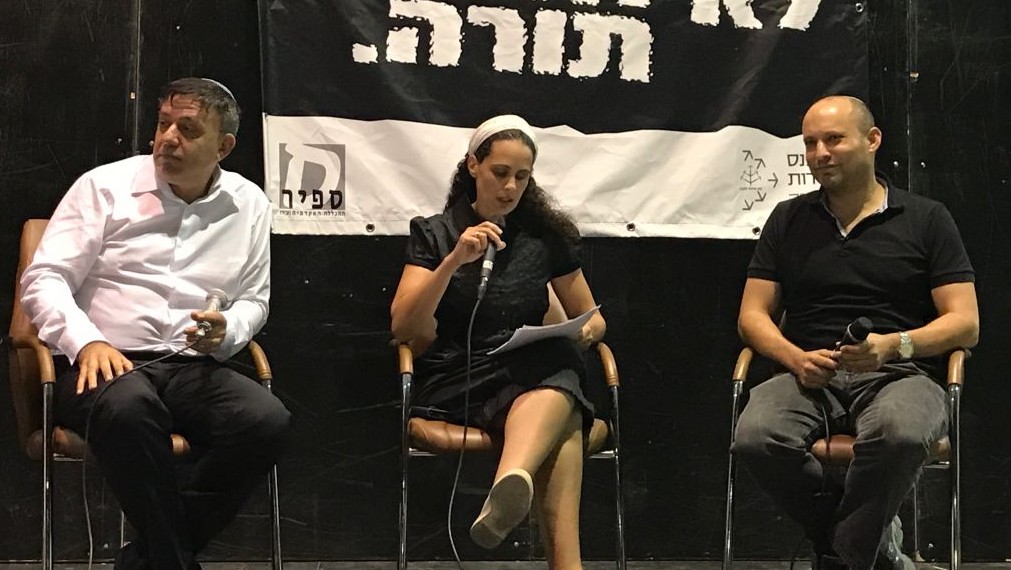
EFRAT, West Bank — Keeping with the theme of the Tisha B’Av Jewish day of mourning, Education Minister Naftali Bennett called on Israelis to cease name-calling and pigeonholing entire sectors of society at a moderated discussion Monday evening in the West Bank settlement of Efrat with Labor chairman Avi Gabbay.
The Jewish Home leader asked the crowd what they thought the most common slur was among junior high students. After several guesses from the audience of roughly 400, Bennett revealed the answer to be “leftist.”
“It is inconceivable that in Israel in 2017, a person can be cursed in the name of a sector,” he said. “The words leftist, haredi, Arab, settler, are not curses. Each sector is first and foremost a collection of people with feelings,” he said.
The Efrat event was one of dozens of sessions organized across the country by the Sderot Conference for Society and the Sapir Academic College to commemorate Tisha B’Av, the Jewish day of mourning for the destruction of the First and Second Temples in Jerusalem. Jewish tradition teaches that the latter of which fell due to “baseless hatred” — an internal struggle between various factions of the Jewish people.
Both Bennett and Gabbay addressed the theme at various points throughout the hour-long discussion.
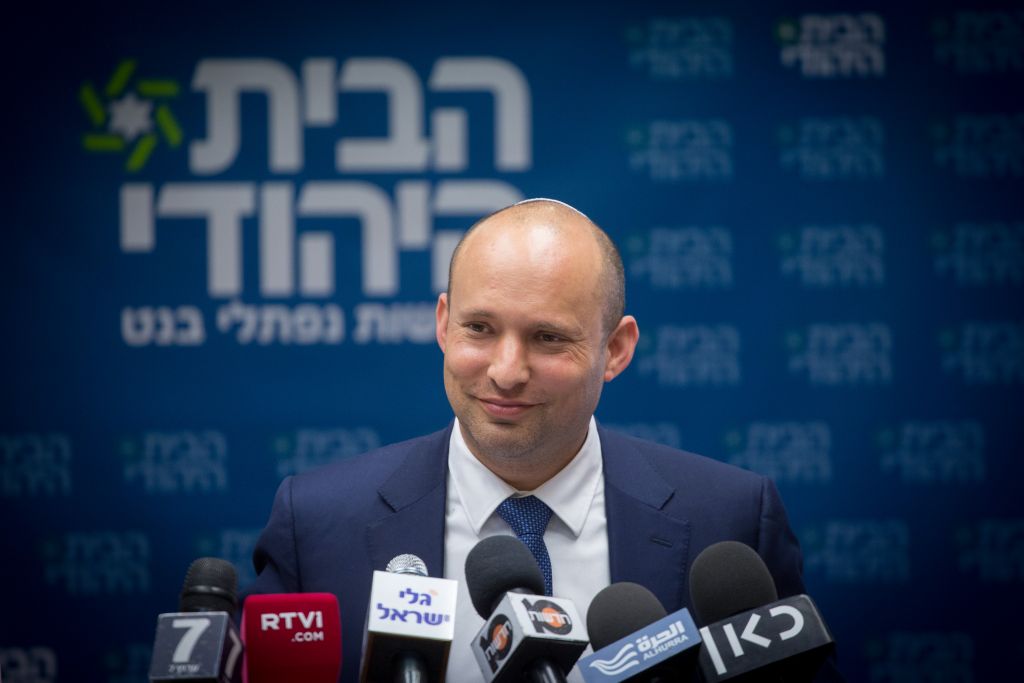
The new Labor chairman recognized the growing feeling of polarization in Israeli society, but argued that social media has created an aura of extremism that doesn’t necessarily exist. “The majority of the public is still moderate and is either silent or simply not voicing their opinions as loudly as others,” said Gabbay.
The former environmental protection minister, then with the center-right Kulanu party headed by Moshe Kahlon, went on to argue that his victory last month in the Labor primaries was a testament to the public’s appreciation for his refusal to campaign negatively against his opponents. “It proved that the public is looking for a positive discourse,” he said.
As the eve of one of the Jewish calendar’s more solemn days kicked off, a correspondingly mellow mood was sensed in the Efrat gymnasium. Bennett, clearly more at home among the settler audience, wore a black polo and jeans. Gabbay, on the other hand, was far-and-away the room’s most formally dressed, sporting a white button-down shirt and black dress pants. Doing his best to fit in among the more religious crowd, the new leader of the left’s largest party donned a blue yarmulke.
While both sat comfortably back in their arm-chairs on each side of moderating journalist Sarah Beck, Gabbay did not shy away from articulating stances at odds with the settler audience.
He stood by statements he made in July in which he called for “leadership that takes care of Dimona – and not just of Amona.” The latter was an illegal outpost evacuated in February after the High Court of Justice deemed it to have been built on private Palestinian land. In June, the government kicked off construction of a new settlement — the first in a quarter century — for the evacuees.
Gabbay said that during his time as government minister, he saw Prime Minister Benjamin Netanyahu’s coalition regularly prioritizing the settlements and not giving an equal amount of attention to periphery cities within the Green Line. Bennett, however, disputed the allegations off-hand.

Overall, Gabbay focused his disagreements with the government from which he resigned in May 2016 on Netanyahu rather than Bennett. The Labor chairman criticized the weekly cabinet meetings led by the prime minister where “every week there would be comments against the left, the media, or the Arabs.”
He reiterated points from his resignation speech, given over a year ago, in which he put forth a similar message to what he told the crowd Monday evening, “For me, the state of Israel is a wonder — the realization of the Third Temple.” he then said. “The Jewish people already destroyed the Second Temple with their civil wars, we must stop these process that will lead to the destruction of the Third Temple.”
Taking advantage of a more home-court crowd, Bennett recommended that his right-wing camp recognize its new societal role. “We are no longer trying to steer the government from the outside. We are the government,” he said. “We need to stop thinking that we’re the persecuted victims.״
When the conversation concluded, both lawmakers were mobbed by audience members, looking to take selfies with the evening’s stars. While Bennett’s throng was twice as big, several individuals made a point of approaching Gabbay despite their ideological differences. Among them was Matan Dansker, a 24-year-old Likud activist. “I told him that I appreciated his fresh messaging, and that it is an important addition to the political discourse,” he said.
Efrat resident Ayala Friedman felt similarly, but wasn’t convinced the evening won Gabbay any new voters.
“There’s a reason Bennett felt so comfortable up there. He knows this was his crowd,” she said.







The Times of Israel Community.