

Roman Polanski’s award-winning Dreyfus Affair film makes long-awaited US debut
Screening in New York from August 8, what may be the best film adaptation of France’s Kafkaesque trial has the exiled director drawing comparisons between himself and his subject
 Add ToI as a Preferred Source on Google
Jordan Hoffman, a member of the New York Film Critics Circle, is The Times of Israel's long-time film reviewer and the co-host of The Reel Schmooze.
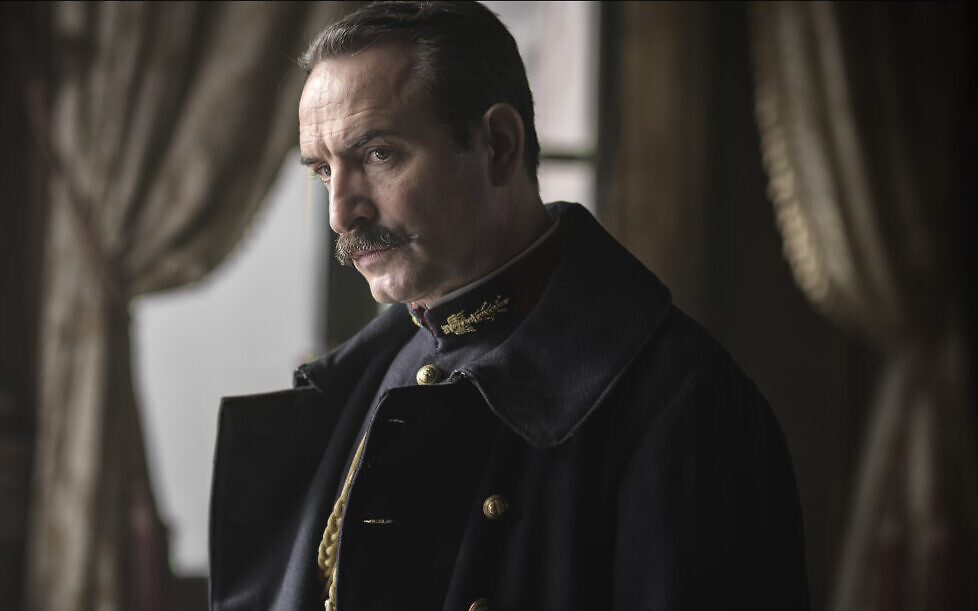
It seems obvious that, to him, there was no better match of artist and repertoire. Roman Polanski is a man whose childhood was shattered by European antisemitism, and his adult years, he’d claim, saw the rug pulled out from under him because of a conspiratorial and unjust legal system. As such, you can see why the Polish-born filmmaker, whose career reached an apex in 1970s Hollywood, would want to make a movie about the Dreyfus Affair. Given the man’s abundant talent, “An Officer and a Spy” is, indeed, a terrific telling of France’s shameful chapter of very public prejudice. But it’s impossible to watch it and not think “of all the people in the world, he is the one who made this?”
Roman Polanski is no Alfred Dreyfus. Whereas Dreyfus was an honorable captain in the French army, dubiously scapegoated with the crime of treason, Polanski drugged and raped a 13-year-old girl and then fled the United States when he learned a particularly harsh sentence was coming his way. He’s spent decades in exile, continually eluding extradition attempts, working with many Hollywood legends who (prior to the #MeToo years) were willing to shrug at his predicament.
Complicating matters somewhat is that Polanski’s work, both before and after his crime, is marvelous, including “The Pianist,” which drew in part from his own experiences hiding from Nazis as a child while his parents were taken to concentration camps. It won him the Palme d’Or at Cannes and the Best Director Oscar in 2002.
The #MeToo movement, however, realigned Polanski’s status: He was expelled from the Academy of Motion Picture Arts and Sciences in 2018. The following year saw the debut of “An Officer and a Spy” at the Venice Film Festival, the first scene of which is Dreyfus’s public “degradation,” recreating an iconic image from late 19th-century European history. In press interviews at the time, Polanski stated, “I am familiar with many of the workings of the apparatus of persecution shown in the film.”
The movie won the Grand Jury prize (second place) at Venice, as well as the critic-determined FIPRESCI prize. Months later, at the César Awards (France’s Oscar equivalent), Polanski, who did not attend due to increased outrage, won the best director and best screenplay adaptation prize. Director Céline Sciamma and actresses Adèle Haenel and Noémie Merlant marched out of the event in protest, to much hooting and hollering.
Now it is over five years later, and with Polanski having already completed another film, “An Officer and a Spy” is getting its first release in the United States. (It will play at New York City’s Film Forum beginning August 8 and will surely become available on a streaming platform soon.) So it is my burden to help you determine if it deserves two hours of your time.
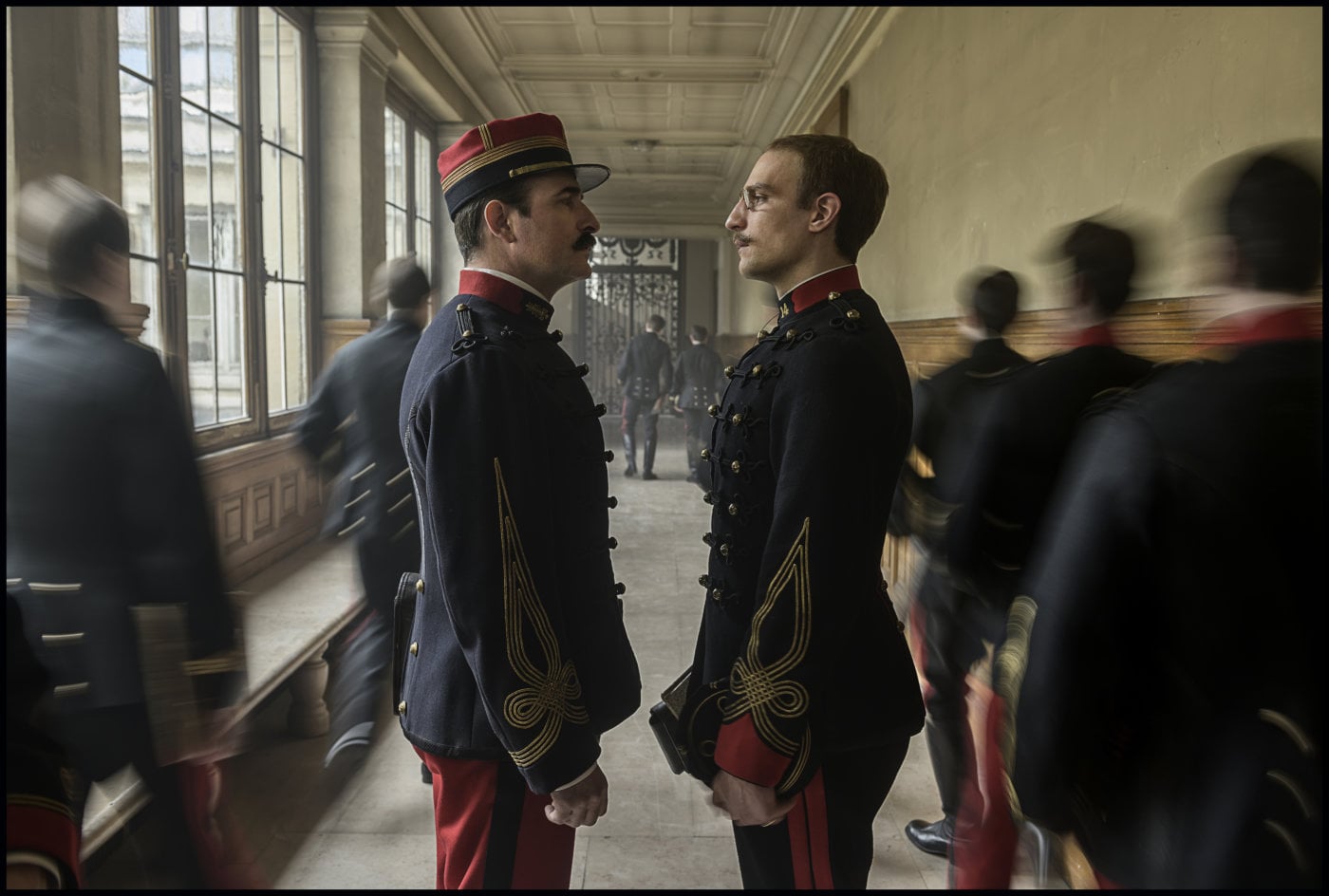
Jean Dujardin plays Colonel Georges Picquart, the “honorable” antisemite who discovers Dreyfus’s innocence and condemns himself to years of torment fighting for a retrial. There’s a moment in the picture where he sighs and admits that life would be a lot easier if, in fact, Dreyfus was guilty. The stakes are considerably lower for me — my opinion will not banish anyone to Devil’s Island — but I did chuckle at that line, as indeed I would have preferred it if this movie stunk. Sadly, it is, in fact, quite good, and works on a number of levels.
Foremost, it is a good mystery! Think of it as “CSI: Paris, 1896.” That’s when Picquart, who knew Dreyfus as his pupil at the War Academy and was an observer to his first trial, became head of Army Intelligence, and slowly grew to accept that the evidence against Dreyfus — then toiling in Devil’s Island — had some Eiffel Tower-sized holes in it.
Picquardt puts things together using the era’s state-of-the-art surveillance techniques. We see torn handwritten notes taped together like jigsaw puzzles, mail surreptitiously opened with steam, and early use of photography. But the essence of any good detective work is eternal: keep your eyes open and use your sechel.
Dreyfus himself, played by Louis Garrel, is out of the picture most of the time. He is presented as taciturn and defiant — all the more infuriating to the political animals in the French military and government who want his story to disappear.
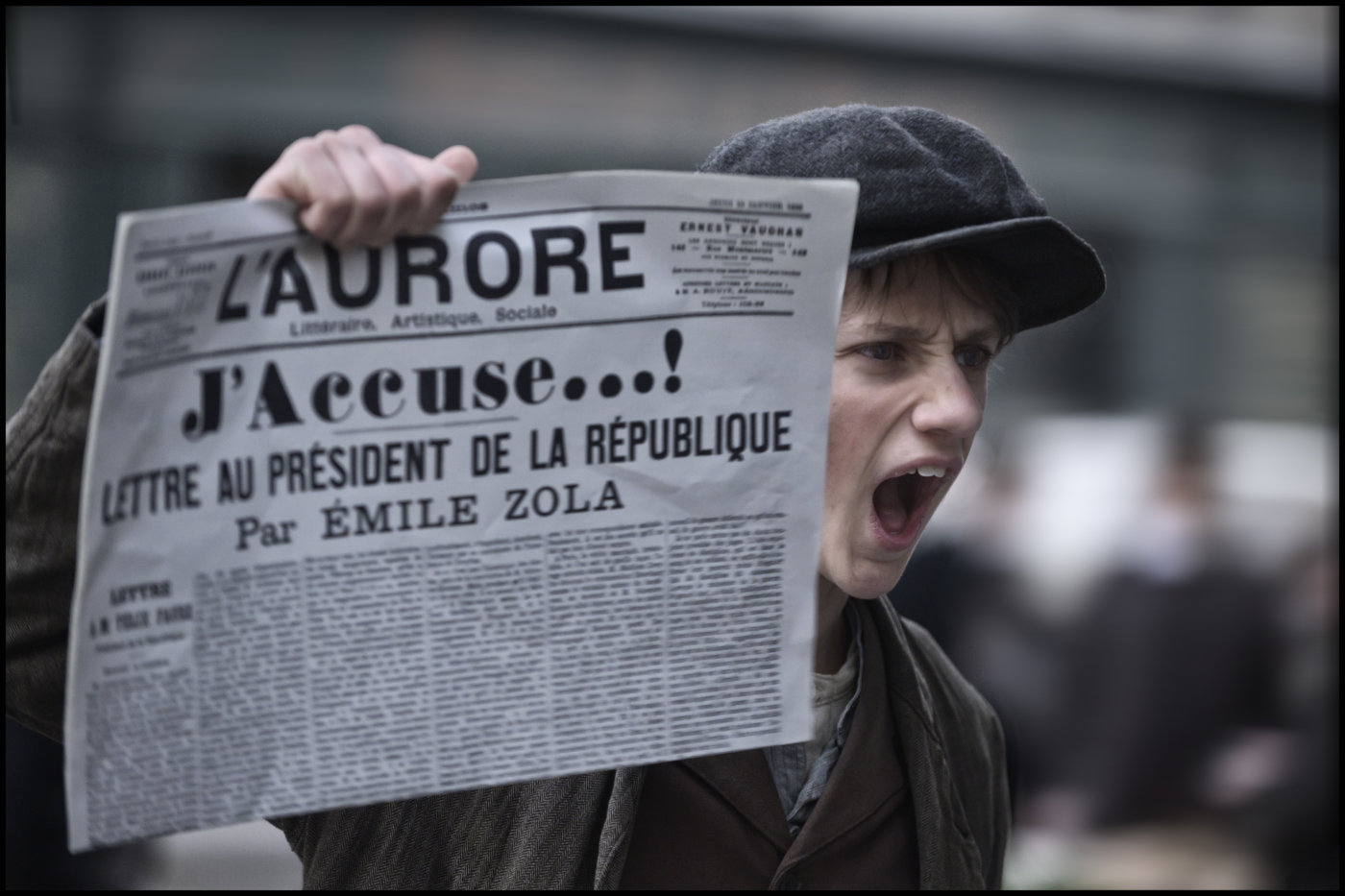
The elusive and illogical nature of Dreyfus’s Kafkaesque experience hangs like an unseen stench throughout the film. This is best expressed during the first trial, when a handwriting expert assures the court of Dreyfus’s guilt because a note’s scribblings share some similarities with Dreyfus’s script — but also dissimilarities, proving that the odious and untrustworthy man was intentionally trying to fool any spies. (Thus, the paradoxical notion of an “auto-forgery” entered the courts.) Damned if you do, damned if you don’t — and doubly so if you are Jewish.
As unwavering as Dreyfus is the presence of antisemitism. Polanski’s script treats its omnipresence merely as a fact — like the stink of the 19th-century sewers or the ceaseless wars with Germany. No one bothers to hide their distrust and distaste of Jews, not even Picquart, who suffers greatly when he advocates to his superiors on Dreyfus’s behalf. Though at the end of the film, he is shown to have great respect for Dreyfus as a man, he never once verbalizes any change of heart for Dreyfus as a Jew.

This refusal to bend to a more typical Hollywood arc is part of what makes “An Officer and a Spy” so fascinating. There is a light touch throughout — we’re watching Picquart watch things — with very mannerly, stage-like flashback transitions when story points become relevant. Along the way, we catch glimpses of late 19th-century French high society — chamber musicians debuting Fauré compositions to men with abundant mustaches and women fanning themselves, who then excuse themselves to trade secrets or hide away for romantic affairs. (Polanski’s wife Emmanuelle Seigner shows up periodically to bed Dujardin’s Picquart and tell him how noble he is.)
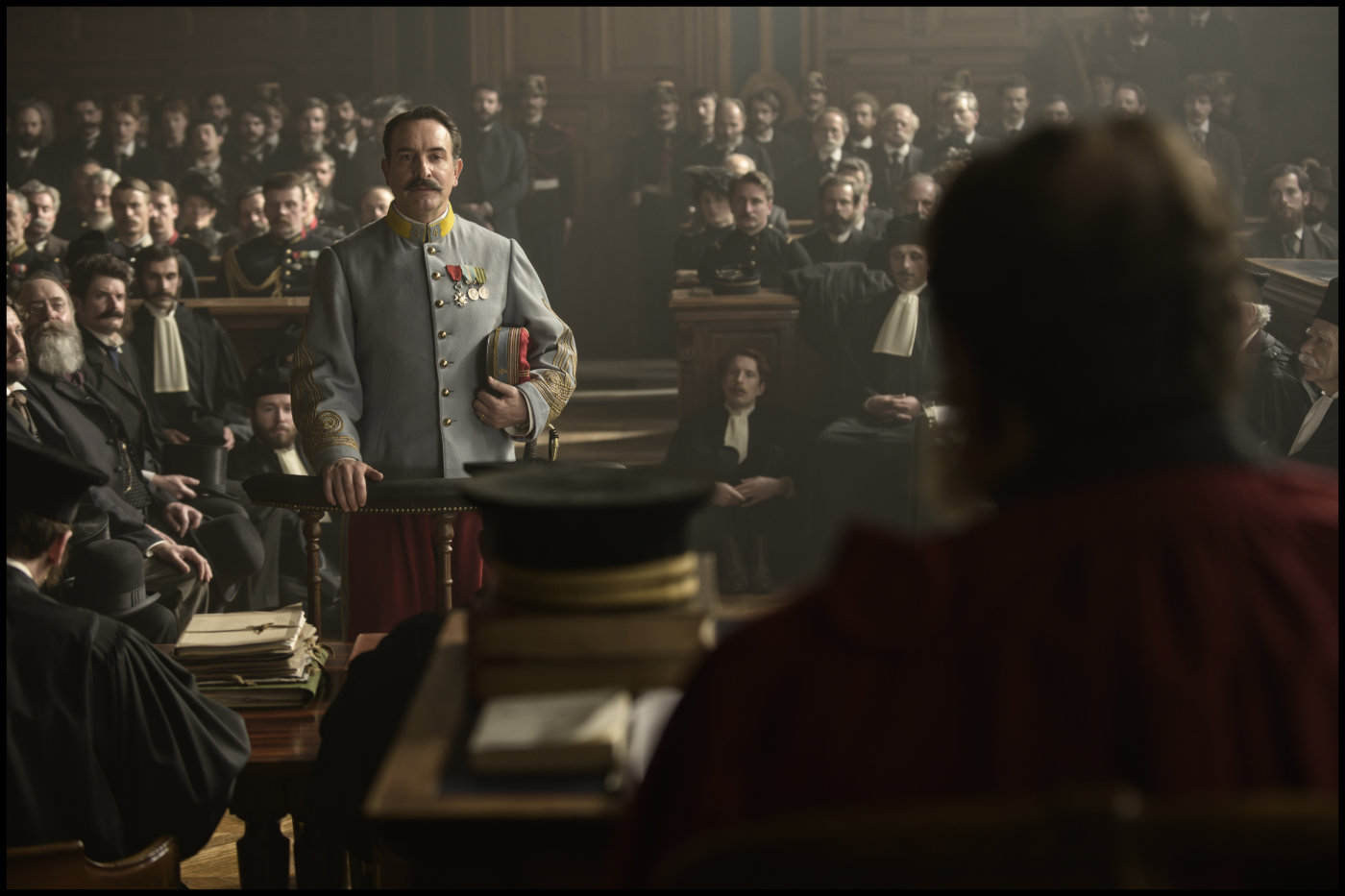
Though the movie does conclude with Dreyfus’s second trial, there is no typical climactic triumph. Dreyfus’s full exoneration was years in the making. Indeed, a fight to secure his posthumous military rank continues to this day.
There are other movies about the Dreyfus Affair, most famously the 1937 Paul Muni-led Oscar-winner “The Life of Emile Zola,” which, typical of the era, avoided any direct references to antisemitism and does not once use the word “Jew.” Also, José Ferrer starred and directed in the 1958 film, “I Accuse!” which, to its detriment, borrowed Dreyfus’s steady, curt demeanor as something of an aesthetic directive. (This is my polite way of saying the movie is a bore.)
As such, Polanski’s version of this very important chapter from history is probably the best, or at least most approachable, one you can find. It is, however, truly remarkable that he made it.

Polanski turning stories from his life into rewarding films is not new. In addition to “The Pianist,” there’s “Chinatown,” a story featuring a murdered innocent Los Angeles woman made not long after his wife, Sharon Tate, was killed by the Manson Family.
With “An Officer and a Spy,” however, both Picquart and Dreyfus defiantly stand up to power and suffer unjust prison sentences as a direct result. If Polanski sees himself in these figures, it’s worth pointing out that when his criminal actions led to a trial, he fled to the comforts of Europe to make movies with Harrison Ford, Nastassja Kinski, Sigourney Weaver, Johnny Depp, and more. There is, I think all can agree, a great difference.









The Times of Israel Community.