

Tillerson says US may consider sanctions on Myanmar citizens
But secretary of state stipulates that he would not recommend ‘broad-based economic sanctions’ against entire regime
 Add ToI as a Preferred Source on Google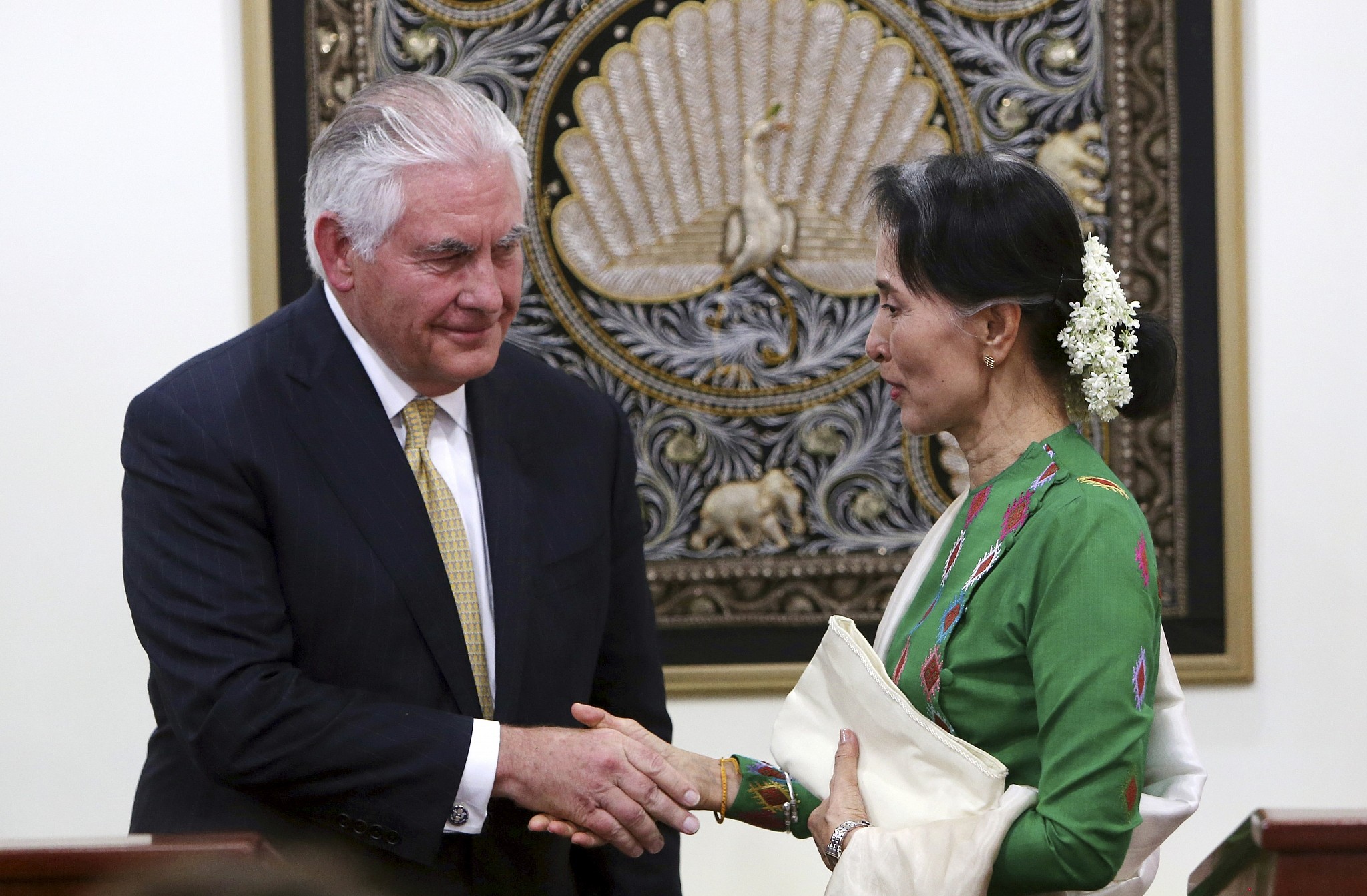
US Secretary of State Rex Tillerson said Wednesday that his country was deeply concerned by “credible reports” of atrocities committed by Myanmar’s security forces and called for an independent investigation into a humanitarian crisis that has seen hundreds of thousands of Muslim Rohingya flee to Bangladesh.
Speaking at a joint news conference with leader Aung San Suu Kyi in Myanmar’s capital, Tillerson said the US would consider individual sanctions against people found responsible for the violence, but he would not advise “broad-based economic sanctions” against the entire country.
“All of that has to be evidence based,” Tillerson said. “If we have credible information that we believe to be very reliable that certain individuals were responsible for certain acts that we find unacceptable, then targeted sanctions on individuals very well may be appropriate,” he said.
Tillerson also met with Myanmar’s powerful military chief, Min Aung Hlaing, who is in charge of operations in Rakhine.
A senior US State Department official said Tuesday that Tillerson would use the visit to “express concerns over the displacement and violence and insecurity affecting Rohingya populations and other local populations and discuss ways to help Burma stakeholders implement commitments aimed at ending the crisis and charting productive ways forward.”
Myanmar was formerly known as Burma.
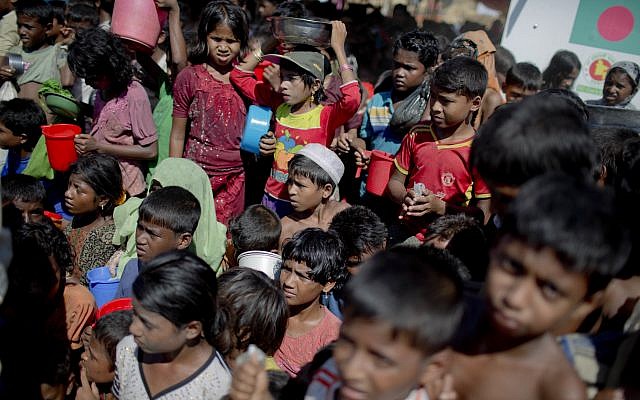
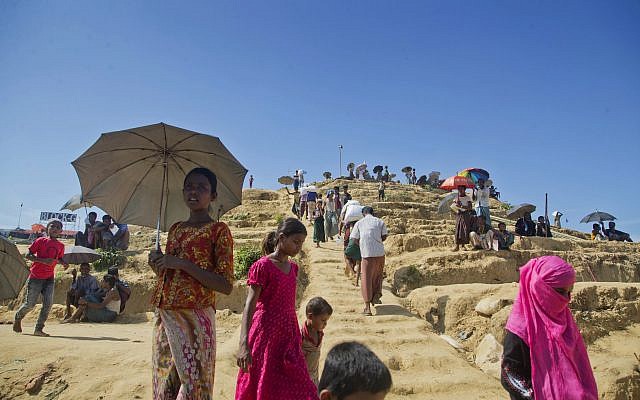
Tillerson’s one-day visit comes as a new report said there was “mounting evidence” of genocide against the Rohingya in Myanmar’s northern Rakhine state, where a government security operation has caused more than 600,000 Rohingya to flee to neighboring Bangladesh.
The report by the United States Holocaust Memorial Museum and the advocacy group Fortify Rights found there is “mounting evidence” of genocide against the Rohingya. It accused security forces and civilians of mass killings, including burning victims alive, among them infants, along with rape and other abuses, and called on the international community to take action.
“These crimes thrive on impunity and inaction,” said Matthew Smith, the head of Fortify Rights. “Condemnations aren’t enough. Without urgent international action towards accountability, more mass killings are likely.”
Myanmar’s military has denied the accusations, most recently with a statement Monday. The military said it had interviewed thousands of people during a monthlong investigation into the conduct of troops in Rakhine after Rohingya insurgents launched a series of deadly attacks there on August 25.
While the report acknowledged that battles against militants from the Arakan Rohingya Salvation Army had left 376 “terrorists” dead, it also claimed security forces had “never shot at the innocent Bengalis” and “there was no death of innocent people.”
Despite the reports of overwhelming human rights violations, Israel has refused to say that it will not sell weapons to the Asian nation.
The issue of Israeli defense exports is difficult to discuss in the media, as many aspects of the industry are subject to military censorship. However, when it comes to arms sales to Myanmar, the country’s military junta is not equally tight-lipped, and has boasted of acquiring Israeli advanced weaponry on social media as recently as last April.
Last month, in response to the apparent Israeli arms sales, a campaign of Jewish leaders in the US has been launched to pressure Jerusalem to cease the dealings: the left-leaning T’ruah: The Rabbinic Call for Human Rights organization published a petition that has already been signed by more than 300 rabbis, cantors and community leaders.
In response to the recent petitions, the Foreign Ministry released a statement that did not deny weapons were being sold to Myanmar, but said that Israel was not directly involved in the apparent ethnic cleansing there.
“Israel vigorously denies the false reports being spread by the media about Israel’s alleged involvement in the tragedy in the Rakhine state in Myanmar,” a Foreign Ministry spokesperson said. “The State of Israel’s oversight policy for defense exports are reviewed regularly in accordance with different considerations, including the human rights situation in the country, as well as the policy of the UN Security Council and other international bodies.”
Judah Ari Gross contributed to this report.





The Times of Israel Community.