

Transmission rate now over 1, Israel may be following UK to COVID resurgence
Cases spreading fast in Omicron bellwether UK, where some 1 in 30 of people age 70-plus had virus in one week. Israel should be concerned — but has an edge in rules and vaccines

 Add ToI as a Preferred Source on Google
Nathan Jeffay is The Times of Israel's health and science correspondent
After weeks of shrinking COVID numbers, Israel’s transmission rate has passed 1. This means that cases are expected to rise — and represents an ominous warning that Israel could be moving in the same direction as the United Kingdom, where cases are rocketing.
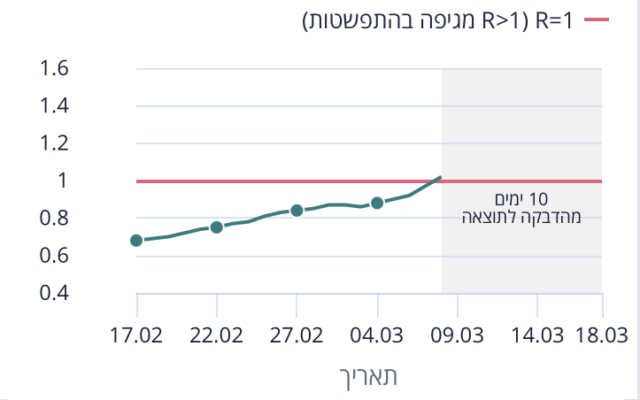
When the so-called R statistic dipped below 1, on January 19, it was a signal that the Omicron wave that started in December was ebbing.
The figure meant that each coronavirus carrier was infecting less than one other person on average, and therefore the number of cases were shrinking.
Now the opposite has happened: the R statistic is at 1.1. This emerged in the Health Ministry’s latest calculation, released Sunday and based on data from 10 days earlier, as is the norm with transmission calculations.
“This is probably happening because of BA.2,” Hebrew University epidemiologist Prof. Ora Paltiel told The Times of Israel, referring to a subvariant of Omicron. “It’s also impacted by the fact there are now fewer restrictions.”
She noted that Israel has just celebrated Purim, which saw many gatherings, and on Sunday close to a million people are expected to attend the high-density funeral of the Haredi leader Rabbi Chaim Kanievsky.
Most of Israel’s remaining coronavirus restrictions were scrapped in late February and as cases have dropped, the population has become less cautious.
BA.2 is thought to be more infectious than the original Omicron, but the jury is out on whether it is more serious.
COVID cases are climbing, and the rising R suggests the numbers will get worse — as does a glance toward the UK.
Israel’s new daily cases peaked in late January. On January 26 the moving average reached 75,564 new cases based on an average over several days to increase accuracy, and then started to sink. Last week it shrank to 5,852. But then, instead of continuing its downward trend, the number rose to 6,774.
Since Omicron emerged, Israel has had a COVID time machine of sorts. The UK has been several weeks ahead of Israel, and patterns there have tended to be broadly replicated here. Leading stats teams forecasted what was in store for Israel at the height of Omicron by analyzing the UK.
The United Kingdom — England, Scotland, Wales and Northern Ireland — saw some 3.3 million people infected, out of a population of 67 million, in the week ending March 12. There, the Omicron wave had started to ebb at the beginning of January, and cases continued to fall throughout February, before starting to increase again at the end of the month.
In the week ending March 12 diagnoses among over-70s, the age group most at risk of serious illness if infected, hit the highest levels of the whole pandemic, according to the Office of National Statistics. In England, the virus is spreading so fast that one in every 30 people aged 70-plus was infected in this timeframe.
Israel probably won’t be a carbon copy of the UK’s new coronavirus experience, since here, more measures to stop the spread of the virus have remained in place.
England has even gone so far as to abolish compulsory quarantine for infected people, and now just requests that people stay home. In Israel, COVID-positive people are still legally required to isolate. Masks remain compulsory indoors in Israel, while in most of the UK they aren’t.
And Israel has led the world with fourth vaccine shots, which have some benefits in cutting infection levels and serious illness, while the UK is only just preparing to roll them out. What is more, in Israel everyone aged five-plus can be vaccinated, while in the UK there hasn’t been widespread vaccination of under-12s. Paltiel said: “It’s always useful to be able to look to another country, in this case the UK, though it’s important to also appreciate that it doesn’t tell the story.
“And while Israel has more restrictions, we’ve also just had the Purim holiday during which many people met and now have a funeral that a million people are expected to attend, which despite being outdoors will bring people very close to each other. All these things impact virus spread,” she said.










The Times of Israel Community.