

UN debates Jerusalem after Trump warns ‘we’re watching’
Dismissed by Israel as a ‘house of lies,’ the UN General Assembly is expected to easily pass a non-binding resolution rejecting Trump’s recognition of Israel’s capital
 Add ToI as a Preferred Source on Google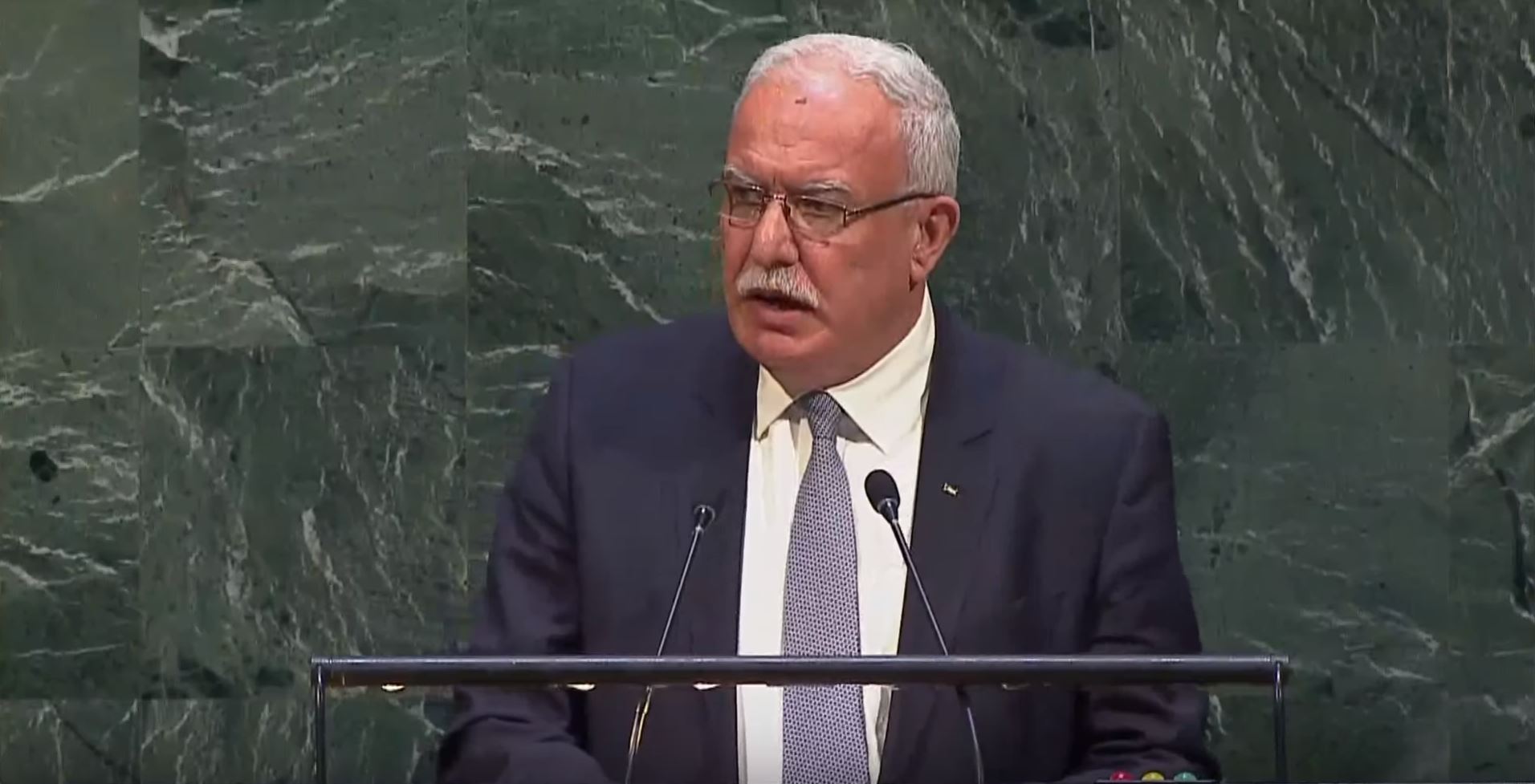
UN member states will vote Thursday on a motion rejecting US recognition of Jerusalem as Israel’s capital, with US President Donald Trump threatening to cut funding to countries that back the measure.
At an emergency session, the UN General Assembly will decide on a draft resolution reaffirming that Jerusalem is an issue that must be resolved through negotiations and that any decision on its status has no legal effect and must be rescinded.
The measure was sent to the General Assembly after it was vetoed by the United States at the Security Council on Monday; all 14 other council members voted in favor.
The status of the city, holy to Jews, Muslims and Christians, is one of the most thorny issues of the Israeli-Palestinian conflict.
The resolution, which is non-binding, is expected to pass easily despite US pressure on countries to abstain, vote against it or simply not turn up for the vote.
Hungary and the Czech Republic will abstain, thus breaking the EU consensus in favor of the resolution, Israel’s Channel 10 reported. Hungary had previously blocked the issuance of an EU condemnation of the US administration’s recognition of Jerusalem as Israel’s capital. After Trump’s announcement two weeks ago, Prague declared that it recognizes West Jerusalem as Israel’s capital.
Trump’s decision on December 6 to recognize the city as Israel’s capital broke with the international diplomatic consensus, unleashed protests across the Muslim world and prompted a flurry of appeals to the United Nations.
In the speech, Trump insisted that after repeated failures to achieve peace a new approach was long overdue, describing his decision to recognize Jerusalem as the seat of Israel’s government as merely based on reality.
Trump stressed that he was not specifying the boundaries of Israeli sovereignty in the city, and called for no change in the status quo at the city’s holy sites. The move was hailed by Netanyahu and by leaders across much of the Israeli political spectrum.

Trump later warned that Washington would closely watch how nations voted, suggesting there could even be reprisals for countries that back the motion which was put forward by Yemen and Turkey on behalf of Arab and Muslim countries.
“They take hundreds of millions of dollars and even billions of dollars and then they vote against us,” Trump said at the White House.
“Well, we’re watching those votes. Let them vote against us. We’ll save a lot. We don’t care.”
‘House of lies’
The draft resolution mirrors the text that was vetoed on Monday, and although it does not mention Trump’s decision, it expresses “deep regret at recent decisions” concerning the city’s status.
Ahead of the vote, Netanyahu blasted the UN as a “house of lies,” saying Israel “rejects outright this vote, even before it passes.”
“The attitude to Israel of many nations in the world, in all the continents, is changing outside of the UN walls, and will eventually filter into the UN as well — the house of lies,” he said.
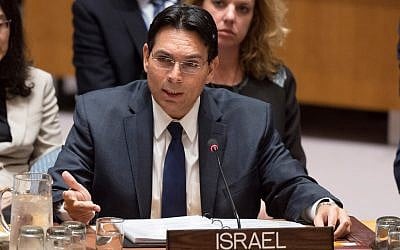
Representatives of at least 34 nations are expected to speak at the session, with Israel’s ambassador Danny Danon slated to be the fifth speaker, following representatives backing the resolution from Yemen, the Palestinians, Turkey and the US.
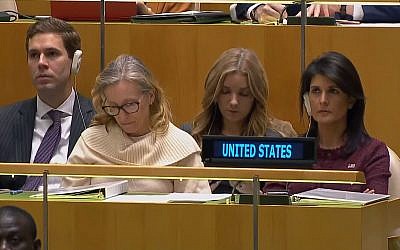
On Tuesday, US Ambassador Nikki Haley sent an email to fellow UN envoys to put them on notice that “the president will be watching this vote carefully and has requested I report back on those countries who voted against us.”
“We will take note of each and every vote on this issue,” she wrote in the message seen by AFP.
And on Twitter she said “the US will be taking names” when ambassadors of the 193-nation assembly cast their votes.
“Nikki, that was the right message,” Trump said.
Turkish President Recep Tayyip Erdogan on Thursday said UN member states should not be swayed by Trump’s threat.
“I am calling on the whole world: never sell your democratic will in return for petty dollars,” he said in a televised speech in Ankara.
Erdogan said he believed that “the world will teach a very good lesson to America today (Thursday).”
Voting with their conscience
A council diplomat said Canada, Hungary and the Czech Republic might bow to US pressure, but the motion is all but certain to be approved.
No country has veto powers in the General Assembly, unlike in the 15-member Security Council where the United States, along with Britain, China, France and Russia, can block any resolution.
Among the 14 countries voting in favor on Monday were Britain, France, Italy, Japan and Ukraine who were expected to do the same at the assembly.
Palestinian foreign minister Riyad al-Malki accused Washington of “threatening” member states, saying the UN session would show “how many countries will opt to vote with their conscience.”
While resolutions by the General Assembly are non-binding, a strong vote in support of the resolution would carry political weight.





The Times of Israel Community.