

With few safeguards, Jewish cemeteries make easy targets for vandals
Two attacks, a week apart, on big, sparsely staffed and easy to access graveyards — combined with JCC bomb threats — have Jewish leaders increasingly concerned
 Add ToI as a Preferred Source on Google
Ben Sales is a news editor at The Times of Israel
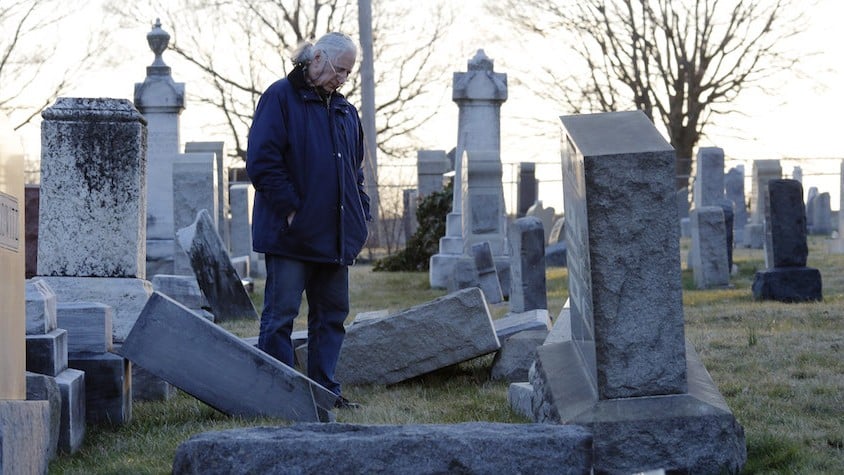
NEW YORK (JTA) — Sometime between the afternoon of Friday, Feb. 17, and the following Monday morning, vandals damaged 170 gravestones at the Chesed Shel Emeth Jewish cemetery outside St. Louis.
Beyond that, cemetery staffers aren’t sure when the attack happened. Groundskeepers leave at 4 p.m. Fridays, and the cemetery is open to the public, unstaffed, all day Sunday. An employee discovered the damaged headstones Monday morning.
Even less is known about Saturday night’s attack on the Jewish Mount Carmel Cemetery in Philadelphia, which saw at least 100 gravestones toppled. Unlike the St. Louis-area cemetery, which is surrounded by a fence and employs groundskeepers, Mount Carmel is run by volunteers, with only a sidewalk separating it from the street.
“There was nothing,” said Steve Rosenberg, chief marketing officer for Philadelphia’s Jewish federation. “It’s wide open. Anyone can walk right in. They can’t find anything that’s closed off to anyone.”
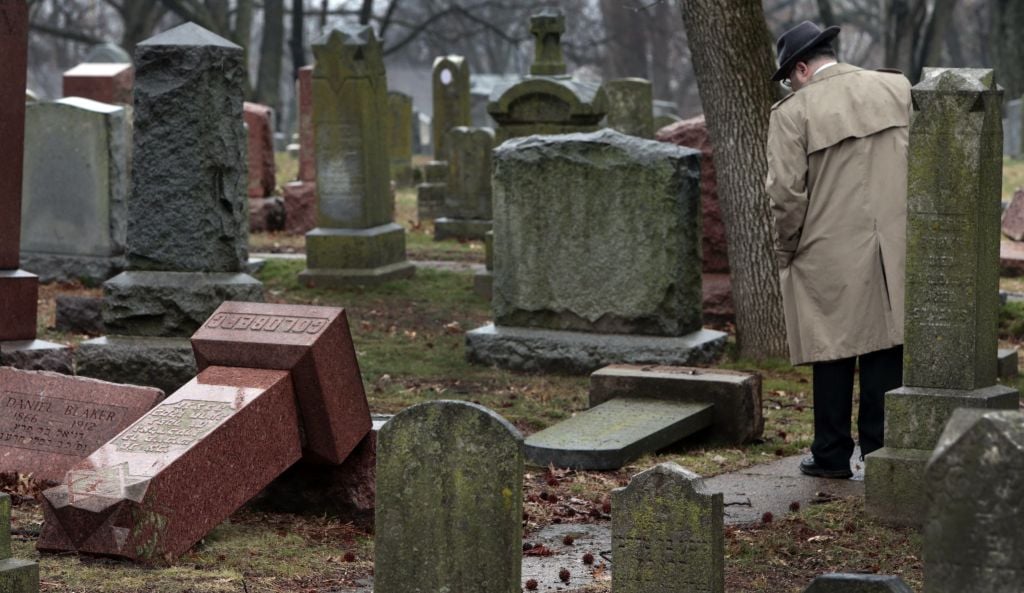
The two attacks, coming one week apart, combined with a series of bomb threats called in to Jewish community centers, have stoked fears of rising anti-Semitism in the United States and have Jewish leaders fearing that more will follow. Cemeteries, security experts say, are particularly vulnerable because they are big, sparsely staffed and easy to penetrate.
Chesed Shel Emet, with two locations in suburban St. Louis, has more than 20,000 grave plots and a staff of seven, including four groundskeepers. Mount Carmel in Philadelphia is even smaller: It has about 5,000 graves and no paid staff.
Cemeteries “are of relatively large size, and if there is a cemetery staff, recent budget cuts tend to make that staff smaller and smaller,” said Michael Trinkley, director of the Chicora Foundation, a South Carolina group that conserves cemeteries and other historic sites. “There’s hardly any night security at cemeteries anymore.”
“You can do a great deal of mischief in a relatively small amount of time, and the odds of getting caught are slim.”
Paul Goldenberg, director of the Secure Community Network, which advises Jewish groups and institutions on security, fears that cemetery attacks could become a trend like the wave of JCC bomb threats, the latest of which came Monday.
Serving in the New Jersey Attorney General’s Office two decades ago, Goldenberg investigated a wave of attacks on some 100 Jewish cemeteries over a period of seven years — including his father’s resting place. That spate, he said, was inspired by the neo-Nazi music scene.
“There’s a feeling that the cemeteries may become a place where vandals may become more proactive,” Goldenberg said. “Right now we’re concerned about copycats.”
Trinkley and Goldenberg said the most effective way to prevent cemetery vandalism is through volunteer patrols that keep the cemetery manned at night, as well as surveillance. Chesed Shel Emeth has security cameras, while Mount Carmel does not.
Goldenberg added that community members need to contact law enforcement when they see a threat, and should let police examine damaged stones before repairing a vandalized cemetery.
“People want to do the right thing and clean up and put stones up,” Goldenberg said. “They need to reconsider that until the police show up for investigation.”
While Goldenberg floated the prospect of paid security, Trinkley said many cemetery budgets probably cannot support that. Even repairing damaged stones can get pricey. Trinkley estimated that setting a toppled headstone aright could cost $500, while buying a new one can run to $4,000.
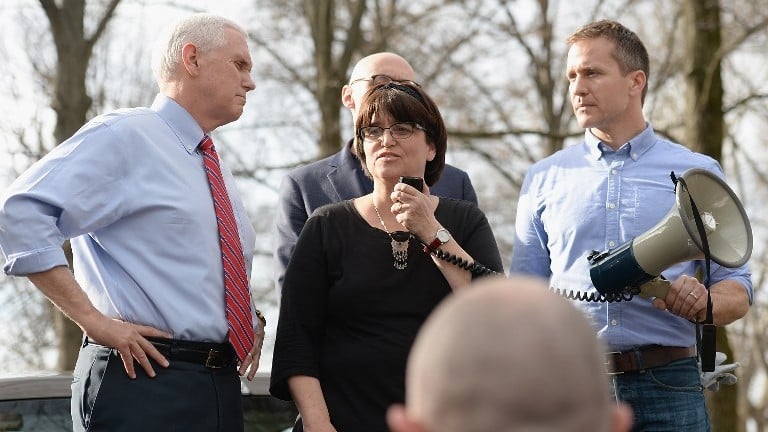
Financial help has streamed in to assist Chesed Shel Emeth, including more than $100,000 raised by Muslim activists. Online fundraising drives for Mount Carmel are ongoing as well. Volunteers including Vice President Mike Pence pitched in to clean up the damage in Missouri, and a similar effort is being organized in Philadelphia.
Trinkley likewise advised against forbidding fences and gates. A fence is ineffective, he said, unless it’s 8 feet tall and topped by protective wire — features that can intimidate grieving families.
“At some point, if you start making a cemetery look like a fortress, you’ve defeated most religious goals of making a cemetery a place of commemoration, visitation,” Trinkley said. “You want to be welcoming so people can go to seek solace and comfort.”
At Chesed Shel Emeth, director Anita Feigenbaum has begun a security assessment on how to make the site less vulnerable to attacks. But though the vandalism happened during a weekend, she said closing the cemetery gates on Sundays in the name of safety might be a step too far.
“A lot of people can’t make it during the week,” she said.









The Times of Israel Community.