

Assassination’s creed
Lebanese media says Israel whacked several top Hezbollah gunmen in Syria, and the Israeli press prognosticates what’s next
 Add ToI as a Preferred Source on Google
Ilan Ben Zion is an AFP reporter and a former news editor at The Times of Israel.
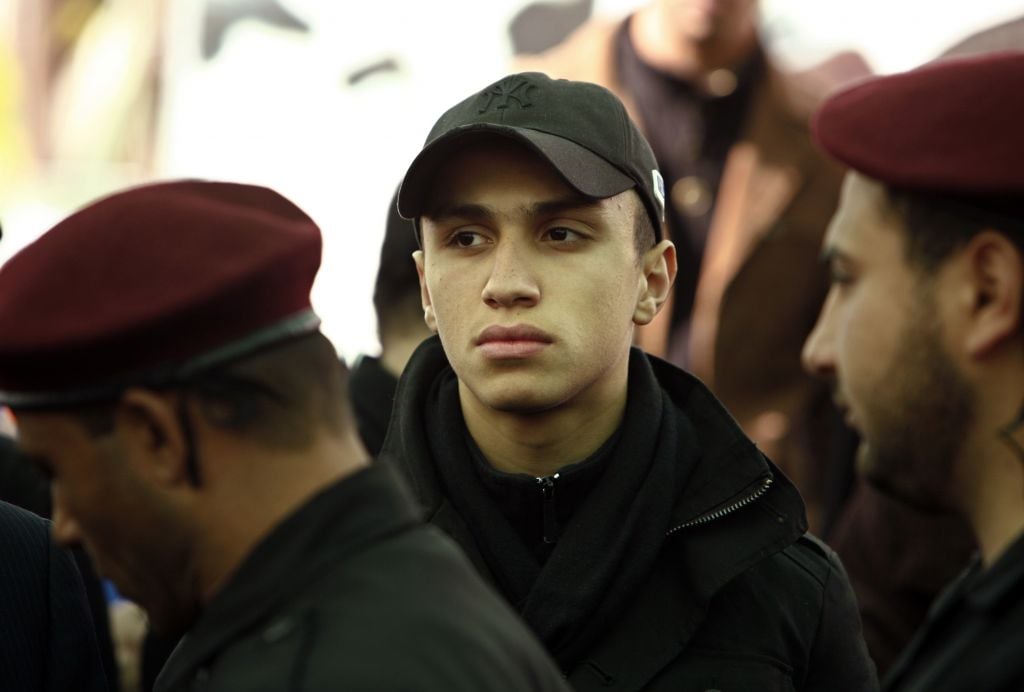
The killing of a Hezbollah commander in the Syrian Golan Heights dominates the headlines in the Hebrew press on Monday. Jihad Mughniyeh, son of a senior Hezbollah officer who was assassinated in 2008 in Damascus, was killed in what the Lebanese press said was an Israeli airstrike just over the border in Syria.
Yedioth Ahronoth and Israel Hayom both call Mughniyeh the younger “the prince of terror” and use the stock graphics of red crosshairs that make violence seem so much more like a video game. Yedioth Ahronoth leads off its coverage with a side-by-side comparison of the father and son, pointing out how both were arch-terrorists and how both met their end “in fire and pillars of smoke,” it says, employing a phrase from the Passover Hagaddah.
The ubiquitous quote justifying the assassination of this man, along with several other Hezbollah fighters and six members of Iran’s Revolutionary Guards Corps, according to Lebanese news accounts cited by the Hebrew press, comes from an anonymous “Western official.”
“Jihad Mughniyeh was a ruthless terrorist. He plotted a series of serious attacks against Israeli soldiers and civilians in the Golan Heights, including rocket fire, infiltration of terrorists, bombs and anti-tank missile fire,” the same source is quoted in all three major papers saying.
The tabloids cross their I’s and dot their T’s, attributing Israeli responsibility for the attack to Lebanese news sources and reporting that Israeli officials declined comment on the incident. Israel Hayom goes to such great lengths that it repeatedly includes phrases such as “if indeed it’s an Israeli attack” in its reporting.
Haaretz, however, writes that “an incident next to the border in the Golan Heights almost doesn’t raise any question marks as to the identity of those responsible.”
“The Israeli Air Force is the only enemy of Hezbollah operating attack helicopters in this area. Syrian rebels groups don’t have choppers and it’s doubtful if they have precise enough intelligence to enable a pinpoint assassination against senior commanders of a group that is punctilious to observe high operational compartmentalization,” it notes.
While there’s no doubt in the press that Mughniyeh was no saint, there’s a certain degree of circumspection concerning the timing of the strike that killed several senior Hezbollah men. Yedioth Ahronoth runs a brief piece quoting political freshman and former IDF general Yoav Galant saying that there’s a coincidence in timing between the airstrike and the upcoming March 17 elections.
Galant, a Kulanu party candidate for the Knesset, is quoted telling Channel 2 Sunday evening that he assumes decisions of this kind are made responsibly, but added that “based on past experience you can learn that sometimes there is a timing that isn’t unconnected to the issue of elections.”
Haaretz asks whether the decision to knock off Mughniyeh was made by the military brass or the Israeli civilian government, pointing out that an escalation of hostilities along Israel’s northern border would not only have grave implications for national security, but also for the upcoming vote.
“The question of the connection between military action and political context arose in the past during the outset of two operations in the Gaza Strip,” it says, referring to Operation Cast Lead in 2008, three months before elections, and Operation Pillar of Defense in 2012, four months before elections.
Israel’s pundits look to the coming storm. Yoav Limor writes in Israel Hayom that Israel needs to be prepared for the possibility of Hezbollah striking back at Israel’s northern border, the Galilee or targets abroad.
“The natural emphasis is on high alert in the intelligence agencies and active defense, but it also requires additional stringency on all activity carried out along the [border] fence, because every soldier is liable to be a target for an immediate attack,” he says.
“An immediate violent response by Hezbollah… will certainly require a counter-response by Israel, and is likely to drag both sides into a dangerous escalation,” he writes. The upcoming, final weeks of IDF Chief of Staff Lt. Gen. Benny Gantz’s term will undoubtedly be tense ones, he says.
In Yedioth Ahronoth, Alex Fishman calls Sunday’s assassination “playing with fire,” and says that “someone threw a match into a barrel of gunpowder and is now waiting to see if it will explode or not.”
Continuing with his use of metaphors, Fishman says that “this surgery perhaps succeeded” in eliminating a potential threat “but the patient — the situation in the north — is only deteriorating.” He says the northern front is reaching “boiling point — perhaps the most explosive since the outbreak of the Syrian Civil War [in 2011].”
He envisions the “game of war” unfolding thus: “Hezbollah responds with fire at the Golan Heights, with an attack on IDF soldiers on the border with Lebanon or worse — firing rockets at Israel. The IDF is likely to respond harshly or with a symbolic response which signals that it’s interested in ending this round of escalation.” He says that the violence is likely, however, to spin out of control.
“Whoever decided on the attack yesterday assessed, of course, that Hezbollah’s interest — its forces are stretched on all fronts — is to respond with moderation. Perhaps he’s right, and perhaps not. Intelligence is not an exact science,” Fishman says.




The Times of Israel Community.