

Automatic Bibi gun
Netanyahu’s headline generator is on repeat as he says he won’t join forces with Zionist Camp and will speak anywhere against Iran
 Add ToI as a Preferred Source on Google
Ilan Ben Zion is an AFP reporter and a former news editor at The Times of Israel.
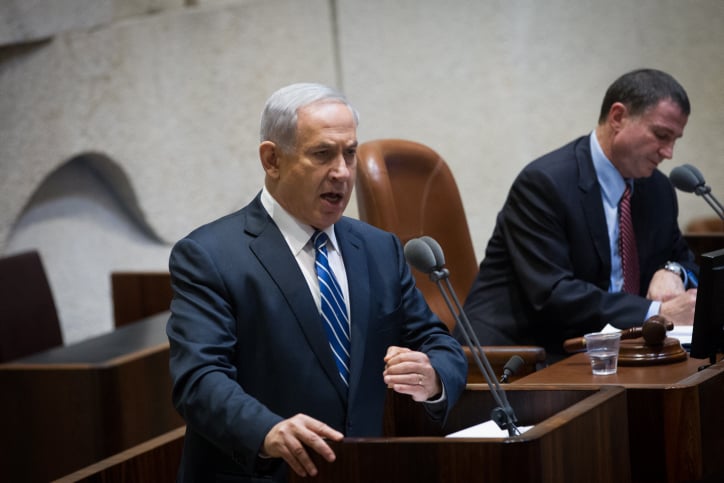
Sunday was undoubtedly a slow news day in Israel, as Prime Minister Benjamin Netanyahu’s reiterated insistence that he will not form a government with the Zionist Camp and will go to Washington to speak out against Iran make headlines in all three major papers on Monday morning. Both of these remarks have made headlines in the past two weeks.
“Netanyahu: I’ll come to speak in Congress as I came to Paris after the attack,” reads the headline on Haaretz’s report on the prime minister’s address to Francophone Likud supporters. He adds that only he, not Tzipi Livni or Isaac Herzog, can “stand before Iran and before the international community.”
The paper points out that Netanyahu was asked by the French government not to come to Paris for the march, because they were concerned his presence would draw attention to the Jewish-Muslim issue in France or the Israeli-Palestinian conflict, and that he would employ the visit as a campaign stop. Haaretz says that the prime minister only decided to go once he heard his rivals, Foreign Minister Avigdor Liberman and Economy Minister Naftali Bennett, would attend.
Bennett’s remarks to an auditorium full of young voters in Tel Aviv, which stirred brief outrage (over the suggestion that Arabs are car thieves), get no mention in Israel Hayom, but the paper highlights the Jewish Home party leader’s comments to Channel 2 about the upcoming election.
“I have no intention to attack the national camp, but it’s critical that people understand,” Bennett said. “The question is if they want government of the left with Netanyahu, or a government of me and Netanyahu.” He asserted that Netanyahu will be the next prime minister and that “everybody knows” it, but said that the bottom line is “that it’s either Tzipi [Livni] or us,” because the Zionist Camp won’t join a government with Jewish Home.
In an apparent response, Netanyahu voiced his determination not to form a coalition with Livni and Herzog after the elections, a remark which isn’t novel but makes a front page headline in Yedioth Ahronoth. The prime minister took to Twitter and said that “I won’t form a government with the left-wing parties because of the wide ideological gulf today between Likud [party] and [Isaac] Boujie [Herzog] and Tzipi [Livni].” He assuaged concerns that he’d leave the right-wing Jewish Home party out of the government, and told right-wing voters that if Likud wasn’t big enough, there’d be a left-wing government.
The paper reports that the Zionist Camp responded saying, “Thanks that after six years of lies you finally said the truth: whoever votes for you gets [far right-wing Jewish Home MK Orit] Strock, [Bezalel] Smutrich and [ultra-Orthodox leader Eli] Yishai.”
Haaretz’s top story, however, is the revelation that the Israeli government is set to allocate just shy of 1,000 acres of West Bank lands adjacent to the settlements of Emmanuel, Vered Yericho, Kedumim and Halamish as state land. The move is seen as a bid to significantly expand those settlements, the paper says.
[mappress mapid=”5024″]
The paper says the Civil Administration is working on the process of outlining where the state lands will be declared, which is ordinarily the first step in expanding a West Bank settlement. Only afterwards can tenders for new construction be proposed. Why the paper made this the top story on its front page is not entirely clear, as there is little meat to the article itself (which is relegated to a tiny column on Page 5 after the initial front page paragraphs).
With so many senior policemen under the microscope for sexual misconduct allegations, Yedioth Ahronoth takes the opportunity to speak with female police officers about what they’re going through with the collapse of the senior brass. The sources are all anonymous, and the picture is not pretty. One policewoman tells the paper that with investigators looking into misconduct everywhere, ordinary female officers also come under scrutiny.
“Every woman has become suspected of having a romantic connection with a superior,” she says. “Every policewoman who’s asked questions, even if there was nothing between her and the commanding officer, automatically becomes ‘suspect’ in the eyes of the rest of the policemen and policewomen, whispering and talking.”
Another woman in blue tells the paper that the investigation is great, and that people “perhaps now finally know to appreciate the professional policewomen who work hard, not just those who wear short skirts and make-up well.” That the standard until now was just that, or at least perceived as such, is grim.
That members of the public come up to younger officers and jokingly ask, “Who’s the next deputy commissioner to get implicated?” as one policewoman tells the paper, is only to be expected.
Israel Hayom also runs a profile of the funder behind the V15 grassroots election organization that’s calling for a change of government in Israel, alongside which it subtly places an article on the state comptroller saying he’ll investigate the organization’s activities.



The Times of Israel Community.