

Beytenu on the take?
Accusations that senior politicians, many tied to Yisrael Beytenu, were running a massive racket trading bribes for favors hit the newstands
 Add ToI as a Preferred Source on Google
Joshua Davidovich is The Times of Israel's Deputy Editor
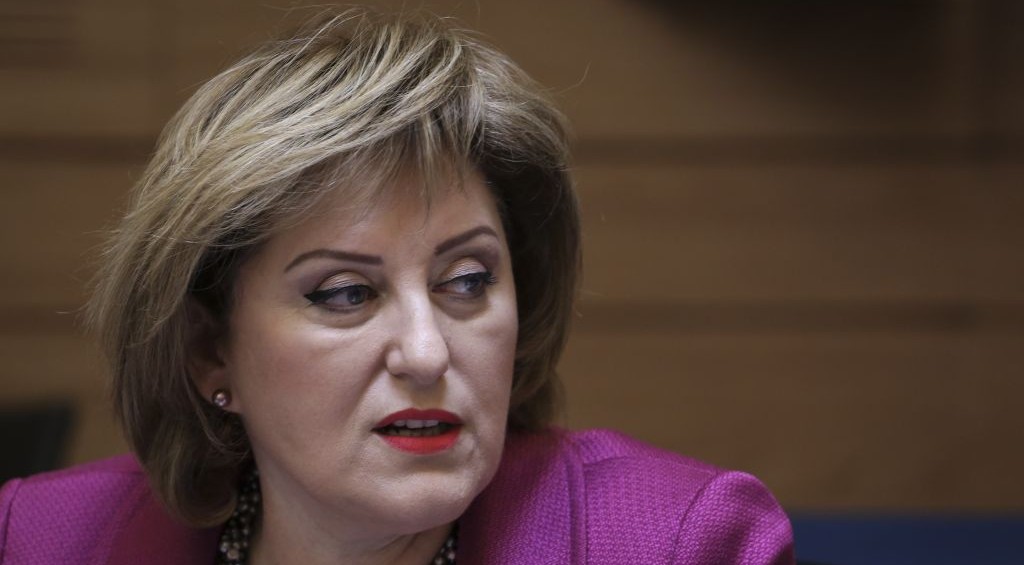
Another day, another corruption scandal. A day after police pounced on some 30 suspected grafters, mostly tied to the Yisrael Beytenu party, newspapers are replete with tsk-tsking tales of woe and corruption from the massive high-level case.
Though some 30 suspects were caught by the dragnet, only the top names like deputy minister Fania Kirshenbaum and former minister Stas Misezhnikov get front page treatment — in some papers police line-up style, and in some, like Yedioth Ahronoth, showing happier times.
Yedioth lays out the suspicions graphically, explaining, somewhat over-complicatedly, that senior officials would hand out money, appointments, pork and other political favors in exchange for bribes via a system of public bodies to cover their trail. The paper reports that police investigated the massive scheme, which involved millions of shekels, for a year before deciding to swoop down Wednesday morning, setting the scene dramatically.
“’These were very organized actions,’” an unnamed source known only as In The Police is quoted telling the paper, “’and we saw a set system that led to more and more affairs.’ Two mornings ago, rumors already started to swirl about a large probe into public corruption, and there were those who turned to Kirshenbaum to clarify why her name was associated with the rumors, but she denied it and said she knew nothing of the story. So yesterday came the call from the police 433 corruption unit to the most powerful woman in Yisrael Beytenu, who told her that in conjunction with approvals from Attorney General Yehuda Weinstein, police head Yohanan Danino and police investigations head Meni Yitzhak, she was suspected of bribery, fraud and money laundering.”
Israel Hayom is arguable the harshest, all but convicting Yisrael Beytenu with headlines like “All in the party,” and “Like an organized crime ring,” though it’s okay because the second one is a bastardized version of a quote uttered by that same rock-solid source known as In The Police.
Commentator Mordechai Gilat at least has the cojones to stand behind his words, positing in the paper that the police have “iron-clad evidence” in their case against Kirshenbaum, the biggest fish in the fry. He bases his assessment on a source who tells him that while investigators don’t have a Shula Zaken-type witness, with her reams of recordings of convicted ex-PM Ehud Olmert, they could have something just as good.
“The hint was clear,” he writes. “This case is built on solid evidence, including infinite [(!)] wiretaps, and there will be more surprises. True, we’re not talking about a case with the scope and importance of Holyland, and we are not talking about an unprecedented case as of now, but those who have seen the material, including Attorney General Yehuda Weinstein, assess that there is a reasonable chance that this case will branch out and go far.”
Haaretz devotes its main editorial to the scandal, calling on the police and public officials to continue their investigation of Yisrael Beytenu despite the fact that the timing of the arrests, as parties are campaigning ahead of elections, leaves them open to accusations of running a political witch hunt.
“The heads of this investigation, therefore, chiefly Attorney General Yehuda Weinstein and State Prosecutor Shai Nitzan, did well to allow it to move forward now, despite the sensitive timing and at the risk of being accused of having ulterior motives,” the paper opines. “Any other decision would itself have been a biased choice influenced by inappropriate political considerations. Voters are entitled to the maximum information about their elected officials, including about legal proceedings, particularly during election season.”
Trio of troubles
The second big news story of Wednesday, a cross border exchange with Gaza that left an Israeli soldier severely wounded and a Hamas commander dead, also garners major headlines, and writers in both Haaretz and Yedioth see the incident not as a one-off but as part of a larger troubling story that could soon spell war.
For Yedioth’s Yossi Yeshoshua, the trouble is that all of Israel’s hard-earned deterrence built up over 50 days of fighting during the summer seems to have dissipated rather quickly, with even Hamas, normally seen as the responsible adult in Gaza, taking part in renewed efforts against Israel.
“Hamas is already undeterred: It continues to carry out dozens of rocket tests at the sea, is rehabbing its military capabilities, putting up posts next to the border fence and trying to rebuild its tunnels (even if we don’t yet have intel that they have begun digging),” he writes. “Hamas is in a crisis, mostly financial, and the worse it gets – as international aid lags – the more it will shoot at Israel. What this means: The clock on the next round is ticking quickly.”
In Haaretz, Amos Harel is troubled to see that Hamas’s lashing out at Israel was seemingly in response to something beyond Jerusalem’s control: the rarely mentioned Egyptian “stranglehold” on the Strip.
“The explanation for Hamas’ provocations appears to be relatively clear,” he writes. “The Strip is still under siege, traffic through the Rafah crossing to Sinai is closed for the most part and the money transfers intended to bankroll the repair and rebuilding of Gaza are all but stuck. The main reason for the standstill is Egypt’s conduct. Cairo has no interest in making things easier for Hamas. The international community hardly complains about Egypt’s treatment of the Palestinians in Gaza. Also, Hamas isn’t likely to engage Egypt directly with a military confrontation. … Despite the Palestinians’ fear of a harsh Israeli retaliation in the Gaza Strip, Hamas may be closer to the point of deciding it has nothing more to lose.”
Israel Hayom buries the southern tensions story, but on the op-ed page Adi Cohen is troubled by other developments in the Arab world, namely Iran’s efforts to meddle in the internal affairs of Middle Eastern states to spread instability and bolster its own regime and Shiites’ standing in the region.
“The Iranian octopus works covertly and overtly in a number of Arab states. It works toward the goal of ‘creating a revolution’ among Shiites in the Arab world, and especially Muslim countries with Shiite communities, like Lebanon, Yemen and Iraq. The Iranians provide money and arms to Shiite groups in these countries,” writes Cohen, a Bar-Ilan University researcher. “Disrupting Iran’s nuclear program is a supreme interest among Arab states, because it’s military, financial and religious meddling greatly harms the security of those countries. A nuclear Iran would be much more threatening to Arab states than the Iran of today.”






The Times of Israel Community.