

Domestic help
Stories about abuse of medical staff and sexual abuse in the ultra-Orthodox community assist papers in filling a foreign news hole
 Add ToI as a Preferred Source on Google
Joshua Davidovich is The Times of Israel's Deputy Editor
With its position arguably near the center of the world stage, Israel’s press focusing on domestic issues usually means one of two things: Either there’s a major scandal afoot, or there’s nothing much going on of international interest.
Domestic issues are the focus of front pages of two of Israel’s top papers Tuesday morning, and in this case, the reasoning appears to be the latter, a sign that tensions with Gaza may be calming and that the AIPAC Policy Conference, where many Israeli bigwigs are spending the first part of the week, isn’t quite as relevant as it has been in past years.
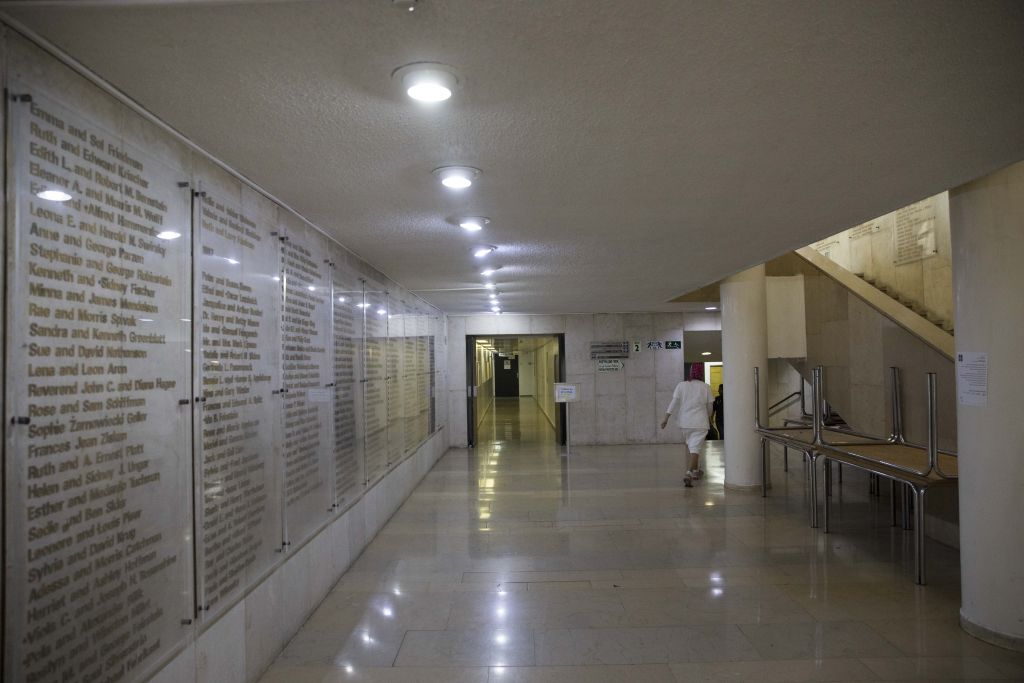
For Yedioth Ahronoth, the international news doldrums gives the paper the space to run what it calls a major expose on the State of Israel’s health system, the latest in a series of exposes by the populist tabloid uncovering problems at institutions meant to serve the country’s weakest populations. While previous reports covered abuse by workers at old-age homes and daycare centers, this time the workers are the ones viewed sympathetically by the paper, as reporter Rotem Alizera takes readers through a day at a crowded ER at Sheba Medical Center at Tel Hashomer outside Tel Aviv.
Tied to an incident earlier this month in which a nurse was burned to death by a disgruntled and unstable patient, and other reports of abuse of medical staff, the report brings to light a slew of unfortunate incidents in just one visit.
“Stinking Arab,” one mother is quoted calling nurse Hatam Asbanioli, after he explains that her son, who needs to have his feet checked out, doesn’t need to be in the emergency room. “Wait wait, I’ll get you after your shift. No wonder they are burning nurses,” the woman adds after Asbanioli tries to explain to the woman where she need to go.
“Even with verbal abuse, you can’t lose your head. This is the reality we deal with every day,” he tells the paper.
That’s not to say all doctors are angels. The paper also reports on hidden cameras at doctors offices catching patients “at their most intimate” with some pictures leaking onto the internet.
Haaretz’s lead story, meanwhile, has to do with the sordid not getting enough sunshine, after police arrested nearly two dozen ultra-Orthodox men accused of sexual abuse. The arrests gives the paper a chance to delve into the secretive method within the Haredi community for dealing with these kinds of crimes, which often involves taking care of offenders in-house.
“These arrests are a reminder that the traditional method of attempting to deal with sexual offenses within the community persists. Allegedly, records concerning the sexual predators were kept by a single person – known in Haredi circles as a ‘fixer.’ This person is said to have operated under the auspices of a Jerusalem-based body known as the purification commission of the community, which works in various Haredi communities,” the paper reports. “The fixer himself is not a suspect in the case and is not under arrest. He has been in contact with the police for years and testified in many sexual-offense cases, helping police obtain convictions. But it is now alleged that he also maintained a network that would field and investigate complaints about sexual offenses, using old-world methods accepted in the Haredi world. Usually, offenders who were said to have undergone “arbitration” proceedings of various kinds within the community reportedly were forced to undergo therapy, possibly with a psychologist, or they may have been ‘exiled’ to another city.”
Israel Hayom’s lead story may not be domestic per se, but it’s about an Israeli as a story can get while ostensibly dealing with issues beyond the Jewish state’s borders, namely terror threats facing Israeli tourists abroad, particularly in the Sinai Peninsula.
“Leave Sinai now,” reads the tabloid’s headline, which is likely meant more to ramp up the fear than provide useful information considering it’s probably not distributed in the restive Egyptian peninsula. (Though, at least it’s not a sexist legs-it pun.)
Despite the stern warning, the paper, which adorns its story with pictures of all the beautiful places Israelis should be too scared to go to, from Sinai to Jordan to Turkey, reports that many still plan on spending their vacations soaking up the Egyptian sun.
“There’s real quiet in Sinai, I don’t ‘buy’ that it’s dangerous. Friends are calling and saying it’s crazy, but I’m careful and go to normal places with Israelis, not alone,” one future vacationer is quoted saying.
Israeli vacationers aren’t the only ones being warned in Tuesday’s papers. Haaretz reports that five US Jewish leaders warned Israeli officials against getting too close to US President Donald Trump and his administration.
The paper can’t name names, but reports that all Israeli officials would offer in response was a knowing nod, indicating acknowledgement but disagreement.
“Close cooperation between Israel and the Trump administration on security and diplomatic issues is a good thing, but when the prime minister seems like he is literally hugging Trump and tweets praise for his plan to build a wall on the border with Mexico, that goes beyond diplomatic relationships and becomes political,” one of the five Jewish leaders is quoted telling the paper.
That lockstep relationship has been seen in many ways personified by Israel Hayom, seen as a Netanyahu mouthpiece that also shills for Trump. That fact that the paper plays Netanyahu’s and US Vice President Mike Pence’s speeches to AIPAC all the way back on page 11 can be seen either as a sign that everything is so hunky dory that there’s nothing to see here, or that Israel Hayom’s attention is shifting to some other horses.
Just as unclear is an accompanying article in the paper that says Israelis are switching horses when it comes to reaching peace with the Palestinians. The paper cites a survey by the Jerusalem Center for Public Affairs that finds that the number of Israelis who support pulling out of the West Bank to make room for a Palestinian state is down from 60 percent in 2005 to just 36% now.
But while the headline calls it a “sharp drop,” the actual story says that decrease is more “gradual,” which is one way of putting it.







The Times of Israel Community.