

Go tell it on the mountain
Not everyone in Israel is convinced the Syrian town of Hader is in that much danger, as the question of whether and how Israel should act to help the Druze community remains unanswered
 Add ToI as a Preferred Source on Google
Joshua Davidovich is The Times of Israel's Deputy Editor
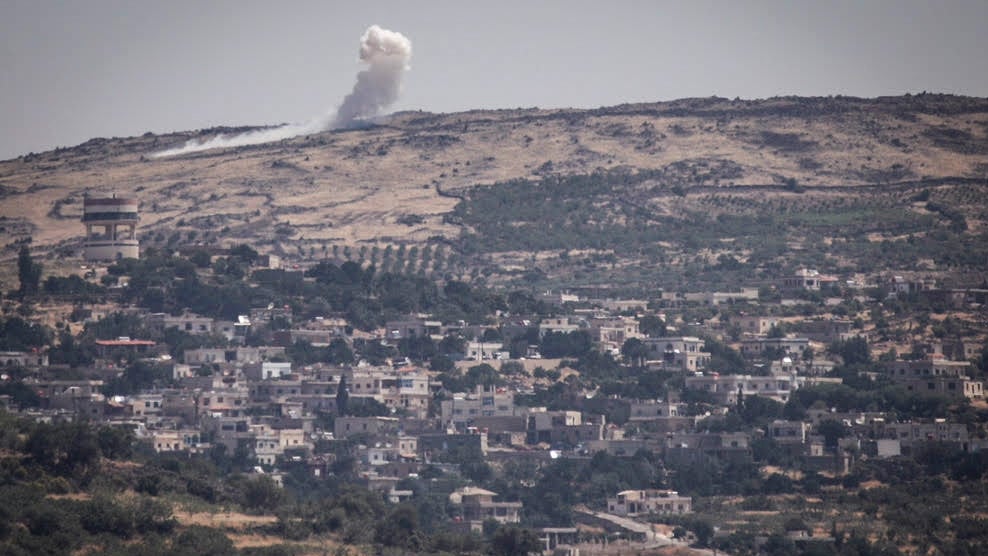
The sirens that sounded in the Golan Heights Wednesday were a false alarm, and if some in the IDF and the press are to be believed, so is the alarm-clanging by the Israeli Druze community over the fate of their brethren just across the border in Syria.
Backed up by pictures of smoke rising near the town of Khader on the slopes of Mount Hermon, all three major Hebrew-language papers give prime real estate to heavy fighting on the Syrian Golan Heights.
Border battles are unfortunately not exactly a novelty, but what has the press abuzz this time are concerns over the fate of the Syrian Druze community, which is reportedly threatened by the advance of Islamist rebel forces in what broadsheet Haaretz calls “the last Assad enclave.”
Israel, though, is not exactly keen to allow Druze refugees into Israel, to say nothing of its policy of non-intervention, which is clearly spelled out in Israel Hayom’s headline “We won’t intervene in the Syrian fighting,” — quote uttered by a senior IDF official in a briefing to reporters on Wednesday, in which he also tried to downplay the chances of a massacre in the village of Hader, where much of the fighting has been centered.
Sticking to the government line of “nothing to see here,” columnist Yoav Limor writes that the Druze in the town and their cousins across the way have nothing to fear since the fighting is just nearby, though one wonders whether he would sing the same tune if Islamist rebels were just fighting outside Tel Aviv , but not actually inside the White City.
“Contrary to reports – seemingly distributed tendentiously, if they can be thus understood, by the Druze community in Israel fearful for the fates of their relatives – the battles this week have been fought next to the village and not inside it, and certainly did not include any massacre of Druze,” he writes.
Other papers are less sanguine and less ready to buy the official line that things are going just swimmingly in Hader for now. Yedioth uses a graphic to show how the rebels have surrounded the village, though the fact that the map shows the insurgents coming through Israel doesn’t inspire much confidence in either its accuracy or Israel’s border fence, take your pick.
Lt. Col. (Res.) Kamil Wahabi, himself an Israeli Druze, explains in the paper why the Druze of Hader and their relatives might not be content to just see how this thing plays out, as the military brass seems to be suggesting they do.
“The radical Islamist groups taking part in the Syrian civil war are carrying out ethnic cleanings: They are light years away from Islam,” he writes. “Yet groups like al-Nusra Front and the Islamic State are already on both sides of the Druze region and are waiting for the right moment to strike – and take over the district hub of Smweida. Just thinking that my Druze brothers could be their next victims is causing me and thousands of other Druze to lose sleep.
In Haaretz, Amos Harel surmises that the fact that the rebels have yet to enter Hader may be the first fruit of what little intervention Israel is offering at this point, noting that Israel abandoning the village may lead the country’s Druze community to end its traditionally loyalty to the state (though he fails to make the distinction that the Golan Druze community directly linked to the Syrian community has never exactly jibed with Jerusalem.)
“The long-standing obligation to preserve the ‘blood alliance’ between the state and its Druze citizens, which led to thousands of Druze men serving in Israel’s security forces, is on a collision course with Israel’s strategy of minimal intervention. This includes a low-profile policy of assisting civilians near the border, but not direct involvement in fighting taking place inside a neighboring country,” he writes. “Is the situation in Hader as critical as portrayed? Obviously, Israeli Druze are concerned about their relatives across the border, with the fighting getting ever closer. So far, it has not reached the village. It is possible that the rebels have taken Israel’s warnings not to enter it into account. … Extremist rebel elements may see the Druze as infidels, but they realize that attacking the village will encounter stiff resistance with possible Israeli intervention, despite its declarations.”
Considering entering a civil war in a neighboring country to save some Druze would have probably been regarded as a joke 22 years ago, as would the idea that it would take until 2015 for a team to knock basketball powerhouse Maccabi Tel Aviv out of the Israeli playoffs. And yet, they were beaten 79-76 by Hapoel Eilat late Wednesday, earning front page coverage across the board and declarations of an “earthquake” in Israel Hayom.
“It’s hard to count how many times the word historic was written last night,” reads the lede to the tabloid’s accounting of the game, which saw the perennial champion blow a 2-0 series lead to be sent packing.
Maccabi’s cagers will thus have something to commiserate about should they link up with former coach David Blatt, whose Cavs were eliminated from the NBA finals less than 24 hours earlier, disappointing Israelis and Clevelanders alike (as well as this writer who does double duty as both). While Blatt was a bit player in a drama dominated by LeBron James, Stephen Curry and other big-name players, in Israel he was the star.
Yedioth takes its headline from the first three words every Northeastern Ohioan learns, “Maybe next year,” and tries to put a positive spin on the loss, writing from Cleveland that at least according to call-in sports talk shows on the radio, most want him to stick around. “It will be crazy if Blatt doesn’t stay, I don’t even think the question is on the agenda,” the paper quotes Plain Dealer sports columnist Bill Livingston saying.
It’s a whole different game in Haaretz, though, where the broadsheet reports that some in the arts community are upset with the Jerusalem Cinematheque for playing ball with Culture Minister Miri Regev’s demand to strike a biopic about Yitzhak Rabin assassin Yigal Amir from a festival lineup.
The paper, which a day earlier castigated the arts community for being too quick to give in to Regev, writes that some filmmakers are calling for a boycott of the festival or other sanctions against the cinema over its caving.
“Lia Van Leer, who died just recently, would have told Miri Regev to go to hell, but the current festival’s directors are obviously made of different stuff,” the paper quotes film critic Gidi Orsher saying on Facebook, referring to the festival’s recently deceased founder. “Therefore, Israeli film and documentary directors, if you have a shred of respect for this profession, for culture, for Lia Van Leer and for morality – remove your films from this ridiculous competition lest you catch this contagious disease of apathy.”







The Times of Israel Community.