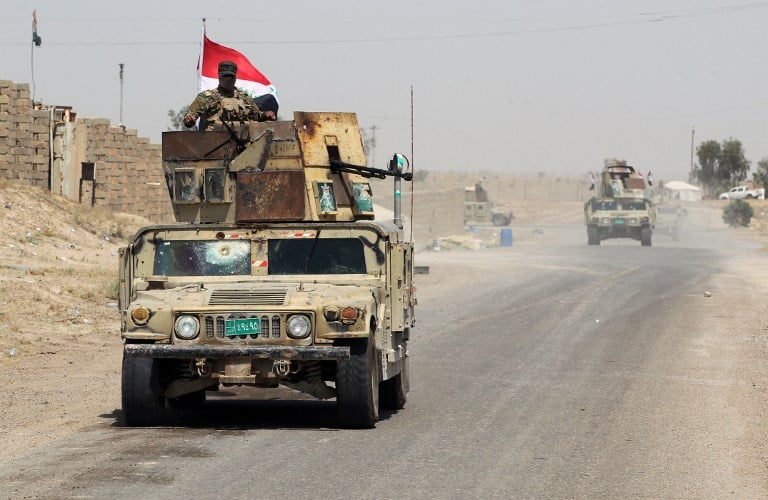
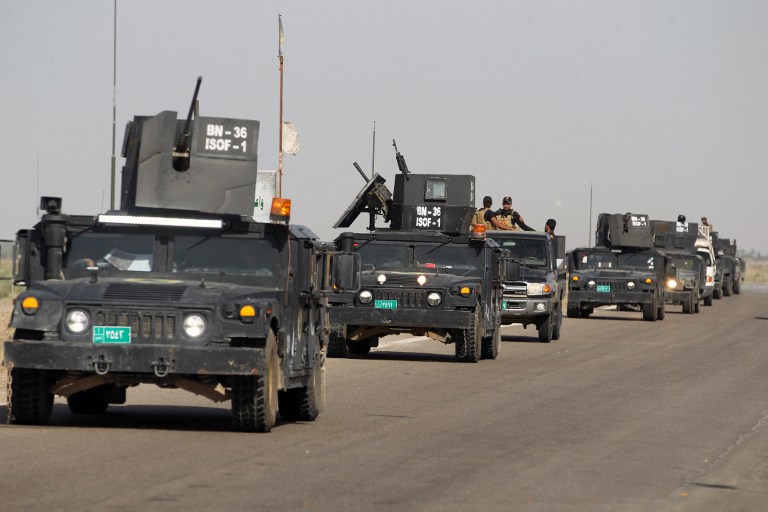
Iraqi pro-government forces reach al-Sejar village in Iraq's Anbar province, on the boundaries of Fallujah, on May 28, 2016, as they take part in a major assault to retake the city of Fallujah, from the Islamic State group. (AFP PHOTO / AHMAD AL-RUBAYE)
BAGHDAD, Iraq — Iraqi forces entered the Islamic State group bastion of Fallujah from three directions on Monday in a new phase of the operation to recapture the city, commanders said.
“Iraqi forces entered Fallujah under air cover from the international coalition, the Iraqi air force and army aviation and supported by artillery and tanks, said Lieutenant General Abdelwahab al-Saadi, the commander in charge of the operation.
“Counter-terrorism service (CTS) forces, the Anbar police and the Iraqi army, at around 4 am (0100 GMT), started moving into Fallujah from three directions,” he said.
“There is resistance from Daesh,” he added, using an Arabic acronym for IS.
Iraq’s counter-terrorism service (CTS) reach al-Sejar village in Iraq’s Anbar province, on the boundaries of Fallujah, as they take part in a major assault to retake the city from the Islamic State (IS) group, May 28, 2016. (AFP/AHMAD AL-RUBAYE)
CTS spokesman Sabah al-Norman told AFP: “We started early this morning our operations to break into Fallujah.”
Get The Times of Israel's Daily Editionby email and never miss our top stories
The involvement of the elite CTS marks the start of a phase of urban combat in a city where US forces in 2004 fought some of their toughest battles since the Vietnam War.
The week-old operation had previously focused on retaking villages and rural areas around Fallujah, which lies just 50 kilometers (30 miles) west of Baghdad.
Only a few hundred families managed to slip out of the Fallujah area ahead of the assault on the city, with an estimated 50,000 civilians still trapped inside, sparking fears the jihadists could try to use them as human shields.
Advertisement
Fallujah is one of just two major urban centers in Iraq still held by IS. They also hold a second city Mosul.
Help us report truthfully on social media
As a multimedia journalist, my job is to take the quality, fact-based journalism produced by The Times of Israel newsroom and make it accessible across every platform — from Instagram posts to podcasts to short-form videos.
This is how many, especially young people, consume news these days. But misinformation is rampant on social media. Our team at ToI produces accurate, responsible short-form reporting on Israel and the Jewish world.
If you believe in the importance of factual social media journalism, please consider joining our reader support group, The Times of Israel Community. Your financial support is essential to sustain responsible multimedia reporting.
We’re really pleased that you’ve read X Times of Israel articles in the past month.
That’s why we started the Times of Israel - to provide discerning readers like you with must-read coverage of Israel and the Jewish world.
So now we have a request. Unlike other news outlets, we haven’t put up a paywall. But as the journalism we do is costly, we invite readers for whom The Times of Israel has become important to help support our work by joining The Times of Israel Community.
For as little as $6 a month you can help support our quality journalism while enjoying The Times of Israel AD-FREE, as well as accessing exclusive content available only to Times of Israel Community members.
Thank you, David Horovitz, Founding Editor of The Times of Israel


 Add ToI as a Preferred Source on Google