

New exhibition spotlights seminal German avant-garde
Special partnership between Israel Museum and Germany’s Nationalgalerie brings recovered ‘degenerate’ art from Berlin to Jerusalem
 Add ToI as a Preferred Source on Google
Renee Ghert-Zand is the health reporter and a feature writer for The Times of Israel.
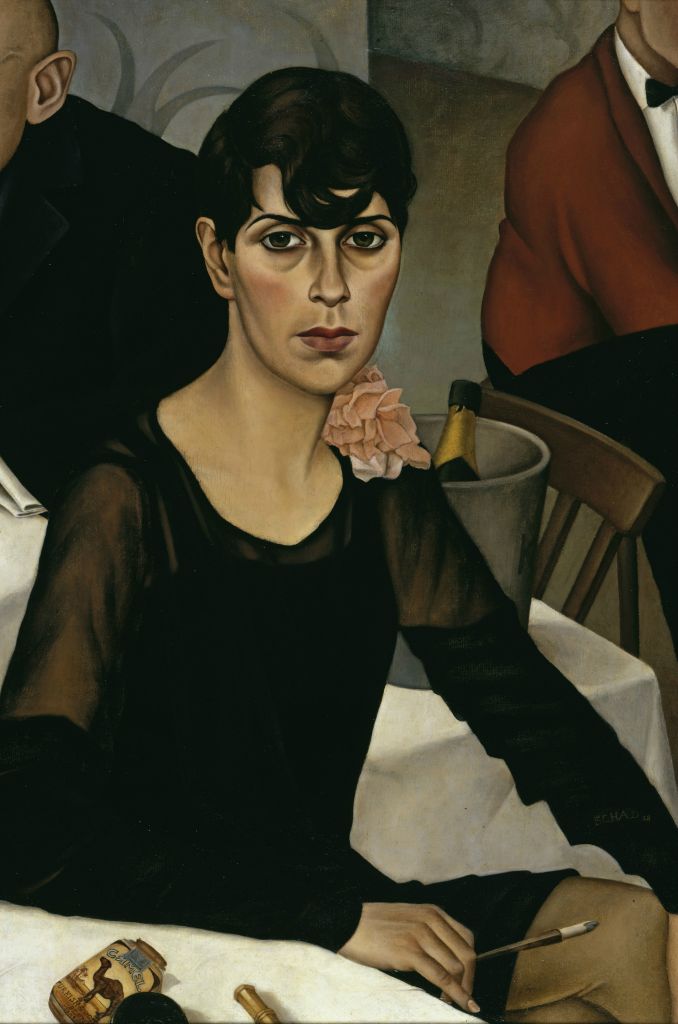
It’s hard to not be a bit unnerved as Sonja stares at you while you read the introductory text panel for a new exhibition at the Israel Museum in Jerusalem.
Sonja is not a live person, but rather a woman depicted in a 1928 painting by the German artist Christian Schad. Sonja, an office worker, has cropped dark hair and wears a fashionable short black dress. She sits in a Berlin cafe smoking Camel brand cigarettes. Often referred to as the Mona Lisa of Germany, she looks straight ahead with an unscrutable expression on her face.
In hindsight, we might imagine that Sonja is looking off into space, thinking about what her fate will be once the Nazis come to power. Approximately a decade after she was painted, the Nazi regime labeled her degenerate art. Sonja, along with more than 16,000 other works of avant-garde art were confiscated from museums, galleries and artists’ studios by the Nazi regime. Some of these artists were Jewish, but most were not. Some of the artworks were destroyed, while others were sold abroad to generate foreign currency revenue for Germany.
It wasn’t until 1997 that Sonja returned to her rightful place at the Neue Nationalgalerie in Berlin. Many other works created in the first half of the 20th century have also made their way back to the museum over time.
Oil on canvas
© Christian Schad Stiftung Aschaffenburg / VG Bild- Kunst, Bonn, 2015
Now, 50 of them are hanging on the walls of the Israel Museum in an exhibition titled, “Twilight over Berlin: Masterworks from the Nationalgalerie, 1905–1945.” The show includes paintings by German Expressionists such as Ernst Ludwig Kirchner, Emil Nolde, and Karl Schmidt-Rottluff, together with others by Weimar period innovators from the New Objectivity (New Realism) and Bauhaus movements, among them Max Beckmann, Otto Dix, George Grosz, Wassily Kandinsky, and Paul Klee.
This is the first time that these paintings and sculptures have left the Nationalgalerie in Berlin. The occasion marks the 50th anniversary of the Israel Museum, as well as the 50th anniversary of diplomatic relations between Germany and Israel.
“We’ve had requests from many museums around the world, but there was not a doubt for a minute that this art had to go first to Israel,” Udo Kittelmann, director of the Nationalgalerie said at a press opening for “Twilight over Berlin.”
The exhibition begins with posters and a film that set the historical the stage for the paintings. The posters, reflecting social, political and commercial themes, are all from the Israel Museum’s collection. The film is a conceptual work from 1917 by Walter Ruttman. Entitled “Berlin, Die Sinfonie der Grosstadt” (Berlin – Symphony of a Metropolis) shows scenes of everyday activities from morning through to nighttime in the German capital. The dazzling scenes of the city’s vibrant nightlife are exceptionally mesmerising.
Oil on canvas
Staatliche Museen zu Berlin, Nationalgalerie
© VG Bild- Kunst, Bonn, 2015
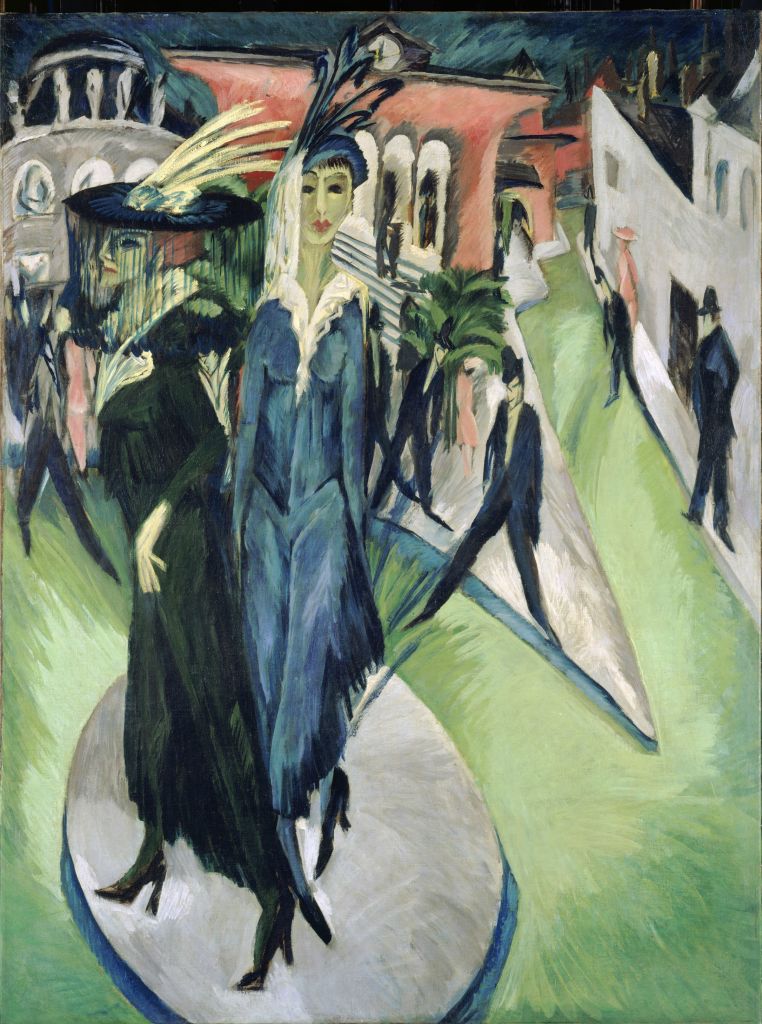
We then encounter Sonja, who leads us to a gallery space dedicated to works by the avant-garde Die Brücke (the Bridge) group who explored religion, primitivism, nudes in nature and metropolitan life in their work. Included in this section is Ernst Ludwig Kirchner’s Potsdam Square, 1914, which has two veiled women (likely signifying they are prostitutes) with greenish faces in the foreground towering over all else. They stand on a round platform, but almost all else in the painting is jagged and angular, even the downward brushstrokes, in a dramatic play on perspective.
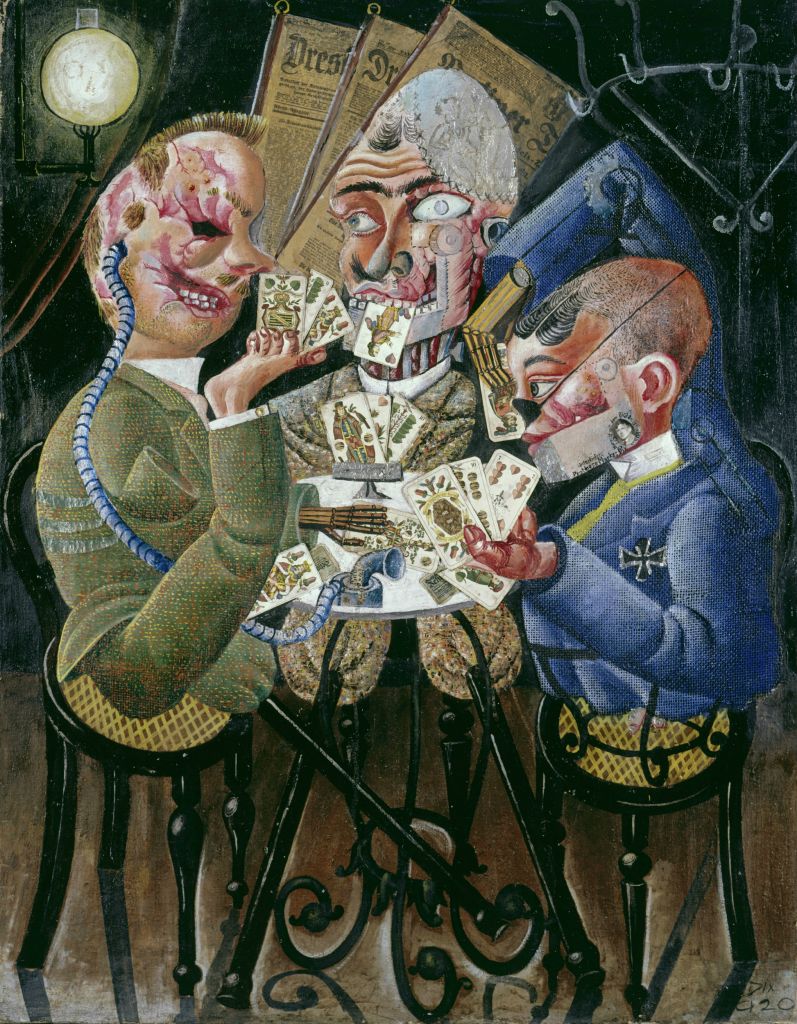
The next room of the exhibition is dedicated to examples of the artistic styles of the Weimar Republic, from Dada to New Objectivity. Many of these works rail against both capitalism and the effects of World War I on society. A prime example is Otto Dix’s The Skat Players (1920), an anti-militarist collage marking Dix’s transition from Dada to the socially critical New Realism, depicting three hideously disfigured officers in a café playing skat, a popular three-handed German card game. Also in this section is George Grosz’s Pillars of Society (1926), a denunciation of German society and the Weimar Republic through four allegorical figures: the earless legal expert with a swastika on his tie and fencing weapon; a journalist with a chamber pot hat carrying a hypocritical palm frond; a politician whose brain is filled with steaming excrement; and a red-faced military chaplain in robes.
Next are examples of works of the Cubist and Bauhaus movements that show the influence of technical developments on artistic style. Included here is art by Paul Klee, Wassily Kandinsky, Oskar Schlemmer and Oskar Nerlinger, among others.
Oil on canvas, collage
Staatliche Museen zu Berlin, Nationalgalerie
© VG Bild- Kunst, Bonn, 2015
Finally, there is a room filled with paintings depicting politics and trauma. Created mainly in the 1930s and early 1940s, these include a horrific looking birth scene in the appropriately titled, Geburt (Birth), 1937 by Max Beckmann, and a sinister family with an scary black dog and a evil-looking giant butcher standing beneath some sharp weapons titled, Family Portrait of Heinrich George, 1935 by the same artist. Also included here is Ecce Homo/Mutilated Man, 1931 by Josef Scharl, a grotesque portrait of a soldier (presumably a WWI veteran) with only one eye and one year, the rest of his face totally disfigured.
Israel Museum curator Dr. Adina Kamien-Kazhdan traveled to Germany to help choose the paintings for “Twilight over Berlin.” She told The Times of Israel that she found this technique used to expose trauma and confront social issues, known as “masking,” to be fascinating.
“Avant-garde artists active between the two world wars sought to expose the gruesome face of this abysmal period, depicting twisted countenances, grossness, suffering, the real tissue of life in interwar Germany. They confront pain and death and denounce militaristic nationalism,” Kamien-Kazhdan said.
“In a sense, they paved the way for the development of present-day art therapy, in which soldiers are encouraged to create masks to help them work through trauma and brain injury, literally putting a face to their pain,” she added.
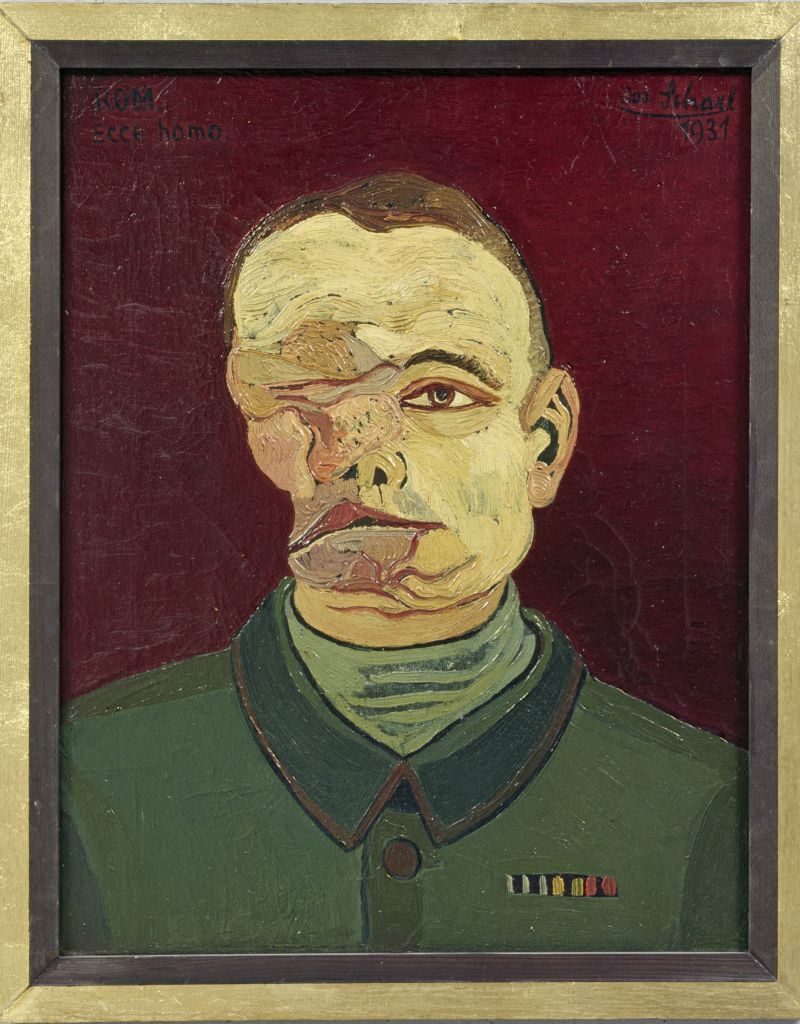
Oil on canvas
estate of the artist©t
Kittelmann noted that while the “degenerate” art in this exhibition provides a window into understanding a dark period in the past, it also serves as a warning for the future.
“This art is related to the brutality of the Nazis…We are in a time now when human beings are again destroying culture and art,” he said.
“Twilight over Berlin” will be on view at the Israel Museum until March 19, 2016.
There are also several other new shows at the museum:
“New Types: Three Pioneers of Hebrew Graphic Design,” which explores the foundational German heritage of Israel’s modern visual culture, focusing on the uniquely seminal influence of German designers on modern Hebrew typography and on the graphic arts.
“Man Ray: Human Equations” presents the artist’s objects, photographs and paintings together for the first time, demonstrating his proclivity for creating art across media that objectifies the body and humanizes the object, transforming everyday objects into novel forms of creative expression.
“Dürer and Friends: German Renaissance Prints” features 100 woodcuts and engravings from the Israel Museum’s collection, providing an insight into the creative genius of Albrecht Dürer, whose innovative approach to printmaking inspired an entire generation of German artists during the first half of the 16th century.
“We the people” is a new exhibition of contemporary art addressing the notions of individual and the collective identity within society. It includes works by Pawel Althamer, Cyprien Gaillard, Melanie Gilligan, Shilpa Gupta, Susan Hefuna, Yoav Horesh, Sala-Manca, Wolfgang Tillmans, Danh Vo, Lawrence Weiner, Artur Žmijewski, and Natalia Zourabova, among others.







The Times of Israel Community.