

Out of line?
With little hard news, the papers weigh in on Arab MKs’ meeting with Palestinian terrorists, and take stock of five months of violence
 Add ToI as a Preferred Source on Google
Ilan Ben Zion is an AFP reporter and a former news editor at The Times of Israel.
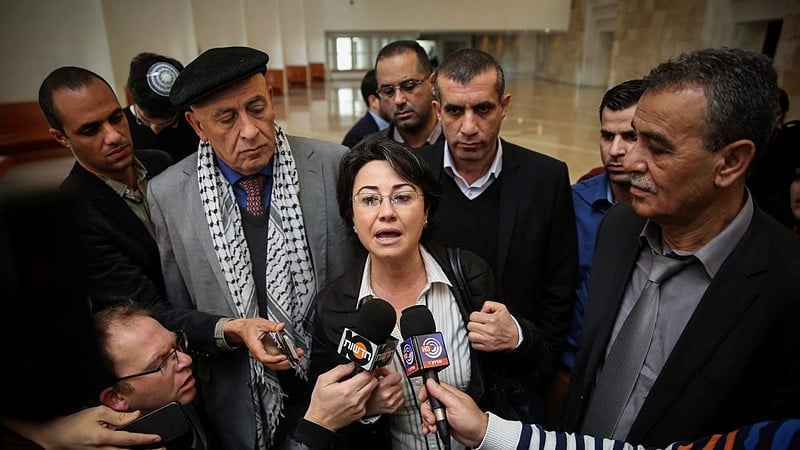
Israel’s press and parliament Monday weigh what should be done with out-of-line politicians, particularly Arab ones who express sympathy for Palestinian terrorists.
Prime Minister Benjamin Netanyahu is pushing for a law that would allow the ousting of lawmakers from the Knesset whose behavior is unbecoming, following a meeting by three Arab MKs with families of Palestinian terrorists last week that provoked outrage across the political spectrum.
Israel Hayom writes that the prime minister seeks to change the law to allow the parliament, rather than the president, Knesset speaker, or one of his deputies, to take action. The bill would require a three-quarters majority, 90 MKs, to suspend a lawmaker.
The paper reports that a poll showed 57 percent of respondents backing the ejection of MKs Basel Ghattas, Hanin Zoabi and Jamal Zakhalka, the Balad faction trio who met families of terrorists last week; 35% say they should be put on trial, and 8% say there’s no cause for action against the Arab lawmakers.
Yedioth Ahronoth reports that the new attorney general instructed the police to open an investigation into the Arab lawmakers’ meeting to see whether they broke the law.
Haaretz’s editorial weighs in on the issue, decrying “the ugly, aggressive persecution campaign” against the Arab MKs, and saying it “has no place in a democracy.”
“The Knesset has united against the three, nearly wall-to-wall. Representatives from every party but their own vied to be the sharpest-tongued against them. The right’s goal was transparent and dangerous: another attempt to delegitimize the Knesset’s Arab representatives as a step toward ostracism and perhaps even removing them from the legislature,” it says.
It accuses Netanyahu of inciting against Arab Israelis and of anti-Arab bias. “If Israel purports to be a democracy and to reject accusations that it is becoming an apartheid state, it must respect these opinions, even when they are irritating or even painful to the Jewish majority,” the paper says. It adds that the MKs’ meeting with the terrorists’ families to help obtain the release of their sons’ bodies is “their right and even their duty.”
Yedioth Ahronoth’s Ben Dror Yemini charges that the Balad party MKs don’t want equality, coexistence or Arab-Jewish understanding. Rather, “they want to stretch the rope of hope until it breaks.” He accuses the Arab MKs of “playing with fire.” But he says the proposed bill’s problem is that there’s no need for it, and predicts it will go the way of previous suggested laws. “Lots of noise, which will raise the number of claims of the ‘end of democracy,'” he predicts.
Yedioth Ahronoth takes stock of the apparently never-ending violence, with its top story reporting that in the past five months of terrorist attacks, 52 Israeli children have been turned into orphans, 30 parents left mourning for lost children, and 12 people widowed. According to statistics presented by the National Insurance Institute at the President’s Residence and cited by the paper, since the murder of Alexander Levlovitz in Jerusalem in September, there have been 140 Palestinian terror attacks targeting Israelis, and 26 Jews and a foreign national were murdered. The statistics cited don’t provide figures on the Palestinian side of the equation, and are oddly lower than other tallies of the violence’s toll.
Curiously, attacks on Israeli have become so banal that a stabbing carried out by a Sudanese national in the southern city of Ashkelon barely gets any press coverage whatsoever, with a tiny blurb on the front page of Haaretz, Page 6 coverage in Yedioth Ahronoth and Page 5 in Israel Hayom. The Sudanese man stabbed an Israeli soldier, lightly injuring him, and was shot dead as he fled. The police aren’t ruling out the possibility that it was a nationalist incident. They also are checking the likelihood that the suspect suffered from psychological problems, Yedioth Ahronoth reports.
Haaretz, meanwhile, puts everyone to sleep with a front page story about Netanyahu vowing to nullify committees to vet candidates for senior civil posts, and make political appointments easier for ministers instead.
“I reject the process that has taken hold here of a nominating committee. If ministers can’t appoint people, they aren’t ministers. If they err in whom they choose, they will pay for it in the elections,” the paper quotes the prime minister saying.
The paper also reports that the police, having taken a public image beating with recent sexual harassment scandals and outrage over the handling of the Tel Aviv Nashat Milhem January 1 shooting case, will invest NIS 800,000 ($200,000) in a private public relations firm.









The Times of Israel Community.