

Peace talks are stalled, and the Gaza fight goes on
Saeb Erekat threatens to walk away from negotiations (again), as Israeli soldiers are wounded destroying Hamas ‘terror tunnel’
 Add ToI as a Preferred Source on Google
Lazar Berman is The Times of Israel's diplomatic reporter
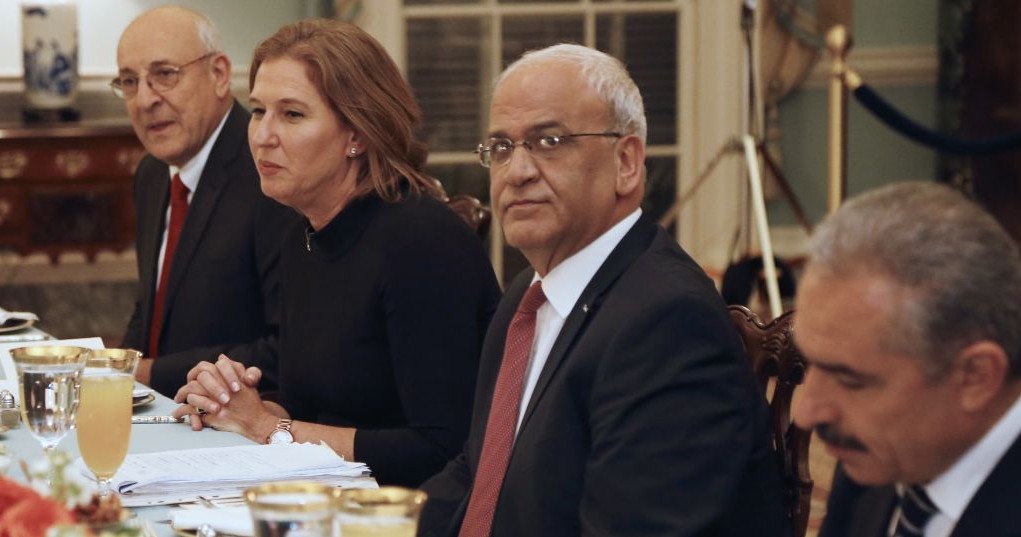
As talks between Palestinians and Israelis find themselves again at an impasse, and US Secretary of State John Kerry heads this way Tuesday to try to un-gum up the works, Hebrew media report on the consequences of the stalled negotiations.
Haaretz’s Barak Ravid covers Saeb Erekat’s threats to resign from the Palestinian negotiating team for the umpteenth time over Israeli settlement construction.
Prime Minister Benjamin Netanyahu announced plans to move forward with the construction of 5,000 housing units in the West Bank while Israel released 26 Palestinian terrorists from prison. After hearing about the plan, Erekat told Justice Minister Tzipi Livni and US special representative Martin Indyk about his intentions to hold a press conference to announce his resignation. The Americans began panicking, and it took a call from Kerry to PA President Mahmoud Abbas to verify that Erekat was going to remain in the game.
Still, the Palestinians were furious about the announcement. “Abbas emphasized to Indyk that the Palestinians were fuming over the Israeli intention to announce the building,” writes Ravid, “but they will not quit the negotiations.” Ravid also reports that the Palestinians were aware that the Israelis would reveal plans to build some settlement housing, but were shocked at the number and the alacrity with which construction would begin. Senior PLO members demanded that Erekat leave the negotiating table and attacked him personally.
But, Erekat has been threatening to walk away from talks for 20 years, as journalist Matthew Kalman points out on his blog. Ravid reports that Erekat made the threat so it would be reported in Palestinian media: to calm the Palestinian street and remove pressure from his PLO critics.
Still, it’s true the Palestinians are disappointed. “The Palestinian feeling is that the US is operating as a passive sponsor of the talks, and is not restraining Israel, especially in settlement construction. ‘Everyone remembers Kerry’s active involvement on the eve of the talks. The leadership now feels that Israel has free rein, and America isn’t lifting a finger.’”
Maariv reports on Netanyahu’s decision to begin building a security fence on the Jordanian border in the Jordan Valley. This development is directly connected to the peace talks. “One central reason is the refugee flow from Syria — about 700,000 — to Jordan. A second reason is to close Israel’s borders. In Netanyahu’s eyes, the building of a fence is also meant to give a message to the Palestinians, who oppose the Israeli presence on the Jordan River and control over the border crossings, that Israel intends to defend its eastern border in the valley, and has no intention of leaving under any arrangement.”
Yedioth focuses its coverage on the tunnel threat, after overnight Thursday, a soldier was seriously wounded and another was in moderate condition after an IDF operation to destroy part of a tunnel, east of Khan Younis just inside the Gaza Strip, was targeted by Hamas using an explosive device.
Two weeks before the attack, Yedioth reporters interviewed Ahiyah Klein, the officer injured seriously in the attack.
Klein and other officers explained their dangerous work in the Samur, the combat engineering unit designed to locate and destroy terrorist tunnels. “We are talking about a landscape that is hidden from us,” Klein told Yedioth. “While Hamas knows every corner of the tunnel, we have no idea what is awaiting us inside…What happened this time will not necessarily happen next time, because we learn something new every day, and every say this war begins anew.”
Klein “was seriously injured last Thursday night when the drill hit and activated, it seems, a huge mine planted by Hamas. A mixture of explosives and diesel fuel…injured the unit commander, Major A., who was injured in the Second Lebanon War, M. and N., and wounded Lt. Klein badly in the face, and doctors have been working for two days now to save his eyes…to save the light of the officer’s beautiful eyes who only two weeks ago sat with us on a mound in the shade of the eucalyptus trees, with the pleasant wind of the western Negev…and spoke with us about the unending war…The war that begins starts every day anew.”
Israel Hayom adds that Hamas’ spokesmen are promising to take revenge for the killing of four of their fighters during the operation. They also claimed to have discovered an Israeli eavesdropping apparatus that allowed them to listen in on Gazan telephone calls.
Yedioth also covers the reaction of families living near the Gaza border to the decision to remove military guards from the towns, despite the recent tunnel finds. The article reports on a family whose kids asked to sleep in their grandfather’s home because he has has a gun in the house. “I feel safe when they sleep next to someone armed,” said the mother. “Since the soldiers left I feel very worried, truly abandoned…The soldiers used to guard right next to the homes. This definitely calmed us and the children. But since Thursday the feeling is terrible. In an instant all of our sense of personal security vanished.”
Haaretz’s editorial criticizes Yair Lapid and the Finance Ministry for folding in the budgetary fight against the defense establishment’s demands for an increased budget. The editors said Lapid was “wounded and injured” after he voted with the national security cabinet to give back 2.75 billion shekels of the 3 billion cut, calling it “the major achievement to a resounding failure.”
“Considering the massive budgetary increases the IDF received after the Second Lebanon War, for training and equipment, and in light of the fact that conventional threats on Israel have shrunken significantly in the way of the internal conflicts in Egypt, Syria, and Iraq — this period could have been a fitting time for cuts and streamlining in the defense ministry, by diverting funds to social benefits, welfare, health and other fields. But the… return of almost the entire reduction, removed every demand for the defense establishment to become more streamlined…”









The Times of Israel Community.