

‘Save us like Shalit’
Abducted Egyptian soldiers beg Morsi to accept a prisoner swap as he persuaded Israel to do for Gilad Shalit; Jordan acquits students of devil worship
 Add ToI as a Preferred Source on Google
Michael Bassin is a founding member of the Gulf-Israel Business Council, a co-founder at ScaleUpSales Ltd, and the author of "I Am Not a Spy: An American Jew Goes Deep In The Arab World & Israeli Army."
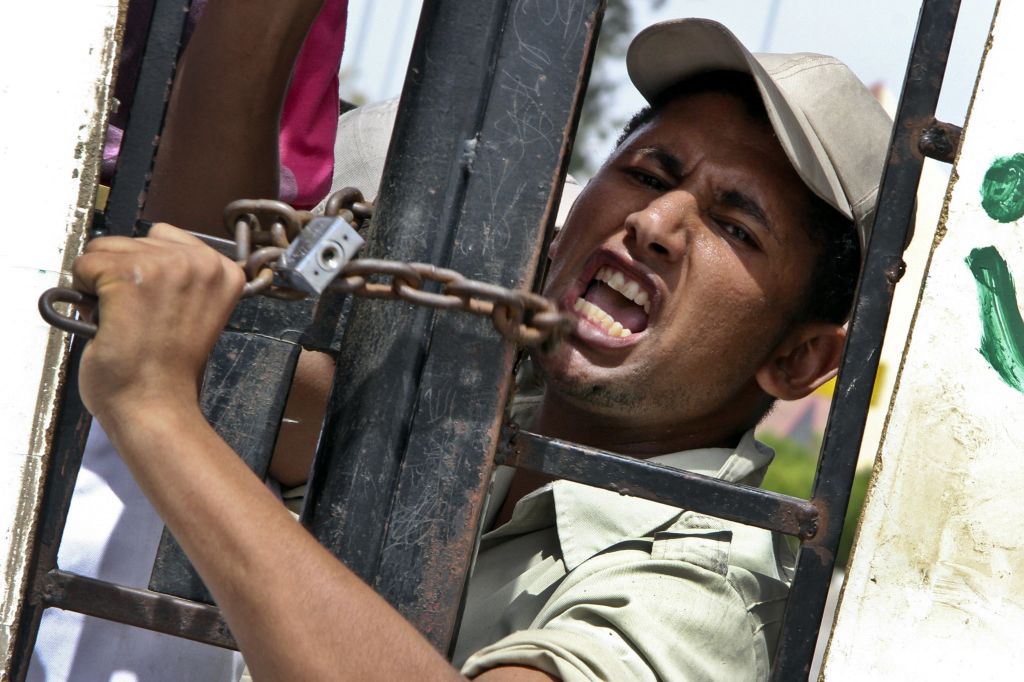
The seven Egyptian soldiers kidnapped last Thursday in Sinai near Egypt’s border with the Gaza Strip are shown in a video released Sunday pleading with Egyptian President Mohammed Morsi to “save us like Shalit,” a reference former Hamas captive Gilad Shalit, Arab newspapers report.
According to the London-based Al-Quds Al-Arabi, the video shows the soldiers blindfolded and with upraised hands. Citing the pressure Morsi exerted on Israel to release over a thousand prisoners in exchange for Shalit, an Israeli soldier who was kidnapped by Hamas in June 2006 and freed over five years later, the soldiers call on Morsi to “save lives” by acceding to their captors’ demands and releasing “all political prisoners in the Sinai.”
Since Israel completely withdrew from the Sinai Peninsula and handed it over to Egypt in 1982 as part of the Egyptian-Israeli peace treaty, it has become a neglected and increasingly lawless area with a native Bedouin population largely disconnected from the rest of Egyptian society.
Al-Hayat reports that Morsi has rejected any form of dialogue with the “criminals” in order “to protect the prestige of the state.” Meanwhile, the president continues to meet with commanders of the Egyptian army to see if a military solution to the situation is realistic.
The Dubai-based media network Al-Arabiya explains that launching a massive military attack would be difficult without consulting heavily with Israel beforehand. The Egyptian-Israeli peace treaty forbids Egypt from moving a military force in the Sinai Peninsula. In August 2012, Egypt moved tanks into the demilitarized zone without Israeli approval; further buildup in the area, regardless of the reason, could strain already shaky relations.
Egypt’s military is currently on shaky terms with the Hamas-led government in Gaza as well. Although the Gazan-Egyptian border is only 13 kilometers long, over 1,000 underground tunnels have been dug that allow Palestinians to circumvent the Israeli blockade on the Strip and smuggle in weapons and insurgents. It is believed that in exchange for cooperation from Sinai’s Bedouin population, Palestinians in Gaza have provided them with arms, to the dismay of the Morsi administration.
Amal Abdul Aziz writes in an op-ed in the Saudi-owned A-Sharq Al-Awsat entitled “Gaza: Egypt’s problem” that Morsi was acting courageously when he ordered the tunnels destroyed by filling them with sewage in February.
‘Egypt has fought four wars for the Palestinians, but today it must show that Egyptian security comes first’
“The duty of the Egyptian government is to close all the tunnels in the Gaza Strip once and for all… It does not matter if Hamas and the other Islamic groups don’t like it because Egyptian national security is not restrained by political courtesies or friendships. The kidnapping of the soldiers was known to Hamas leaders at home and abroad,” Aziz continues.
“Egypt has fought four wars for the Palestinians, but today it must show that Egyptian security comes first.”
Accused ‘satanists’ go back to school
A Jordanian court has acquitted five university students of Satanism and devil worship due to lack of evidence and permitted them to return to their studies at Al al-Bayt University near Amman, the Doha-based media network Al-Jazeera reports.
The students were arrested in mid-March after fellow students accused them of throwing copies of the Koran into toilets and worshiping demons. Prosecutors alleged that the students, four men and one woman, were inciting sectarian strife and defaming the Islamic religion. They faced up to three years in prison if convicted.
The accused students, who were known to wear “strange clothing,” claimed throughout their trial that they were merely the victims of harassment by other students who disliked them.
The Jordanian daily Al-Ghad stresses in its coverage that other students at the university vouched for the female in the group, calling her “a religiously committed girl who is known to pray.”
Administrators Al al-Bayt University insist there will be no problem re-integrating them into the student body and that they are free to resume their studies immediately. However, due to the death threats the defendants received during the trial, questions remain over whether additional security measures will be taken.









The Times of Israel Community.