

181 days later
Six months into a wave of attacks, one paper tries to tally up the death and destruction, while others highlight controversial ways Israel is trying to keep the numbers from rising
 Add ToI as a Preferred Source on Google
Joshua Davidovich is The Times of Israel's Deputy Editor
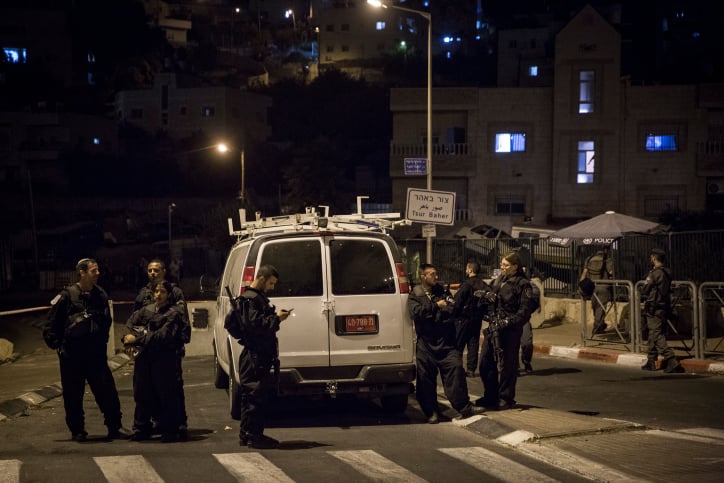
Leave it to Gazan terror groups to try to ruin a perfectly mark-able six-month anniversary. Half a year after a wave of stabbings, shooting and vehicular assaults started (according to some counts), the press seems eager to record the occasion and note how Israel has dealt with the issue and is continuing to try to grapple with it.
And despite the Gazans’ best attempts — a volley of rockets into Israel, preceded by a creepy threatening video that hacked the TV broadcasts of some Israeli “Big Brother” viewers Friday night — they fail to derail coverage away from attacks in the West Bank and Jerusalem and Israel’s response to it.
Yedioth Ahronoth fails the breakfast test with flying colors, specifically one shade – blood red. The front page, emblazoned with a picture of a phylacteries-clad man holding up a bloodied piece of cloth, is likely to make average readers lose their Cheerios, and if the picture doesn’t, the paper’s unequivocal declaration of the wave violence as an “intifada” may do the trick.
While the IDF and most others count the start of the violence on October 1, with the shooting death of Naama and Eitam Henkin, some count the start on September 13, when Alexander Levlovitz was killed after crashing his car which had been hit by rock-throwing Palestinians in East Jerusalem.
The paper gives all the terrible stats, including 34 people killed (a number which includes four non-Israelis, and at least one person shot by Israelis by mistake), and 342 people injured. The score sheet also includes 74 vehicular assaults, 71 shootings, 1,400 rock and Molotov cocktail attacks, 168 attacks with explosives, like pipe bombs, but somehow only 33 stabbings, which is low, given that this intifada has been mostly characterized by its high number of stabbings. (The Israeli Foreign Ministry counts 202 stabbings over the same time period).
As if that weren’t strange enough, the stats, which do not include casualties on the Palestinian side, are accompanied by a column by Eitan Haber, in which he notes the high number of stabbings his paper seems to ignore, as well as the lack of Israeli concern for the other side, though it’s unclear if he thinks that’s a good thing.
“This time, we were more ready than in the past, but we were still surprised at the lack of organization by the other side, by their old and antiquated weapons, and also in the willingness of everyday folk to use knives, knowing that it will most end with them losing their lives,” he writes. “The current intifada is shapeshifting, but as always carries the same angering tag: needless victims on both sides. But we are only interested in the Israeli side. The people who want to live here are dying before our eyes.”
Not to worry, though, as Haaretz comes galloping in to the rescue to fill the public in on the woes of the other side. The paper’s lead story reports that the number of Palestinians injured by police action has risen with the use of a new, more dangerous, type of rubber bullet.
The paper notes that police have started using black foam-tipped bullets, shooting some 57,000 of them (and fewer lethal blue foam-tipped bullets over the last two years), compared to about 17,000 bullets in the three years prior.
“In 2014, after complaints from police over a lack of effectiveness of the blue-tipped bullets, they were replaced by the black-tipped type. It was after this that complaints began to accumulate of significant injuries from these bullets,” the paper reports. “According to figures collected by the Associated for Civil Rights in Israel, 30 people have sustained significant injuries from the black-tipped bullets to date. However, with one exception, none of the injured have been summoned to give testimony. An adult struck by such a projectile can expect to sustain a painful but superficial injury. In some cases, it may cause a slight bone fracture. But for children or the elderly, the injury can be very serious.”
Israel Hayom leads off its coverage with an even less lethal fight taken on by Israel, but one some say is no less dangerous – closing Palestinian media outlets, something the paper calls “a new stage in the fight against Palestinian incitement.” While troops raided the Ramallah offices of Filistin al-Youm, the paper reports that Prime Minister Benjamin Netanyahu also got on the ringer to Paris to shut down another station.
“Paris shut down Hamas’s al-Aqsa TV, which is broadcast from a French satellite. Netanyahu called the president of France, Francoise Hollande, and asked him to cut off the inciting broadcasts. The Israeli Embassy in Paris updated him that the company stopped broadcasting the channel,” the paper reports.
Given the clampdown, it shouldn’t come as much of a surprise that Hamas felt the need to go Max Headroom on Israel and cut into a broadcast of “Big Brother” with a threatening video, which was followed by some Gazan rocket fire.
In Yedioth, Ariela Ringel Hoffman gives an account of her time vacationing at Kibbutz Nir-Am, about a kilometer from Gaza, over the weekend and trying to deal with the unexpected rocket fire.
“There was panic, even if everyone kept it mostly cool, and a lot of fear. It was a little after 3:30 a.m., and nobody knew if our rooms were rocket-proof – they were, it turns out – and if not, where to run to with the babies,” she writes. “So we stood there, in the chilly night, wondering what to do, and wondering why nobody else in the kibbutz was out.”
It’s not just dumb northerners who were caught off guard by the rockets, but southern veterans, like Yuval Timsit, quoted in Israel Hayom.
“We’re tired, we’re really tired. We’re sick of this that after a period of quiet, suddenly they shoot a volley of rockets without any warning or message beforehand, and without Israel making any attempt to take punitive action against Gaza,” he’s quoted saying. “This needs to end now and for forever.”
Of course, Israel did take action, targeting Hamas training camps but killing two Palestinian children in the process. Haaretz, the only paper to give significant coverage to the deaths, reports that the two, 10, and 16, along with a third child who was injured, were hit by shrapnel from a rocket fired at a Hamas training base nearby. The paper notes that Israel’s policy is to always go after Hamas, even if they weren’t responsible for the fire, which they almost always aren’t.
“The defense community estimates that the fire from time to time is the result of internal struggles and emphasizes that since the end of Protective Edge in 2014, Hamas ‘has not fired a single bullet,’” The paper writes. “Yet even in past cases, the IDF has struck targets belonging to the group since it sees it as responsible for anything done in the Strip.”







The Times of Israel Community.