21-year-old said in serious condition from ‘long COVID’
TV report says mainly children suffer from syndrome that attacks those who have already recovered from the virus; hospital says no apparent link to the vaccine
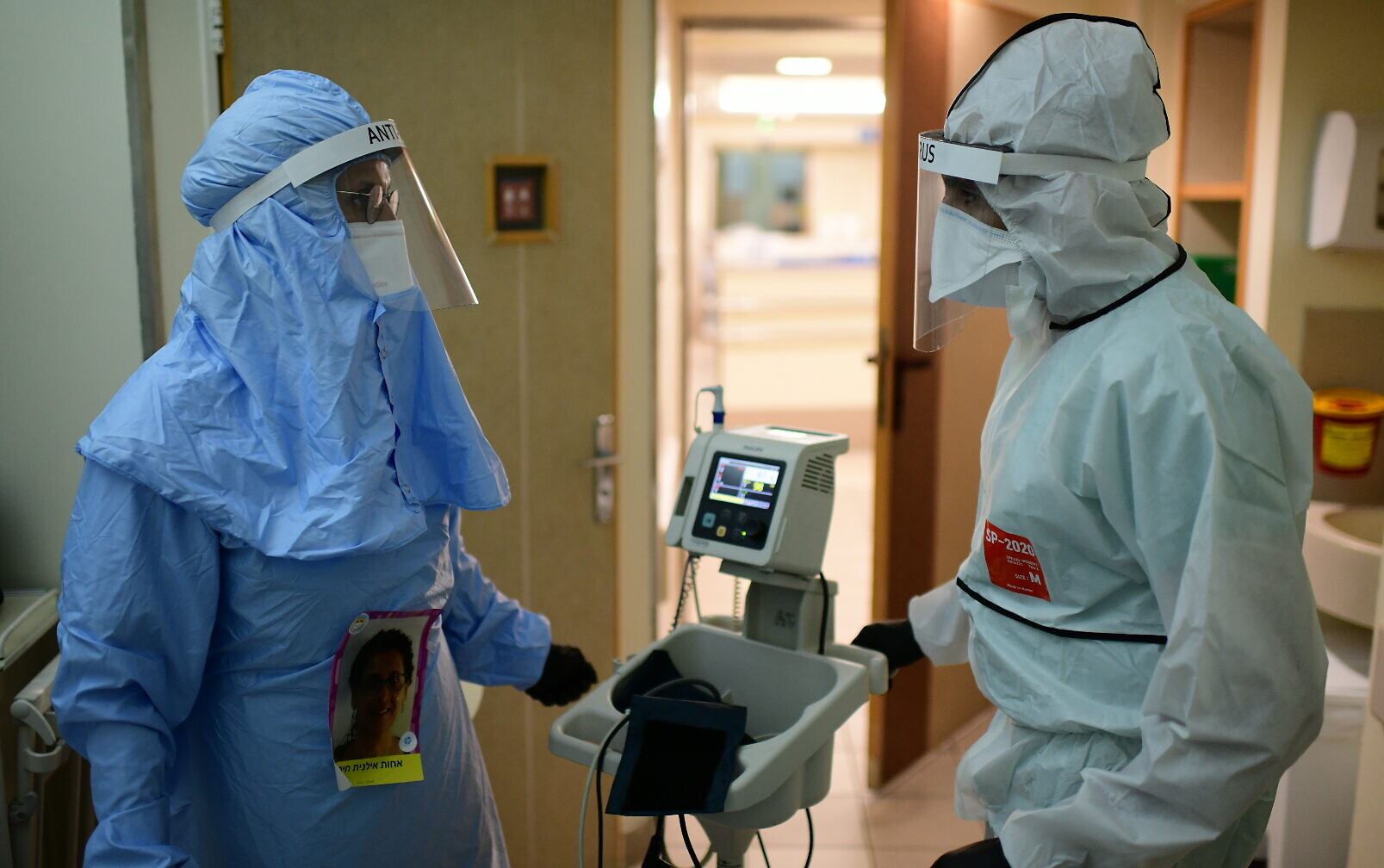
Medical workers in the coronavirus ward at Ichilov Hospital in Tel Aviv, on January 1, 2021. (Tomer Neuberg/Flash90)
A 21-year-old Israeli man who recovered from COVID-19 has been hospitalized in serious condition from an apparent post-coronavirus syndrome, a television report said Monday.
The young man, who had received his first vaccine dose, was transferred to Ichilov Hospital in Tel Aviv. He arrived with a high fever and damage to his liver and lungs, Channel 12 news reported.
According to the report, the man was unaware that he had been previously infected with COVID-19, and that was only discovered upon his admission to the hospital.
He was connected to an extracorporeal membrane oxygenation (ECMO) machine to receive cardiac and respiratory assistance.
A nurse monitors an Extracorporeal Membrane Oxygenation (ECMO) machine connected to a patient in the COVID-19 Intensive Care Unit at Harborview Medical Center in Seattle, May 8, 2020. (Elaine Thompson/AP)
Some 50 Israelis have been reported to have had the post-coronavirus syndrome, also known as “long COVID,” the majority of them children. The illness attacks those who had already recovered from the virus.
Get The Times of Israel's Daily Editionby email and never miss our top stories
The hospital said, that as of now, it cannot link the vaccine to the renewed sickness, and believe there is no causation.
So far, 5,017,355 people in Israel have received the first dose of their vaccination, and 3,899,027 have had the second as well, ministry figures published Tuesday showed.
In total, 807,755 people in Israel have been diagnosed with the coronavirus. There are currently 37,841 active patients.
Advertisement
Help us report truthfully on social media
As a multimedia journalist, my job is to take the quality, fact-based journalism produced by The Times of Israel newsroom and make it accessible across every platform — from Instagram posts to podcasts to short-form videos.
This is how many, especially young people, consume news these days. But misinformation is rampant on social media. Our team at ToI produces accurate, responsible short-form reporting on Israel and the Jewish world.
If you believe in the importance of factual social media journalism, please consider joining our reader support group, The Times of Israel Community. Your financial support is essential to sustain responsible multimedia reporting.
We’re really pleased that you’ve read X Times of Israel articles in the past month.
That’s why we started the Times of Israel - to provide discerning readers like you with must-read coverage of Israel and the Jewish world.
So now we have a request. Unlike other news outlets, we haven’t put up a paywall. But as the journalism we do is costly, we invite readers for whom The Times of Israel has become important to help support our work by joining The Times of Israel Community.
For as little as $6 a month you can help support our quality journalism while enjoying The Times of Israel AD-FREE, as well as accessing exclusive content available only to Times of Israel Community members.
Thank you, David Horovitz, Founding Editor of The Times of Israel


 Add ToI as a Preferred Source on Google