

A family affair: 7 things to know for March 27
The PM’s wife and son join him in the hot seat, with Sara Netanyahu reportedly telling investigators she deleted text messages to make room on her phone
 Add ToI as a Preferred Source on Google
Joshua Davidovich is The Times of Israel's Deputy Editor
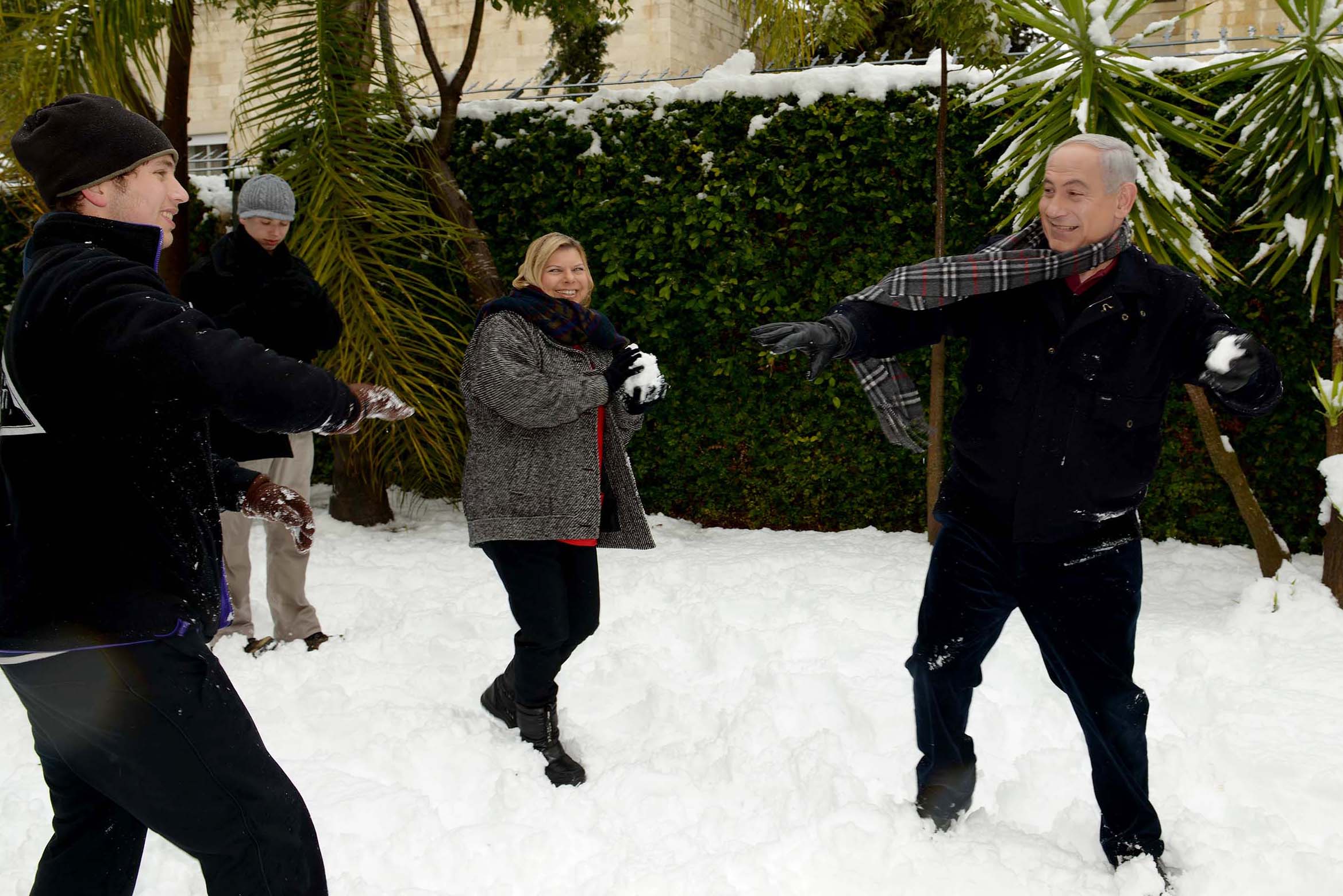
1. The Netanyahu family faced investigators Monday and focus has turned to the prime minister’s wife’s entanglement in the affair and her refusal to face state’s witnesses in so-called Case 4000, in which there are suspicions that the owner of Bezeq received regulatory kickbacks in exchange for positive coverage of the family in the Walla news website he owned.
- Police had reportedly wanted to have Sara Netanyahu face off against former top Netanyahu adviser Nir Hefetz and former Communications Ministry director general Shlomo Filber, and had brought the two to the national fraud unit headquarters in Lod, but she refused the encounter, according to Channel 10 news.
- She was still questioned about her erasing of text messages, and Yedioth Ahronoth reports on what it says is part of her back and forth with investigators, including her saying it was legitimate of her to demand positive coverage of her and her family in the press and for her to erase messages about it.
- “I didn’t erase messages in a selective manner. I erased whole groups to clear room on my phone. Everyone does it,” the paper reports she told investigators.
- However, according to the paper, “Cellphone experts claimed yesterday that as opposed to video, songs or pictures, which should be erased to clear memory, text messages like those erased by Netanyahu don’t take up much digital memory.”
2. Haaretz reports that both Sara Netanyahu and son Yair Netanyahu are suspected of obstruction of justice in the case, with Yair questioned in the case for the first time.
- “Even though Sara and Yair are not public servants, police see them as involved with the prime minister in the bribery deal in the Bezeq-Walla case. Police suspect they took part in one side of the deal, and also benefited from the demand for positive coverage in Wallas, and knew about the other side — the regulatory favors for Bezeq,” the paper reports.
- Pro-Netanyahu tabloid Israel Hayom leads off not with the interrogation, but the prime minister’s Facebook defense of himself, in which he vowed he would celebrate Passover “with a lot of haroset and no bitter herbs.”
3. Netanyahu is at least making sure to stay out of trouble with Russia, which is how Israel’s decision to break with much of the West in not expelling Russian diplomats over the UK nerve gas attack is being played.
- “By not joining the countries who seek to punish Russia over its alleged involvement in the Salisbury poison attack, Israel is in the company of countries such as China, Brazil and India, who have similarly tried to keep away from this controversy, a Russian official told The Times of Israel, speaking on condition of anonymity,” The Times of Israel’s Raphael Ahren reports.
- Haaretz’s Chemi Shalev warns that the US decision to confront Putin could have wide-ranging consequences: “The decision whether to ride this wave of popular indignation to escalate or moderate tensions with the West is now in Putin’s hands, of course, but the intensity of the confrontation is already sufficient to have a negative influence on the national security challenges awaiting Trump over the coming weeks in Syria, North Korea and, first and foremost from Israel’s point of view, Iran.”
4. Israel’s more pressing security concern is likely not Iran, but Hamas, with a month of protests on the Gaza border leading up to Nakba day in May.
Israel Hayom reports on efforts being undertaken by Israel’s allied Arab neighbors to make sure the protests don’t get out of hand, amid fears of an Arab Spring-type spread of mass protests. “Jordan, Cairo and Ramallah fear a planned escalation of violence in Gaza and its spread to the West Bank and even Jordan,” the paper reports.
While Hamas and other groups supporting the protests claim they will be nonviolent, few believe that is actually the case. “The immediate objective of the prospective fence-stormers is not so much to kill Israelis (though if that can be achieved, even better), but to get killed themselves,” Prof. Hillel Frisch writes in a position paper for the conservative leaning Begin-Sadat Center at Bar-Ilan University. Their hope is that Israel will resort to force to maintain the border (as would any sovereign state) and thereby create the graphics and funerals that delegitimize Israel. … Hamas and other factions are hoping this will lead to mass waves of violent protest and self-initiated suicide terrorist acts in the West Bank and among Israel’s Arab citizens. Ideally, from the perspective of the Palestinian organizations, it will yield a full-scale intifada.”
5. A live fire exercise by Hamas on Sunday and Monday is seen as only adding to those tensions and tied to the protests.
- “The timing of the maneuvers seemed to be more significant than the weapons on display, none of which came as a surprise to military experts. It was a message to several parties, including Israel, the Palestinian Authority and Palestinians living under Hamas rule in the Gaza Strip,” Khaled Abu Toameh writes in The Times of Israel. “The large-scale drill is seen as a warning to Israel not to ‘interfere’ with the protests, especially in light of preparations by the IDF to prevent any Palestinian attempt to cross the border.”
- Machine gun fire from the drill set off Israel’s anti-missile Iron Dome system, in an incident Haaretz’s Amos Harel notes is embarrassing to the IDF, as Hamas tries to find ways to circumvent the system. Harel surmises that the system and operators became less willing to take risks about unknown threats after a rocket hit a kindergarten in December.
- “An analysis of over 700 successful interceptions during the Gaza war in the summer of 2014 showed that in about 60 cases an operator decided to intercept despite the fact that the Iron Dome did not react. In most of the cases, it turned out that it was the right thing to do,” he notes.
6. While Israel appears to be choosing Russia over the UK, the press also seems to have little time for perfidious Albion, devoting little space to protests in London on Monday against alleged anti-Semitism within the Labour Party.
- The protests dominated the British press, though, after some 2,000 people showed up to demonstrate against Jeremy Corbyn’s stewardship of the party and anti-Semitic elements festering within.
https://twitter.com/EylonALevy/status/978403372461166595
- While Labour has defended itself saying it takes anti-Semitism concerns seriously, and Corbyn has said it only exists within “pockets” inside the party, the Guardian reports Monday that Labour repeatedly dismissed concerns about party leader Jeremy Corbyn defending an anti-Semitic mural, including a formal complaint filed last year by supporter Sam Shemtob.
- “When Shemtob asked in March 2017 what steps the party had taken to withdraw Corbyn’s endorsement of the mural, it said it could not give running updates on the issue. A year later he heard no more until the row about the mural resurfaced last week,” The Guardian reports.
- In The Times of Israel, Robert Philpot notes that even as Corbyn has come under increasing pressure over the issue, and the Jewish community is finally taking a stand, his statements don’t presage any genuine shift in the party or its leadership: “It would be a mistake to confuse the outpouring of anger — and Corbyn’s new attempts to show some form of contrition — with any loosening of the Labour leader’s vise-like grip on the party or a fundamental change in his worldview,” he writes.
7. What Israel is more concerned about is making sure the new US embassy in Jerusalem opens in time, with the national planning council acceding to a request by the Finance Ministry and gleefully announcing Tuesday morning that it has fast-tracked planning for a wall and escape route that will allow the embassy shoft to move forward.
- “As I promised, we will not let needless bureaucracy delay the transfer of the embassy to Israel’s eternal capital,” Finance Minister Moshe Kahlon says in a statement.
- An embassy staffer official tells Reuters the initial move will be little more than in name only, though it will expand in coming years: “Initially, the interim Embassy in [the Jerusalem neighborhood of] Arnona will contain office space for the Ambassador and a small staff. By the end of next year, we intend to open a new Embassy Jerusalem annex on the Arnona compound that will provide the Ambassador and his team with expanded interim office space.”







The Times of Israel Community.