

Abbas okays taking sample from Arafat’s body for tests amid polonium poisoning claims
The truth must come out, says widow Suha; Saeb Erekat calls for international inquiry following Al-Jazeera report of radioactive material on late PA president’s clothing
 Add ToI as a Preferred Source on Google
Stuart Winer is a breaking news editor at The Times of Israel.
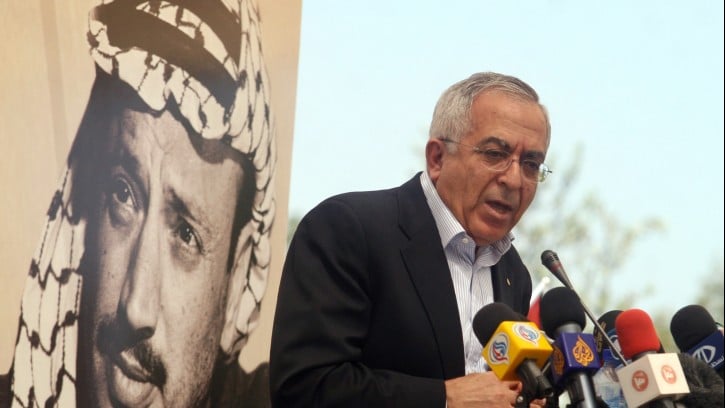
Chief Palestinian negotiator Saeb Erekat called for an international investigation into the death of Palestinian leader Yasser Arafat on Wednesday, after an al-Jazeera report claimed that the deceased president’s belongings have abnormal traces of radioactive polonium.
The call came as Palestinian officials confirmed Wednesday they would support exhuming Arafat’s body to take samples for further tests, a move backed by the deceased leader’s widow Suha Arafat.
“The truth must come out,” she said on Wednesday. If a crime had been committed, she added, the only way to prove it would be via tests on Arafat’s body. “I want to ask to exhume the body of my husband,” she said. “This is my message to the Palestinian Authority — that they must cooperate.”
In a statement issued by his office, Palestinian President Mahmoud Abbas said he is willing to cooperate with further testing, provided Arafat’s family agrees.
“The Palestinian Authority was and remains fully prepared to cooperate and to provide all the facilities needed to reveal the real causes that led to the death of the late president,” the statement said. “There are no religious or political reasons that preclude research on this issue, including an examination of the late president by a reliable national medical body, upon request and approval by his family.”
In an interview with Al-Jazeera about the recent claims that Arafat was poisoned, Erekat supported exhuming his body and called for the establishment of inquiry by the United Nations Security Council or the International Criminal Court. Erekat said the matter required clarification equal to that of the murder of former Lebanese prime minister Rafik Hariri.
“I knew in my heart that Arafat didn’t die of natural causes,” Erekat told the Qatar-based news station.
Erekat stressed the importance of resolving the mystery of Arafat’s death because it has implications even to this day.
“The issue here is the whole political picture,” Erekat said in the interview. “The same people who said that Arafat was an obstacle to peace are the same people who are calling to be rid of Abbas and the same people who say the Palestinians need a leader who will accept the Israeli terms.”
Rumors swirled around Arafat’s death in 2004 after he was rushed from his compound in Ramallah to France suffering from a mystery illness. Analysis of Arafat’s clothing conducted by Al Jazeera and thec, Switzerland, found irregularly high levels of the rare radioactive element. Polonium’s effects on the human body are deadly but largely undocumented.
“Arafat’s personal effects, particularly those with bodily fluids on them, registered much higher levels of the element” than occurs naturally, Al Jazeera reported. “The urine stain on [Arafat’s] underwear” registered 27 times the amount of radioactivity than a control pair of underwear.
In an interview to Army Radio Thursday, Darcy Christen, the Swiss institute’s spokesman said researchers were surprised by the high levels of polonium, but could not determine that it was the cause of Arafat’s death.
“The fact that we found polonium doesn’t mean it was there eight years ago,” said Christen, explaining that to determine that, the body itself needed to be checked.
Christen said that the polonium found on Arafat’s effects was not from a natural source, but had to be produced in a nuclear plant, extracted from uranium. “It’s not like you can find it at the shop down the road,” he said.
Two years after Arafat’s death, former Russian spy Alexander Litvinenko died in London after a mysterious three-week illness. A British inquiry found that Litvinenko was poisoned with polonium that was slipped into his tea at a sushi restaurant. Arafat and Litvinenko shared symptoms: diarrhea, weight loss and vomiting.








The Times of Israel Community.