

Fight for the right (wing): 9 things to know for December 17
Ministers rallying against their own government and cabinet infighting over security and settlements sharpens rifts, though a centrist may shake up the scene anyway
 Add ToI as a Preferred Source on Google
Joshua Davidovich is The Times of Israel's Deputy Editor
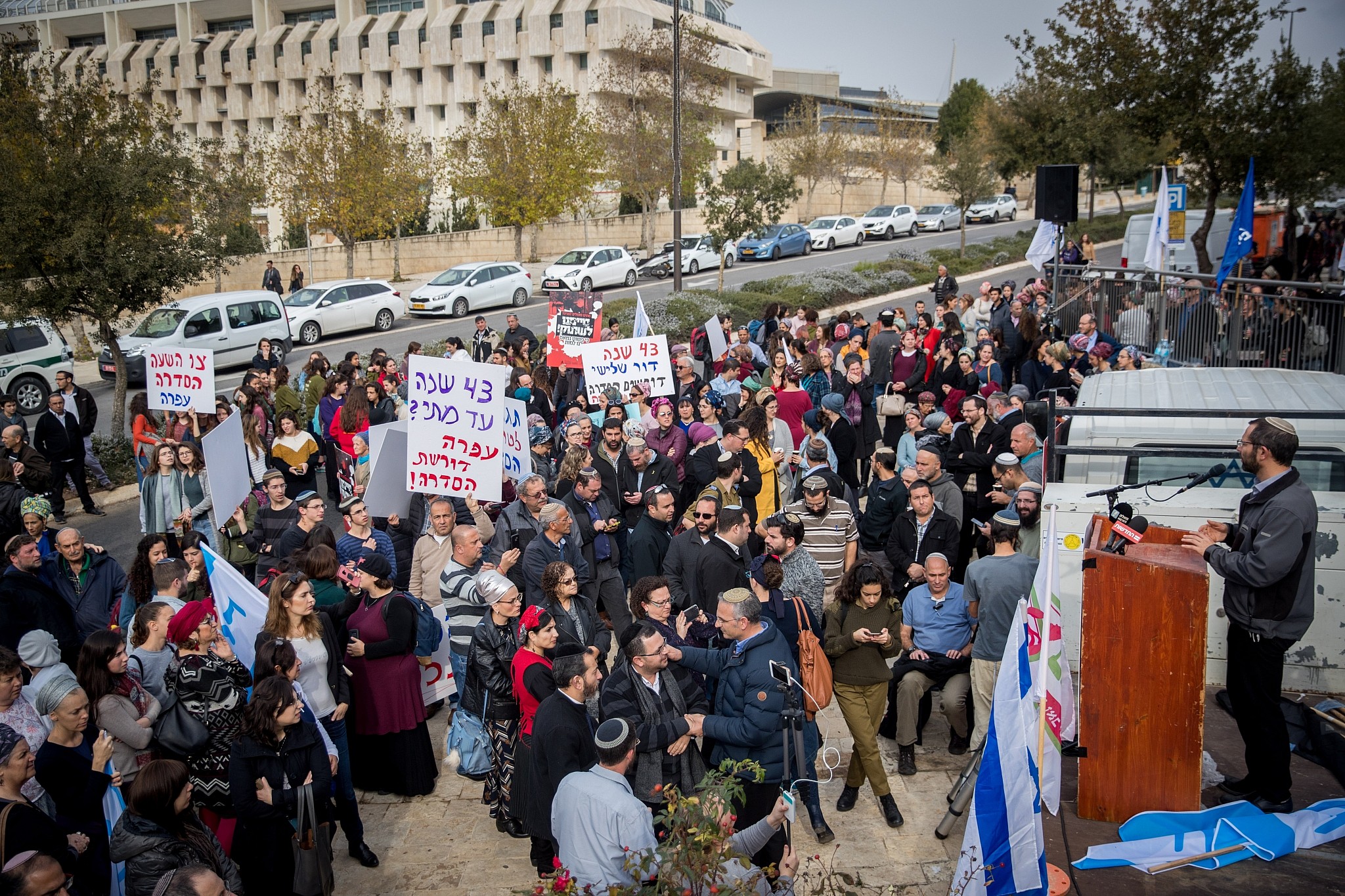
1. Rallying against yourself: The latest sign that early elections may be coming was on display Sunday as ministers jockeyed for positions on the right with a protest against the government’s handling of the security situation in the West Bank.
- Many took note of the seemingly Kafkaesque situation as nine ministers from the most right-wing government in the country’s history rallied against the very government they sit in and against minister of ministers Benjamin Netanyahu.
- “Protesting against themselves” reads the top front page headline in tabloid Yedioth Ahronoth.
- “Protests against the government are not rare in Israel or around the world, but the sight yesterday in Jerusalem was out of the ordinary in every sense of the word: a protest against the government, after which nine of the main speakers made their way to the cabinet meeting to take part in a decision-making process they had just protested against,” the paper’s lede reads.
- Columnist Sima Kadmon, also in Yedioth, describes the rally as representing the great paradox of the Netanyahu government: “On the one hand, its members are trying to save it, since nobody wants to be the one to take down a right-wing government. On the other, elections are getting close, primaries are around the corner, and most ministers are mostly concerned with how the voting public sees them.”
- Israel Hayom calls it “shooting within the APC,” a pretty self-explanatory Hebrew idiom, though notably the graphics department at the pro-Netanyahu paper somehow “leaves out” the four Likud ministers who took part.
2. Bennett vs. Bibi: The rally was just a lead-in to a cabinet meeting that saw Netanyahu bickering with Jewish Home ministers Naftali Bennett and Ayelet Shaked.
- In a raw exchange involving several senior ministers, first reported by Hadashot news and later confirmed to The Times of Israel by a coalition source, Netanyahu told Shaked and Bennett that “you two are doing something inappropriate that should not be done. The defense establishment is acting as it should.”
- Referring to Bennett’s unfulfilled vow to leave the coalition if he were not appointment defense minister, Netanyahu goaded, “We already know about your ultimatums.” Bennett hit back, saying, “It’s a shame you don’t fight terror like you do your own ministers.”
- Israel Hayom’s Mati Tuchfeld writes that the fight is actually part of a long-term plan by Bennett as he attempts to position himself to become defense minister after elections: “It’s the first step by Bennett to prepare hearts and minds for the new ultimatum he plans to put before the prime minister as a condition for him entering the government. Unlike last time, Bennett wants to make sure ahead of time that his demand, which will be accompanied by a real threat, has enough support from his party and gets its full backing before going ahead with it.”
3. Settlements as security: Shaked, who took part in the protest, later told Hadashot news that the ministers were not protesting against themselves, but the rally (during which protesters called for Netanyahu’s resignation) was meant to pump up the government ahead of a vote (which passed) on retroactively legalizing outposts in the West Bank.
- The move has been criticized as possibly breaking international law. While settler leaders and ministers have pushed it as a security measure, others disagreed, like opposition leader Tzipi Livni who told settlement heads Sunday that they were taking advantage of terror to push their agenda of building, drawing a furious response from them.
- “The ministerial decision to okay the bill shows that the government is not interested in security or the rule of law. Only political survival,” Haaretz’s Mordechai Kremnitzer writes.
- In Israel Hayom as well, columnist Nadav Shragai writes that policy makers should not be looking at settlement policy only through a defense lens, but rather an ideological one (that ideology being settling the whole Land of Israel).
- “According to reductive — and maybe crooked — defense logic, you can put the whole population of the country in the Tel Aviv region, Jerusalem and Haifa. The rest, the north, the south, the east, is not the main thing and is protected by the IDF. This is a distorted view. It ignores the fact that settling the land is the essence of Zionism and defense and peace are important national goals, but only to help the main goal: the return of the people of Israel to the land of Israel.”
- Interestingly, the debate of settlements as security assets goes back to the beginning of the movement. The first settlements were built on former army outposts in the West Bank and approval was given for those by the Labor-led government based on security considerations. Only later did settler leaders manage to convince the government to approve settlement building on land that has no obvious security purpose, thus allowing the enterprise to expand considerably. One of the first places that happened was Ofra.
4. Gantz contest: A Hadashot news poll published Sunday night showed former IDF chief Benny Gantz, thought likely to run for the Knesset, becoming the second largest party with 16 mandates to Likud’s 28 if he runs under his own party, and Yair Lapid’s Yesh Atid getting 13.
- The poll also found that if Gantz teams up with Yair Lapid, the two would get 26 seats to Likud’s 29. Interestingly, the duo would do better if they run separately and then join forces.
- Forget who he will run with. Gantz has become a juggernaut without even releasing a political platform or making clear his vision for the country. In Yedioth, columnist Ben-Dror Yemini urges him to open up already and stop pussyfooting around.
- “The support in the polls is a sort of security. It gives him room in order to present his way forward. Sitting on the fence is only good until a certain point. We’ve reached it, and now is the time to present a more official alternative [vision]. 16 seats is a lot of people. They deserve an answer.”
5. TIPH of the iceberg: Haaretz reports on a confidential report by TIPH, an international observer group in Hebron monitoring daily life there, that accuses Israel of regularly breaking international law in the flashpoint West Bank city.
- “According to the report, Israel is clearly in ‘severe and regular breach’ of the right to non-discrimination as well as the obligation to protect the population living under occupation from deportation. The Israeli settlement in Hebron is a violation of international law and ‘radical Israeli settlers’ make life in the Israeli-controlled area difficult for its Palestinian residents,” according to Haaretz, intended to sum up the 20 years the group has been in the city.
- The organization, which the paper notes is seen as toothless by the Palestinians (and Netanyahu has threatened to boot the group after incidents in which observers were seen fighting with settlers) only releases its reports to host countries and not publicly, thus its findings rarely see the light of day.
6. Demolition derby: Israel has also continued its recent drive to blow up the homes of terrorists, demolishing parts of a home that had belonged to the Palestinian terrorist who carried out the Barkan attack.
- Pictures published show the bottom two floors of a building reduced to rubble, though the overall structure remains standing.
כך נראה בית המחבל אשרף נעאלווה אחרי ההריסה pic.twitter.com/lOvBNf6iZQ
— יוסי יהושוע – Yossi Yehoshua (@YehoshuaYosi) December 17, 2018
- “This is a joke,” Shahar Levengrod, whose sister was among those killed in the attack, says according to Israel Hayom. “To tear down a wall with a hammer, it doesn’t make sense. I’m laughing at it.”
- On the other side, Yariv Oppenheim, a former head of Peace Now turned media pundit, writes on Twitter that the push to see homes destroyed is “barbaric revenge.”
- “The terrorist was killed, he’s no longer alive. What bigger punishment can there be for a family? It’s not deterrence and not nothing. Just more hate and the conflict distilled,” he writes.
7. Questions over alleged terrorist: ToI’s Adam Rasgon speaks to the family of another alleged Palestinian terrorist who was shot by troops after he allegedly rammed his car into them in the West Bank last week, who say there’s no way the 58-year-old father and successful businessman would suddenly turn into a terrorist at the drop of a hat.
- “He was on his way home and was not a person who would ever run his car into someone on purpose,” son Firas tells ToI about his father Hamdan al-Arda.
8. Slam dunk: On the northern border, CNN is given permission to drop a camera down a tunnel shaft, giving a rare view of one of the passages dug under the frontier by Hezbollah.
Watch as @CNN got exclusive access from the @IDF to one of the #Hezbollah attack tunnels.
1. An @NBA player could stand up in these tunnels.
2. It's more complicated than finding a needle in a haystack. @IDFSpokesperson
מגיש לעולם את חזבאללה על מגש של כסף. ככה עושים תקשורת. pic.twitter.com/8z0tn8UqkQ— Lt. Col. (R) Peter Lerner (@LTCPeterLerner) December 17, 2018
- Describing the tunnel, Israel’s Channel 10 plays up the fact that an NBA player could stand up in it, which will probably give the hasbara spin-doctors in Jerusalem some ideas.
- He’s not an NBA player (or an NFL player, or an MLB player bless his heart) but if the IDF hurries, it can grab Tim Tebow, who is in Jerusalem, and get a picture of him scrambling for a few yards down the tunnel.
Great to have @TimTebow on the @TBN #Jerusalem set a few days ago to talk about his first trip to #Israel—look for it soon @TBN @CUFI pic.twitter.com/7ILnM8kr0T
— Erick Stakelbeck (@ErickStakelbeck) December 16, 2018
9. Yair vs. Zuckerberg: Yair Netanyahu, bad-boy son of the prime minister, can’t seem to stay out of the news, and none of it can be making his parents especially proud. Days after posting on Facebook about wanting Muslims to leave Israel, he posted again about taking revenge on Palestinians over terror attacks, calling them “monsters disguised as people.”
- The post was quickly yanked by the social media giant, leading Netanyahu to post a screenshot of it and complain that Facebook “thought police” were after him.
- A few hours later, he posted on Twitter that his account was suspended because he had criticized Facebook.
- Not so, says journalism professor Yuval Dror: “He was blocked because of a post he put up claiming that Japan and Iceland don’t have terror attacks because they don’t have Muslims,” he writes on Twitter. “I know he was blocked because of it because I reported the post and Facebook thanked me for drawing their attention to it.”





The Times of Israel Community.