

Finance Ministry says US tax reform likely to have impact on Israel
Though it’s too early to estimate the total effect, its ramifications on issues like startup incentives and IP should be assessed, treasury says
 Add ToI as a Preferred Source on Google
Shoshanna Solomon was The Times of Israel's Startups and Business reporter
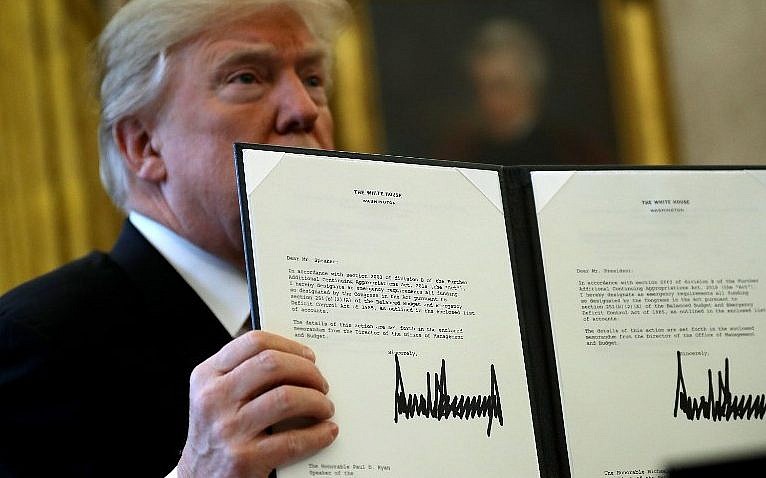
The wide-ranging tax reform pushed by US President Donald Trump, which entered into force on December 31, could have an impact on Israeli companies operating in the US and on US companies operating in Israel, the Finance Ministry said in its weekly economic note.
“Israel, a country that has wide ranging corporate activities in the US and export services, is likely to be affected by the tax changes in the US. At this point it is still early to estimate the extent of its impact on the Israeli economy in general, and on the high-tech sector in particular,” the Finance Ministry wrote in the report.
Trump’s Tax Cuts and Jobs Act, hailed as the largest in the US in over 30 years, is expected to have vast repercussions both on corporations and on households in the US. It is expected to make the US economy more attractive for investments, thus affecting both the US and the global economy, in a world in which competition for capital and talented human capital is fierce, the Finance Ministry said in the report.
The reform aims to overhaul the US tax code by cutting the number of personal income brackets and limiting or doing away with a selection of popular tax breaks. It caps the mortgage-interest deduction on new home sales and allows for capital expenditures to be deducted in year one.
More significantly, the bill slashes the federal corporate tax rate to 21 percent from the previous 35%. The rate will be effective this year.
The tax reform will make it more attractive for Israeli firms to set up businesses or acquire companies in the US market, international tax attorneys have said. The lower US tax rate could also spur an outflow of Israeli startups to US shores, impacting Israeli tax revenues, tax attorneys warned earlier this year.
Until now the US tax rate was higher than in Israel — an average US rate of 35% compared to the Israeli rate of up to 25%. But as the US rate drops to 21%, the incentives to setting up a business in the US have grown.
Earlier this month, Prime Minister Benjamin Netanyahu instructed senior officials in his office and the Finance Ministry to study the implications of the reform on Israeli and US firms operating in Israel, and to come up with recommendations within 30 days.
Israel’s economic strengths — its educated workforce, existing tax legislation and incentives for corporations — could help reduce some of the negative impact the reform may have, the Finance Ministry said in the report.
Even so, the implications of the reform on a number of matters must still be assessed. These include taking a close look at the incentives given to US firms that buy Israeli companies or who have business activities in Israel; the impact the reform could have on R&D centers set up by US firms in Israel and on Israeli companies that export their products to the US.
In addition, Israel should also study the impact of the reform on the incorporation of Israeli startups in Israel, on the intellectual property developed in Israel and on the activities of multinational corporations that have manufacturing operations locally, the report said.










The Times of Israel Community.