

French FM: Iran flirting with ‘red lines’ with uranium enrichment plan
Jean-Yves Le Drian says Tehran’s newly announced program does not breach nuclear accord limitations, but is ‘quite unwelcome’
 Add ToI as a Preferred Source on Google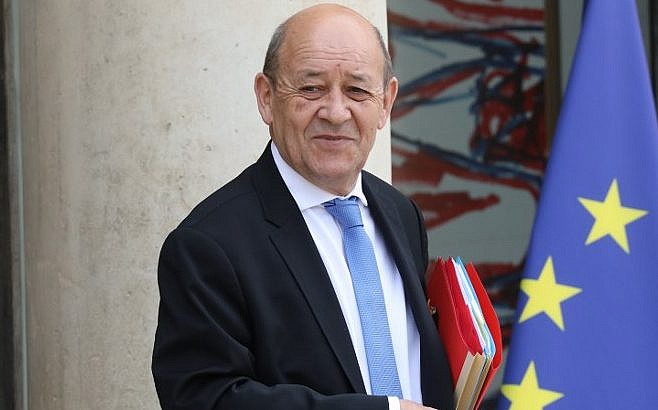
Iran’s plan to increase its uranium enrichment capacity is “unwelcome” and flirts with “red lines,” but is still in keeping with the 2015 agreement on Tehran’s nuclear program, France’s top diplomat said Wednesday.
“This initiative is quite unwelcome, it shows a form of irritation and it is always dangerous to flirt with the red lines,” Jean-Yves Le Drian said.
“But today, the initiative that has been taken to strengthen the uranium enrichment process remains entirely within the framework of the Vienna agreement,” he added.
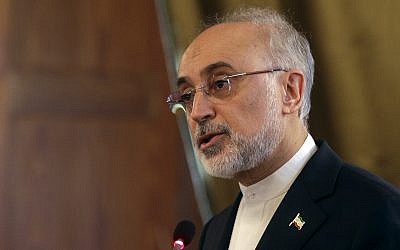
Iran has notified the International Atomic Energy Agency that it plans to open a center for producing new centrifuges, the Islamic Republic’s nuclear chief Ali Akbar Salehi said Tuesday, drawing an angry response from Israel.
“If we go to a higher stage, yes the agreement would be broken,” Le Drian said. “But the Iranians must realize that if they break the agreement, then they expose themselves to new sanctions and the Europeans will not be able to avoid a response.”
The European Union said Tuesday that a “first assessment” indicated that Iran’s announcement did not breach its commitments under the beleaguered nuclear deal.
The EU, which is working to save the agreement with Iran after the US pulled out, warned the Iranian announcement would not help build confidence in the Iranian program, but said it did not constitute a breach of the deal.
“Following a first assessment, the announced steps per se are not a violation of the JCPOA,” Maja Kocijancic, spokeswoman for EU diplomatic chief Federica Mogherini, told AFP. The agreement is officially called the Joint Comprehensive Plan of Action (JCPOA).
“However, at this particularly critical juncture, they will not contribute to build confidence in the nature of the Iranian nuclear program.”
Salehi stressed that his announcement was just the start of the production process and did not mean Iran was about to start assembling centrifuges.
Under the 2015 nuclear agreement that Iran signed with the US, China, Russia, Britain, France, and Germany after years of difficult talks, Tehran can build and test parts for advanced centrifuges, but specific restrictions exist on what technology can be researched and in what quantity within the first decade of the deal.
European governments have been trying to salvage the nuclear deal since the United States last month withdrew and said it would reimpose sanctions on foreign companies working in the Islamic Republic by November.
The remaining parties have vowed to stay in the accord but many of their companies have already started to wind down Iranian operations.
A European source told AFP that the Iranian enrichment announcement is being interpreted as a bid to step up the pressure on Brussels to deliver on these promises.
The EU is trying to come up with ways to persuade Iran to stick with the deal by protecting the economic benefits it gained when tough sanctions were lifted in return for it halting the weapons-capable aspects of its nuclear program.
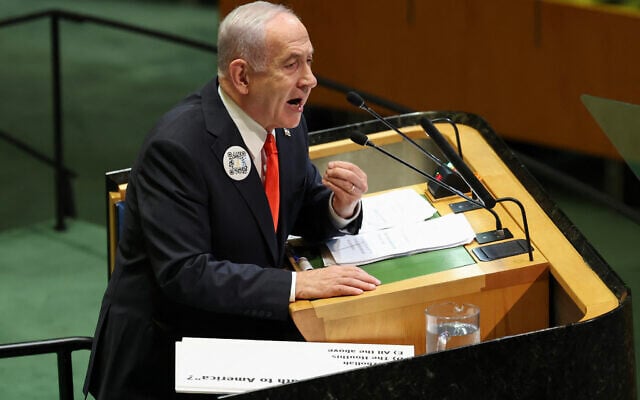
Prime Minister Benjamin Netanyahu said Tuesday he believes renewed US sanctions against the Islamic Republic will sink the 2015 accord.
Netanyahu met with French President Emmanuel Macron at the Elysee Palace in Paris as part of his European tour, aiming to rally support from allies against Iran. In addition to the nuclear deal, the prime minister also raised the subject of pushing Iranian forces out of Syria.
“I didn’t ask President Macron to withdraw from the nuclear deal with Iran because I think it is going to collapse anyway soon under pressure from US sanctions,” he said at a joint press conference with Macron after a closed-door meeting between the two leaders.
“What we focused on, and what I focused on, is how to stop Iranian aggression in the region,” he said.
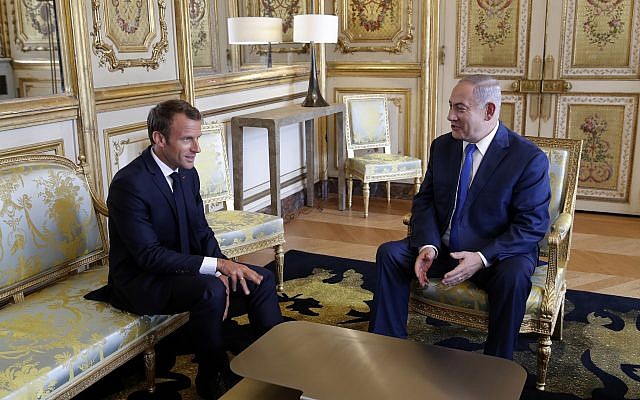
However, Netanyahu did urge the French leader to impose economic sanctions on Iran to help dissuade it from pursuing a nuclear weapon.
At the briefing, Macron warned of the risk of an “escalation” in the Iranian nuclear standoff. He called on “everyone to stabilize the situation and not give into this escalation which would lead to only one thing: conflict.”
Macron noted that while France shares Israel’s concerns regarding Iran’s actions in the region, his government stands by the nuclear agreement. He said the international community should seek to curb Iran’s ballistic missile program through a separate deal, and not by revamping the existing agreement.


The Times of Israel Community.