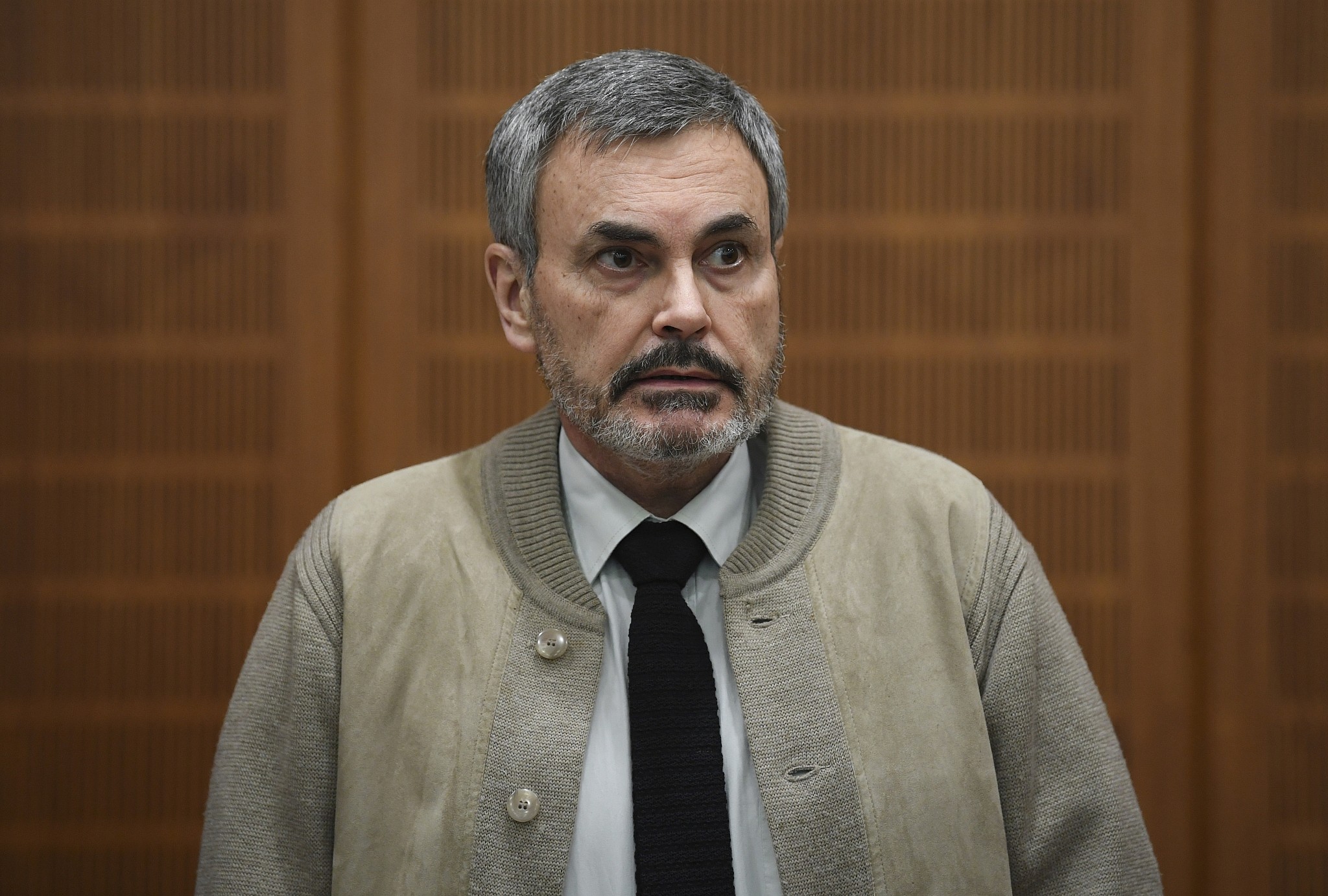
John Ausonius in a courtroom in Frankfurt, Germany, Wednesday, Feb. 21, 2018. ( Arne Dedert/dpa via AP)
BERLIN — Germany said Friday it had extradited to Sweden John Ausonius, the convicted killer known as the “the laserman” for using a precision-scope rifle to target immigrants.
“He was extradited on Thursday,” Frankfurt state prosecutor Nadja Niesen told AFP.
Ausonius, a 65-year-old Swedish citizen, has been found guilty of murder in both countries, most recently receiving a life term in Germany in February last year that was upheld on appeal in November.
Previously he was already serving a life sentence in Sweden for a six-month shooting spree in 1991-92.
In this photo from February 2, 1995, John Ausonius sits during a trial in Stockholm’s district court. (Tobias Rostlund/TT News Agency via AP, File)
Using the laser-scoped rifle, he had killed a 34-year-old Iranian man and wounded 10 other people from countries including Brazil, Greece, Syria and Zimbabwe.
Get The Times of Israel's Daily Editionby email and never miss our top stories
Anders Behring Breivik makes a Nazi gesture as he enters a courtroom in Skien, Norway, on March 15, 2016. (Lise Aserud, NTB scanpix via AP)
In a sign of Ausonius’s notoriety, Norwegian white supremacist mass murderer Anders Behring Breivik at his own trial mentioned the “laserman” as a figure who shared the same goals.
The convict, who was extradited to Germany in late 2016, was in February 2018 found guilty of the murder of 68-year-old Jewish Holocaust survivor Blanka Zmigrod in Frankfurt in 1992.
Ausonius, having now received life terms in two countries, is considered almost certain to spend the rest of his life locked up without parole.
Advertisement
Help us report truthfully on social media
As a multimedia journalist, my job is to take the quality, fact-based journalism produced by The Times of Israel newsroom and make it accessible across every platform — from Instagram posts to podcasts to short-form videos.
This is how many, especially young people, consume news these days. But misinformation is rampant on social media. Our team at ToI produces accurate, responsible short-form reporting on Israel and the Jewish world.
If you believe in the importance of factual social media journalism, please consider joining our reader support group, The Times of Israel Community. Your financial support is essential to sustain responsible multimedia reporting.
We’re really pleased that you’ve read X Times of Israel articles in the past month.
That’s why we started the Times of Israel - to provide discerning readers like you with must-read coverage of Israel and the Jewish world.
So now we have a request. Unlike other news outlets, we haven’t put up a paywall. But as the journalism we do is costly, we invite readers for whom The Times of Israel has become important to help support our work by joining The Times of Israel Community.
For as little as $6 a month you can help support our quality journalism while enjoying The Times of Israel AD-FREE, as well as accessing exclusive content available only to Times of Israel Community members.
Thank you, David Horovitz, Founding Editor of The Times of Israel


 Add ToI as a Preferred Source on Google