

Haniyeh: From refugee camp to Hamas leader
Though seen as a relatively pragmatic voice in the group, he remains wholly committed to terrorism and ‘liberation’ of Israel
 Add ToI as a Preferred Source on Google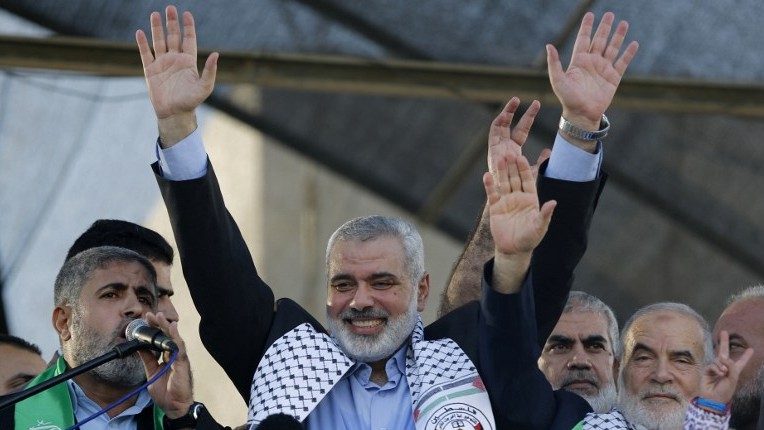
Ismail Haniyeh, named Saturday as head of Hamas, is seen as a charismatic leader from the Gaza streets who represents the so-called pragmatic wing of the terror group.
Though he is considered a more pragmatic voice than some others in the organization, he is no less committed to the Jewish state’s eradication.
He has often threatened Israel in speeches and at rallies, and has praised the killings of Israeli civilians in terror attacks. He has pledged to continue violent opposition to Israel until it is “liberated.”
Haniyeh’s modest home in the narrow alleys of Gaza City’s Shati refugee camp next to the Mediterranean Sea is under constant guard.
Also known as Abu Abed, he was born in the same camp in 1963 to parents who fled when Israel was created in 1948. They had previously lived in Ashkelon, in southern Israel near the border with the Gaza Strip.
Haniyeh, a father of 13, was educated at a UN-run refugee school, later earning an education degree from the Islamic University and becoming a university administrator.
Hamas has frequently highlighted his modest background as a counterpoint to officials within the Palestinian Authority who have been accused of being corrupt and too easily compliant with Israel or the United States.
Haniyeh was jailed several times by Israel during the first intifada, or uprising, which erupted in 1987, and was deported to southern Lebanon in December 1992 along with hundreds of Hamas and Islamic Jihad members.
He first rose to prominence as bureau chief under Hamas’s spiritual father Sheikh Ahmed Yassin, the cleric who advocated suicide bombings against Israel and who was assassinated by Israel in 2004.
Haniyeh escaped assassination in September 2003 when an Israeli aircraft bombed a house where he and Yassin were meeting.
In 2006 he led Hamas to a shock legislative election victory over Abbas’s Fatah and became prime minister. The international community however refused to deal with any government in which Hamas participated until it renounced violence and recognized Israel and past peace agreements, which it has never done.
The resulting deadlock led to mounting friction between Hamas and Fatah which culminated in Hamas’s seizure of Gaza in 2007.
Always dressed impeccably in Western-style suits and a sharp orator, Haniya has exemplified Hamas’s internal struggle between the traditional and the modern, between terrorism and mainstream politics.
An advocate of the right to “resistance,” he advocates that a future Palestinian state should be governed by laws “inspired by sharia.”
In a bid to improve its flagging international standing, Hamas on Monday unveiled a new policy document that presents softened language on Israel while still calling for its destruction. The document, which does not replace Hamas’s founding charter, accepts the idea of a Palestinian state in territories captured by Israel in the Six-Day War of 1967 but dismisses the establishment of the State of Israel as “illegal,” asserting a Palestinian claim to the entire land of Israel, and a so-called right of return for all descendants of refugees.
Israel dismissed the new document as an attempt to “fool the world.”
Hamas officials said the document, which reserves the right to wage “resistance and jihad for the liberation of Palestine,” in no way amounts to recognition of Israel.





The Times of Israel Community.