

IDF to investigate soldier who reportedly threw rocks at journalists
Reporters from Haaretz say they were attacked while documenting proposed site designated for residents to be evacuated from Bedouin hamlet of Khan al-Ahmar
 Add ToI as a Preferred Source on Google
The IDF said Wednesday it will investigate an incident in which a soldier allegedly threw rocks at a team of journalists close to the West Bank village of al-Eizariya while they were documenting the dismantling of a site designated for the evacuated residents of the Bedouin village of Khan al-Ahmar.
The team, from the Haaretz newspaper, said the soldier threw five rocks at them, which did not cause any injuries or damage to equipment.
The journalists said a civilian contractor operating at the site asked them to move locations, at which point they relocated to an adjacent road. They identified themselves as journalists to soldiers operating in the area. Those soldiers were not involved in the incident.
Two workers, one of whom apparently identified themselves as an official from the Civil Administration, reportedly began to curse at the journalists.
The journalists said that shortly after this, a soldier appeared and began to throw rocks at them. They said the perpetrator tried to evade having his picture taken, but that they documented the suspect in a photograph which the journalist later tweeted.
https://twitter.com/yotberg/status/1055014491484835840
The IDF gave a statement to Haaretz saying the soldier “acted contrary to the values expected of him in the IDF, and the incident will be investigated and dealt with by his commanders.”
A security source told the newspaper that workers at the site had recently received threats from Palestinians in the area, including from Palestinian Authority officials who opposed the construction of the new housing, and that therefore tensions were running high there.
https://twitter.com/yotberg/status/1055014494840209409
Israel last week indefinitely pushed off the razing of Khan al-Ahmar, giving no date for when a decision would be made on whether to move ahead with the demolition.
The Prime Minister’s Office said the delay was to allow more time for talks with residents of the hamlet and to consider proposals regarding the village’s fate. Army Radio reported Sunday the decision was due to an offer from residents to voluntarily relocate to a nearby site.
Last month, the High Court rejected a final appeal from residents, and authorities have since been preparing to flatten the hamlet and transfer the residents several miles east near the Palestinian town of Abu Dis, close to al-Eizariya, in a move that has drawn international condemnation of Israel.
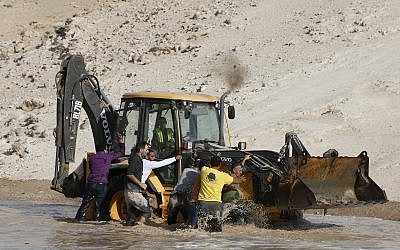
That relocation site is hooked up to water, electricity and sewage and has a school constructed from falafel oil and mud-caked tires, which has become a symbol for the village as it to replace the current Italian-funded institution.
But residents of Khan al-Ahmar — 180 in number, according to the United Nations — have vehemently opposed moving there, saying that they were never consulted, the location is unsuitable for their rural way of life and is next to a garbage dump, and residents of Abu Dis have warned them to stay away.
They have similarly been uninterested in a second relocation site proposed to them by the state two months ago adjacent to the nearby settlement of Mitzpe Jericho as well as to a sewage treatment facility.
Israel argues that Khan al-Ahmar was built illegally and its homes are dangerously close to a highway, and emphasizes that the demolition has been approved by the country’s independent courts.
The villagers — who have lived at the site, then controlled by Jordan, since the 1950s, after the state evicted them from their Negev homes — argue that they had little alternative but to build without Israeli construction permits, as such permits are almost never issued to Palestinians for building in parts of the West Bank, such as where Khan al-Ahmar lies, where Israel exerts full control over civilian affairs.
They also argue that the demolition is part of an effort to enable the expansion of the nearby settlement of Kfar Adumim, and to create a region of Israeli control from Jerusalem almost to the Dead Sea, a move critics say will bisect the West Bank, making a contiguous Palestinian state impossible.









The Times of Israel Community.