Images show rings of Neptune, solar system’s outermost planet, with dazzling clarity
Pictures taken by James Webb Space Telescope show not only planet’s thin rings, but also faint dust bands, never before observed in the infrared, as well as 7 of its 14 known moons
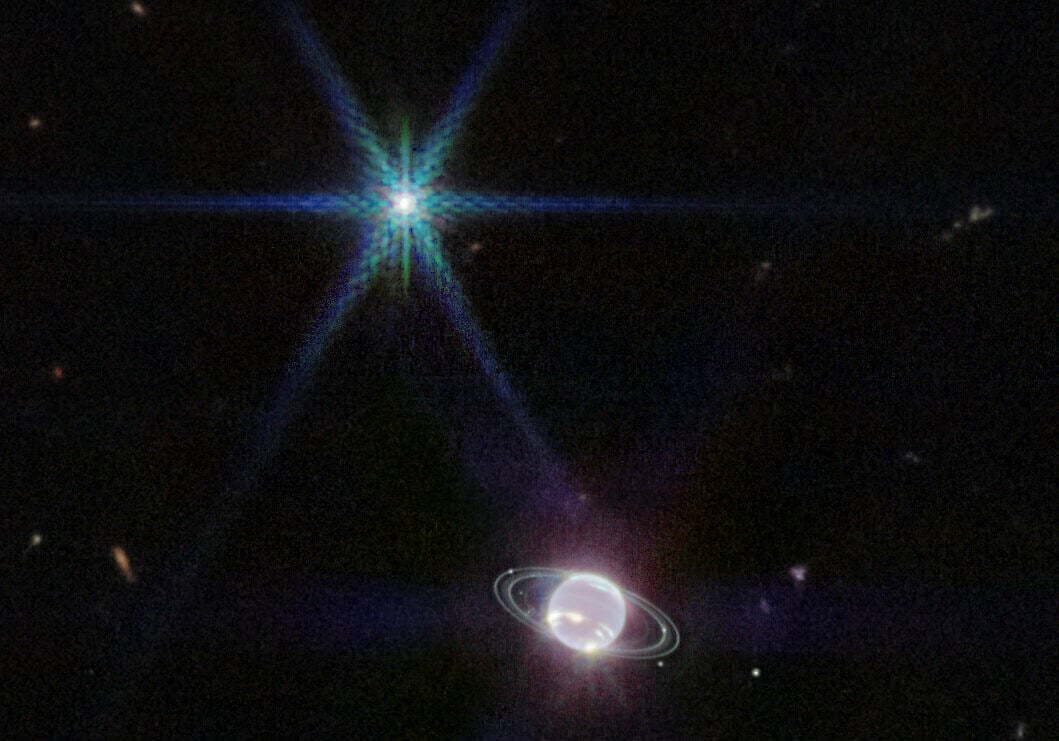
This image provided by NASA on September 21, 2022, shows the Neptune system captured by Webb’s Near-Infrared Camera, revealing the planet’s rings, which have not been seen with this clarity in more than three decades. (NASA, ESA, CSA, STScI via AP)
CAPE CANAVERAL, Florida (AP) — Neptune and its rings haven’t looked this good in decades.
NASA released new glamour shots of our solar system’s outermost planet Wednesday taken by the James Webb Space Telescope. The pictures taken in July show not only Neptune’s thin rings, but its faint dust bands, never before observed in the infrared, as well as seven of its 14 known moons.
Webb showed Jupiter at its best in a series of fresh photos released last month.
Launched less than a year ago, the $10 billion Webb is spending most of its time peering much deeper into the universe. Astronomers hope to see back to almost the beginning of time when the first stars and galaxies were forming.
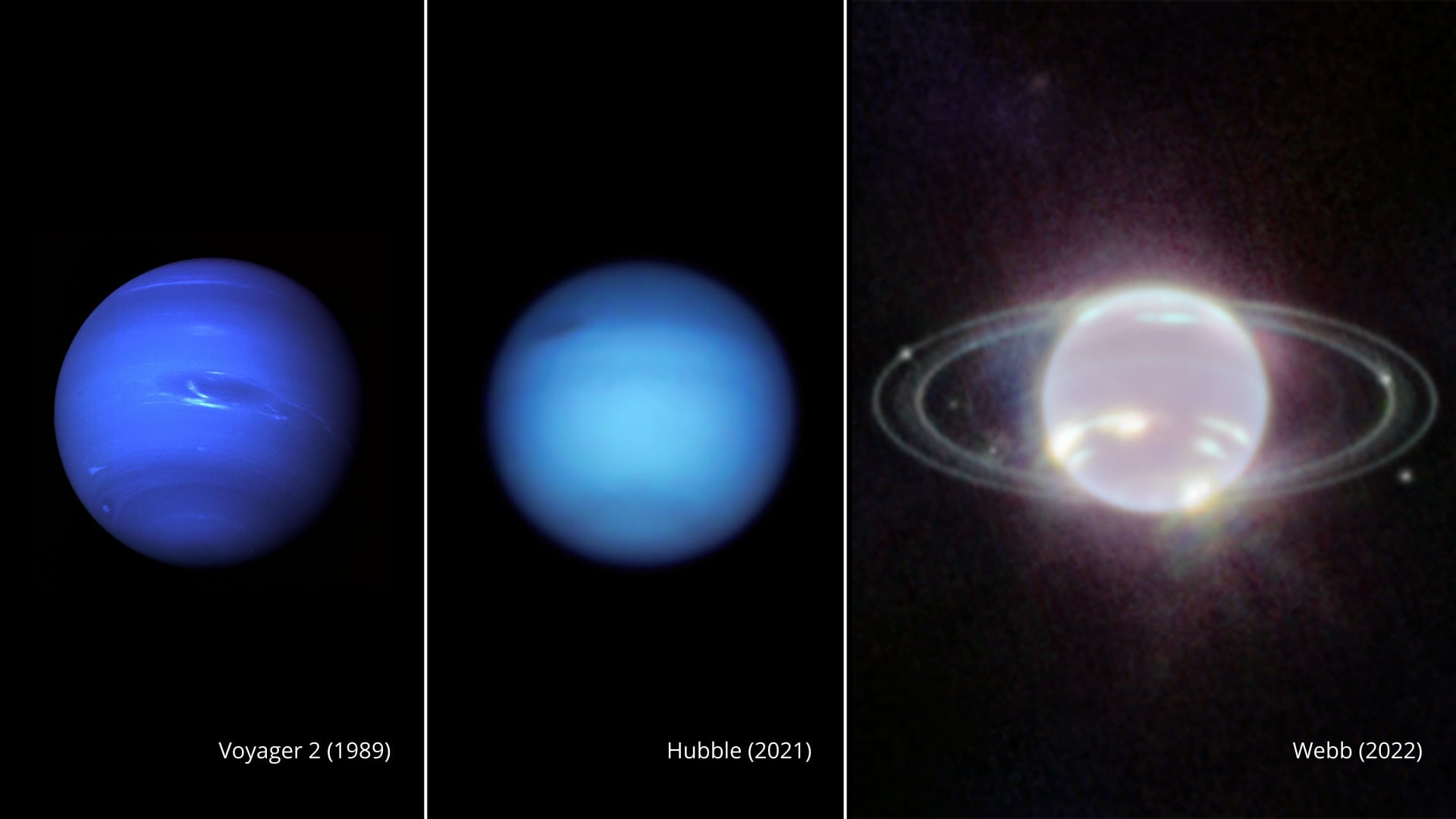
NASA’s Voyager 2 was the first spacecraft to see Neptune in all its gaseous glory, during a 1989 flyby. No other spacecraft have visited the icy, blue planet. So it’s been three decades since astronomers last saw these rings with such detail and clarity, said the Space Science Institute’s Heidi Hammel, a planetary astronomer working with Webb.
Get The Times of Israel's Daily Editionby email and never miss our top stories
Hammel tweeted that she wept when she saw the rings, yelling and making “my kids, my mom, even my cats look.”
This composite image provided by NASA on Sept. 21, 2022, shows three side-by-side images of Neptune. From left, a photo of Neptune taken by Voyager 2 in 1989, Hubble in 2021, and Webb in 2022. In visible light, Neptune appears blue due to small amounts of methane gas in its atmosphere. Webb’s Near-Infrared Camera instead observed Neptune at near-infrared wavelengths, where Neptune resembles a pearl with thin, concentric oval rings. (NASA, ESA, CSA, STScI via AP)
Webb is the world’s biggest, most powerful telescope, operating 1 million miles (1.6 million kilometers) from Earth. It rocketed into space last December.
The observatory is in good health, according to NASA, except for one item.
Advertisement
NASA reported this week that a mechanism on one of Webb’s instruments showed signs of increased friction late last month in one of four observing modes.
Observations are on hold in this one particular observing track, as a review board decides on a path forward.
Help us report truthfully on social media
As a multimedia journalist, my job is to take the quality, fact-based journalism produced by The Times of Israel newsroom and make it accessible across every platform — from Instagram posts to podcasts to short-form videos.
This is how many, especially young people, consume news these days. But misinformation is rampant on social media. Our team at ToI produces accurate, responsible short-form reporting on Israel and the Jewish world.
If you believe in the importance of factual social media journalism, please consider joining our reader support group, The Times of Israel Community. Your financial support is essential to sustain responsible multimedia reporting.
We’re really pleased that you’ve read X Times of Israel articles in the past month.
That’s why we started the Times of Israel - to provide discerning readers like you with must-read coverage of Israel and the Jewish world.
So now we have a request. Unlike other news outlets, we haven’t put up a paywall. But as the journalism we do is costly, we invite readers for whom The Times of Israel has become important to help support our work by joining The Times of Israel Community.
For as little as $6 a month you can help support our quality journalism while enjoying The Times of Israel AD-FREE, as well as accessing exclusive content available only to Times of Israel Community members.
Thank you, David Horovitz, Founding Editor of The Times of Israel


 Add ToI as a Preferred Source on Google