Sue Surkes is The Times of Israel's environment reporter
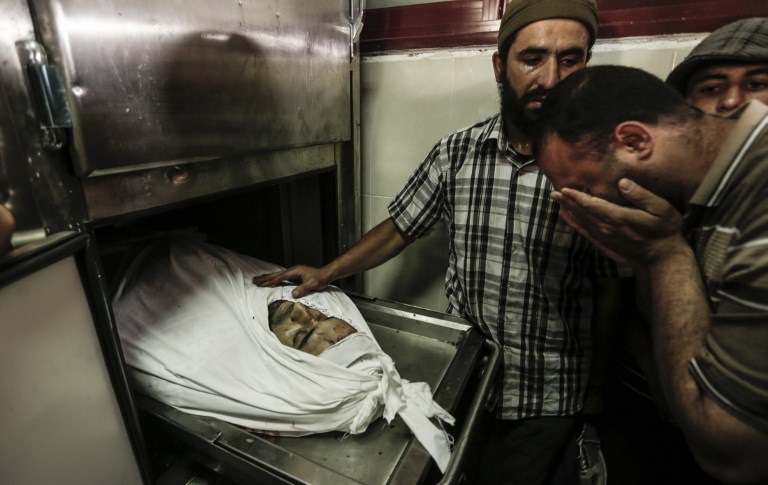
A Palestinian man mourns near the body of Mohammed al-Radeia, 30, prior to his funeral in Beit Lahia in the northern Gaza Strip on May 28, 2018. The Palestinian man was killed by Israeli tank fire into northern Gaza earlier in the day, the health ministry in the Hamas-run enclave said. An Israeli army spokeswoman told AFP that two Palestinian men tried to breach the border fence "with the intention of carrying out an attack." (AFP PHOTO / MAHMUD HAMS)
The Palestinian Islamic Jihad terror organization, which the IDF blamed for barrages of at least 28 mortar shells at Israeli communities near the Gaza Strip on Tuesday morning, said the attack on Israel was a “welcome response by the resistance.”
“Our people’s blood is not cheap,” the group added in a statement.
The shells, one of which landed next to a kindergarten, apparently came in response to the Israeli army’s killing three of its members in a cross-border exchange earlier in the week.
Israel’s Iron Dome missile defense system intercepted most of the projectiles. Nobody was hurt and no damage was caused.
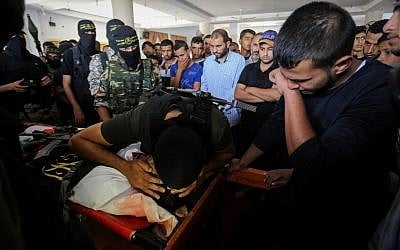
Family and friends mourn near the body of Islamic Jihad militiaman Hussein al-Amour during his funeral in Khan Younis, southern Gaza Strip, on May 27, 2018. Al-Amour was killed during an Israeli strike earlier the day. (Abed Rahim Khatib/Flash90)
It is the policy of the Israel Defense Forces and the government to hold the Strip’s rulers, the terror group Hamas, responsible for all attacks on Israel, regardless of whether other groups launched them.
Get The Times of Israel's Daily Editionby email and never miss our top stories
Hamas, like Islamic Jihad, is committed to the destruction of Israel.
On Tuesday, the military responded to the mortar attack by shelling a number of positions belonging to terrorist groups in the Gaza Strip, Palestinian media reported.
The army would not immediately confirm it had conducted retaliatory strikes. Additional reprisal raids were expected, in accordance with Israel’s standard policies regarding attacks from Gaza.
Advertisement
Help us report truthfully on social media
As a multimedia journalist, my job is to take the quality, fact-based journalism produced by The Times of Israel newsroom and make it accessible across every platform — from Instagram posts to podcasts to short-form videos.
This is how many, especially young people, consume news these days. But misinformation is rampant on social media. Our team at ToI produces accurate, responsible short-form reporting on Israel and the Jewish world.
If you believe in the importance of factual social media journalism, please consider joining our reader support group, The Times of Israel Community. Your financial support is essential to sustain responsible multimedia reporting.
We’re really pleased that you’ve read X Times of Israel articles in the past month.
That’s why we started the Times of Israel - to provide discerning readers like you with must-read coverage of Israel and the Jewish world.
So now we have a request. Unlike other news outlets, we haven’t put up a paywall. But as the journalism we do is costly, we invite readers for whom The Times of Israel has become important to help support our work by joining The Times of Israel Community.
For as little as $6 a month you can help support our quality journalism while enjoying The Times of Israel AD-FREE, as well as accessing exclusive content available only to Times of Israel Community members.
Thank you, David Horovitz, Founding Editor of The Times of Israel


 Add ToI as a Preferred Source on Google