

 From the Liveblog of
Thursday, February 11, 2016
From the Liveblog of
Thursday, February 11, 2016
Scientists glimpse Einstein’s gravitational waves
 Add ToI as a Preferred Source on Google
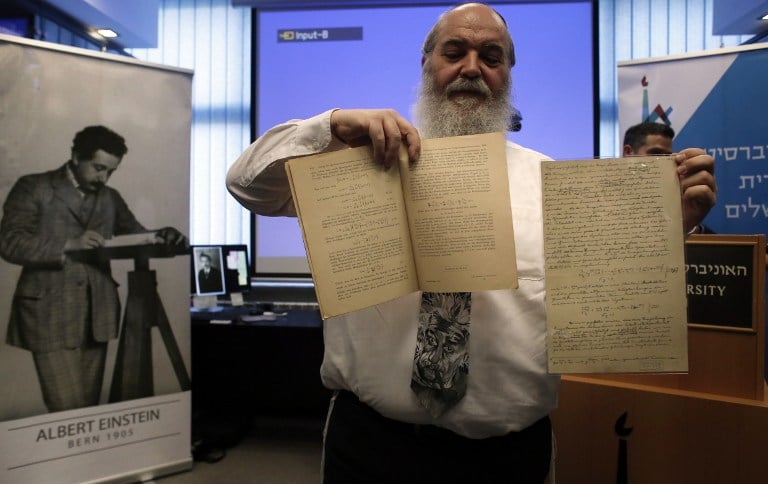
In a landmark discovery for physics and astronomy, international scientists say they have glimpsed the first direct evidence of gravitational waves, or ripples in space-time, which Albert Einstein predicted a century ago.
When two black holes collided some 1.3 billion years ago, the joining of those two great masses sent forth a wobble that hurtled through space and arrived at Earth on September 14, 2015, when it was picked up by sophisticated instruments, researchers announce.
“Like Galileo first pointing his telescope upward, this new view of the sky will deepen our understanding of the cosmos, and lead to unexpected discoveries,” says France Cordova, director of the US National Science Foundation, which funded the work.
The phenomenon was observed by two US-based underground detectors, designed to spot tiny vibrations from passing gravitational waves, a project known as the Laser Interferometer Gravitational-wave Observatory, or LIGO.
It took scientists months to verify their data and put it through a process of peer-review before announcing it, marking the culmination of decades of efforts by teams around the world.
“LIGO has ushered in the birth of an entirely new field of astrophysics,” says Cordova.
Gravitational waves are a measure of strain in space, an effect of the motion of large masses that stretches the fabric of space-time — a way of viewing space and time as a single, interweaved continuum.
They travel at the speed of light and cannot be stopped or blocked by anything.
Einstein said space-time could be compared to a net, bowing under the weight of an object. Gravitational waves would be like ripples that emanate from a pebble thrown in a pond.
While scientists have previously been able to calculate gravitational waves, they had never before seen one directly.
— AFP










The Times of Israel Community.