Mattis on taking action in Syria: ‘I don’t rule anything out’
US secretary of defense says he will consult with allies and partners, questions how Damascus regime still has chemical weapons if Russia guaranteed stockpiles would be removed
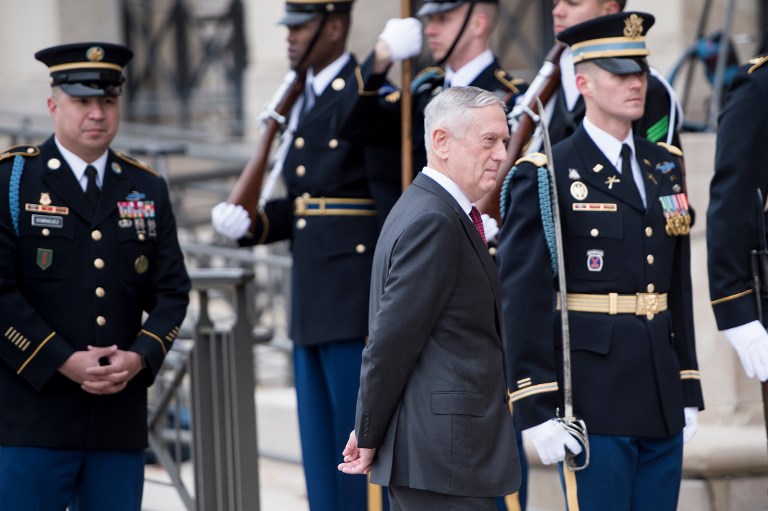
US Secretary of Defense James Mattis awaits the arrival of Qatar's Emir Sheikh Tamim Bin Hamad Al-Thani during an honor cordon at the Pentagon in Washington, DC, April 9, 2018. (Brendan Smialowski)
WASHINGTON, United States — US Defense Secretary Jim Mattis on Monday pointed toward Russia’s role in a suspected poison gas attack on the Syrian rebel-held town of Douma, and said he would not rule out a military response.
Russia was supposed to guarantee the disposal of Syria’s stockpile of chemical weapons in September 2013, but Syrian President Bashar Assad’s regime is suspected of conducting repeated gas attacks since then.
“The first thing we have to look at is why are chemical weapons still being used at all when Russia was the framework guarantor of removing all the chemical weapons,” Mattis said at the Pentagon in a meeting with his Qatari counterpart.
“Working with our allies and our partners from NATO to Qatar and elsewhere, we are going to address this issue … I don’t rule out anything right now.”
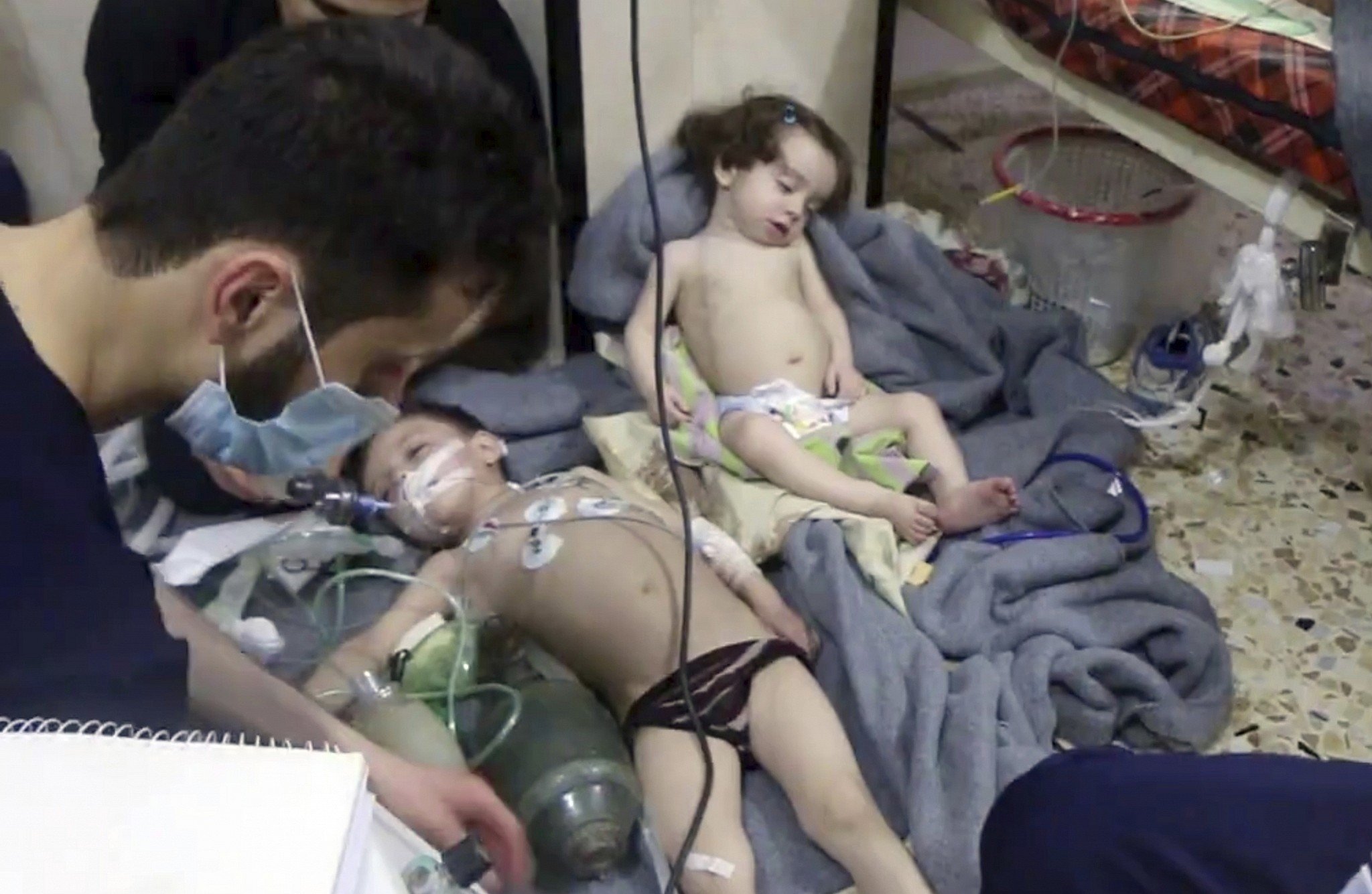
Medical workers treating toddlers following an alleged poison gas attack in the opposition-held town of Douma, in eastern Ghouta, near Damascus, Syria, Sunday, April. 8, 2018 (Syrian Civil Defense White Helmets via AP)
Syria has been accused multiple times of using toxic weapons including sarin gas in the country’s seven-year war, which has killed more than 350,000 people.
Get The Times of Israel's Daily Editionby email and never miss our top stories
Backed by Moscow, Assad has waged a seven-week assault on Ghouta that has killed more than 1,700 civilians and left Islamist rebels cornered in their last holdout of Douma, Ghouta’s largest town.
Dozens of people died April 4, 2017, after regime warplanes struck the rebel-held town of Khan Sheikhun in Idlib, with medical sources reporting patients suffering from symptoms consistent with a chemical attack. In retaliation for that attack, US President Donald Trump unleashed strikes by Tomahawk missiles against the regime’s Shayrat airbase overnight April 6-7.

Advertisement
We can't do this work alone.
The war with Iran has been draining for all of us in Israel. But when I heard about a high casualty incident – ballistic missile impacts in Arad and Dimona that left nearly 200 people wounded – I drank a cup of coffee, packed a bag, and headed south.
There, I spoke with Shilgit, the head of an after-school program for underprivileged youth. Standing outside her destroyed center, Shilgit said it was a miracle that no children were hurt and spoke about the community coming together in the hours since.
As a Times of Israel reporter, I’m committed to telling stories of resilience like Shilgit’s. But my colleagues and I can't do this alone. If you value work like this,please consider joining our reader support group, The Times of Israel Community. Your financial support is essential to keep real human reporting like this going.
We’re really pleased that you’ve read X Times of Israel articles in the past month.
That’s why we started the Times of Israel - to provide discerning readers like you with must-read coverage of Israel and the Jewish world.
So now we have a request. Unlike other news outlets, we haven’t put up a paywall. But as the journalism we do is costly, we invite readers for whom The Times of Israel has become important to help support our work by joining The Times of Israel Community.
For as little as $6 a month you can help support our quality journalism while enjoying The Times of Israel AD-FREE, as well as accessing exclusive content available only to Times of Israel Community members.
Thank you, David Horovitz, Founding Editor of The Times of Israel