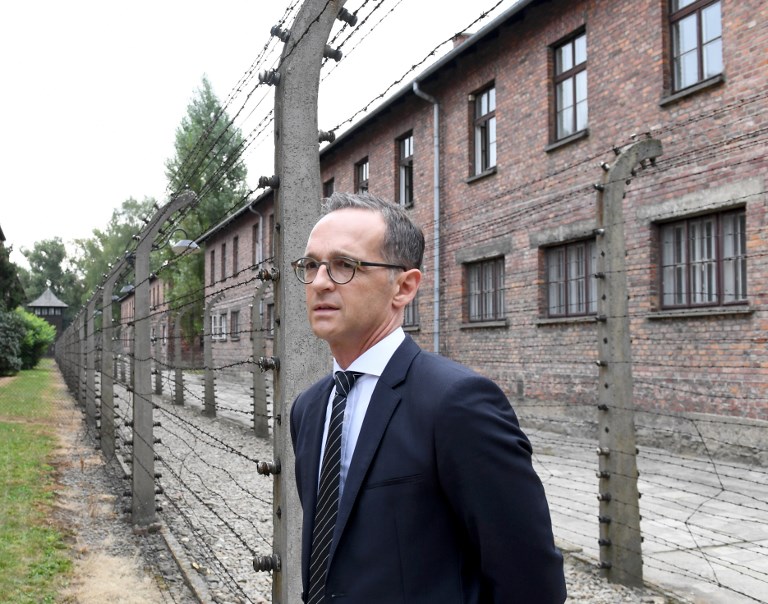
German Foreign Minister Heiko Maas passes a barbed wire fence in the former German concentration camp Auschwitz on August 20, 2018. (AFP PHOTO / JANEK SKARZYNSKI)
OSWIECIM, Poland — German Foreign Minister Heiko Maas on Monday visited the former Nazi-German death camp Auschwitz-Birkenau, which he called “the most horrible place on earth.”
Maas has often said that the site which Nazi Germany installed in occupied Poland during World War II inspired him to go into politics.
“I saw thousands of children’s shoes that were taken off them on their way to the gas chamber, tons of human hair that was taken from people before they were sent to the gas chamber,” Maas said after visiting the site in the southern Polish city of Oswiecim.
“This is the most horrible place on earth. And it is here where you have to make a choice: either you lose all faith in humanity, or you gain the hope and the strength to stand up for human dignity and to work for it,” he added.
“This is a place of remembrance that reminds us Germans above all of what we did to millions of people. We need this place because our responsibility will never end.”
Get The Times of Israel's Daily Editionby email and never miss our top stories
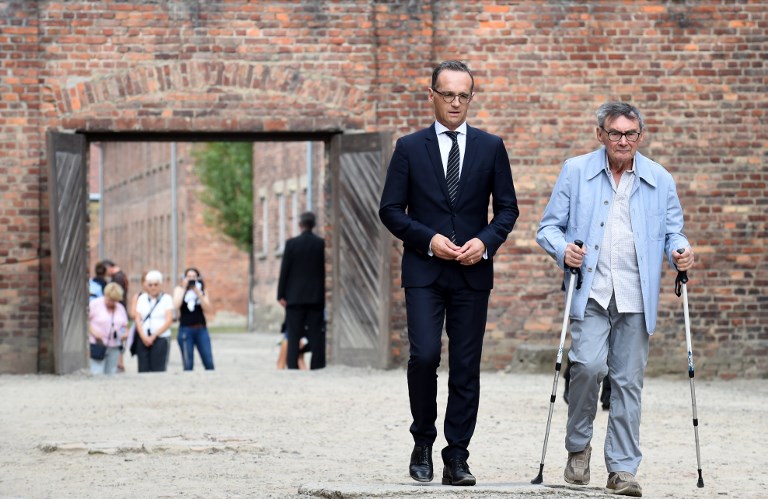
German Foreign Minister Heiko Maas and Marian Turski (R), a former inmate of Auschwitz and chairman of the Jewish Historical Institute in Warsaw walk to the death wall in the former German concentration camp Auschwitz on August 20, 2018. (AFP PHOTO / JANEK SKARZYNSKI)
Auschwitz-Birkenau has become a symbol of Nazi Germany’s genocide of European Jews, one million of whom were killed at the camp between 1940 to 1945.
More than 100,000 others, including non-Jewish Poles, Roma, Soviet prisoners of war and anti-Nazi resistance fighters, also died there.
Later Monday, Maas will hold talks with Polish counterpart Jacek Czaputowicz at the Maximilian Kolbe Center, a spiritual site in the nearby village of Harmeze.
Advertisement
Kolbe was a Polish priest who died at Auschwitz after taking the place of a condemned man. He was made a saint by the Catholic Church in 1982.
Help us report truthfully on social media
As a multimedia journalist, my job is to take the quality, fact-based journalism produced by The Times of Israel newsroom and make it accessible across every platform — from Instagram posts to podcasts to short-form videos.
This is how many, especially young people, consume news these days. But misinformation is rampant on social media. Our team at ToI produces accurate, responsible short-form reporting on Israel and the Jewish world.
If you believe in the importance of factual social media journalism, please consider joining our reader support group, The Times of Israel Community. Your financial support is essential to sustain responsible multimedia reporting.
We’re really pleased that you’ve read X Times of Israel articles in the past month.
That’s why we started the Times of Israel - to provide discerning readers like you with must-read coverage of Israel and the Jewish world.
So now we have a request. Unlike other news outlets, we haven’t put up a paywall. But as the journalism we do is costly, we invite readers for whom The Times of Israel has become important to help support our work by joining The Times of Israel Community.
For as little as $6 a month you can help support our quality journalism while enjoying The Times of Israel AD-FREE, as well as accessing exclusive content available only to Times of Israel Community members.
Thank you, David Horovitz, Founding Editor of The Times of Israel


 Add ToI as a Preferred Source on Google