

Netanyahu rules out immunity law that affects ongoing probes
Amid clash with Jewish Home party, Likud ministers flog coalition whip Bitan for his handling of controversial legislation
 Add ToI as a Preferred Source on Google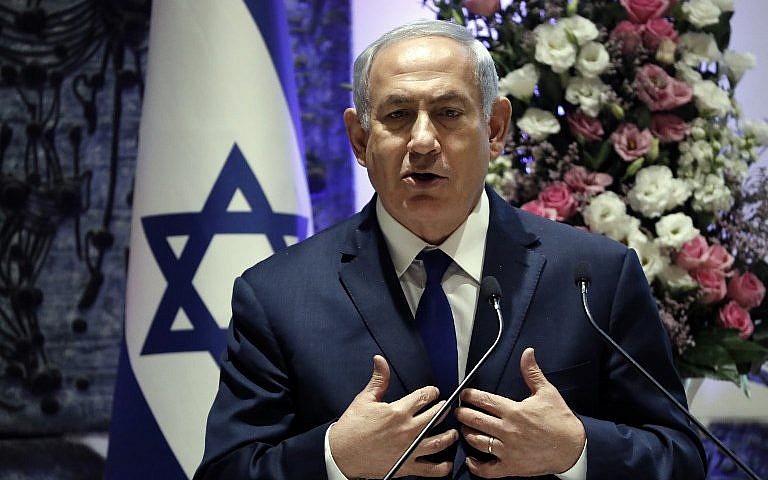
With coalition parties at odds over his party’s efforts to advance the so-called “French Law” granting serving prime ministers immunity from corruption investigations, Benjamin Netanyahu said Sunday he is “not interested” in legislation that could have an effect on a pair of investigations involving him.
“Regarding the French Law, I am stating here clearly: I am not interested in any law relating to ongoing investigations involving me or ones that don’t relate to me,” the prime minister said at a meeting of Likud ministers, in his first public statement on the initiative. Last week he declined repeated requests to comment on the proposal.
Netanyahu’s comments regarding the law came as the coalition was beset by infighting over the bill, which coalition chairman David Bitan (Likud) has vowed to advance despite the opposition of the Jewish Home party.
During Sunday’s meeting, Likud ministers Ze’ev Elkin and Yuval Steinitz strongly criticized Bitan’s handling of the bill, accusing him of imperiling the coalition and imploring him to solve the matter behind closed doors, according to Hebrew media reports.
Bitan has been outspoken in his criticism of Jewish Home for not supporting the proposed legislation, and in an interview with Army Radio on Sunday accused the party of violating an agreement between them to support the bill.
He also said Jewish Home was using the flareup over the bill for “public relations, at the expense of Likud.”

As part of the ongoing coalition crisis over the legislation, a ministerial panel whose job is to fast-track legislation through the Knesset, set to meet Sunday, will not convene for the second week in a row.
Bitan said the Ministerial Committee for Legislation, chaired by Justice Minister Ayelet Shaked of Jewish Home, would not consider bill proposals after a coordination conference call Saturday night broke down over opposition to the immunity bill.
The bill is intended to prevent sitting prime ministers from having to deal with investigations into their affairs during their terms, leaving them able to focus on the business of governing the country. Its current draft excludes from its protections any investigation already launched, and so would not protect Prime Minister Benjamin Netanyahu from ongoing probes into him.
Critics, including Attorney General Avichai Mandelblit and many lawmakers, have said the measure would place prime ministers above the law for years at a time, making them more likely to act unethically while they occupy the highest office in government. Fears have also been raised that provisions protecting Netanyahu himself could be added to the bill in committee after it passes its first readings in the plenum.
When Jewish Home refused to back the legislation during the conference call Saturday night, a decision was made to freeze all pending legislation until further notice, Bitan, the coalition whip, said. “We won’t advance any coalition bills, like last week,” if Jewish Home won’t vote for the bill, he told the Walla news site.
On October 22, Bitan froze the committee’s work as he attempted to fend off criticism of the bill from several coalition members.
Another piece of legislation that was initially slated to come to a vote in the committee on Sunday, on extending Jerusalem’s municipal boundaries to include several West Bank settlements, was taken off the agenda on Saturday, as Israel sought to avoid a clash with the US administration over the move.

Likud MK David Amsalem, the bill’s sponsor, told Channel 2 news Saturday that the legislation would go ahead without Jewish Home’s support, accusing the hawkish party of failing to live up to its coalition agreements and claiming support from Finance Minister Moshe Kahlon of Kulanu, a strident critic of the legislation.
Nevertheless, the Jewish Home party was adamant there would be no vote Sunday.
“Because this is a [quasi-constitutional] Basic Law, it can’t advance without our support,” sources in the party said. “There was a clear agreement that the bill would not come up now, and so, tomorrow it will also not come up for a vote.”
According to a letter sent Wednesday from Jewish Home’s Knesset faction chair, MK Shuli Moalem-Refaeli, to Bitan, Jewish Home’s decision to oppose the bill followed a “substantive and detailed discussion” in the faction meeting on Monday.
“The discussion revealed significant disagreements between members of the faction, and no agreement was reached,” she wrote. In light of that disagreement, Jewish Home decided to formally oppose the bill’s passage, Moalem-Refaeli said.

According to the agreements that underpin the current ruling coalition, no changes to Israel’s quasi-constitutional Basic Laws can be passed without the agreement of all six coalition parties, giving each coalition partner a veto over such bills. Amsalem’s bill is just such an amendment to the Basic Law: The Government.
The proposed legislation comes as Netanyahu is being investigated in two corruption cases.
Earlier this month, it was reported that police were deepening their investigations into the actions of the prime minister and that he will be summoned soon for questioning in the two investigations against him, cases 1000 and 2000.
Case 1000 relates to allegations that Netanyahu and his wife, Sara, received illicit gifts from billionaire benefactors, most notably hundreds of thousands of shekels’ worth of cigars and champagne from the Israeli-born Hollywood producer Arnon Milchan.
Case 2000 involves a suspected illicit quid-pro-quo deal between Netanyahu and Yedioth Ahronoth newspaper publisher Arnon Mozes that would have seen the prime minister hobble a rival daily, the Sheldon Adelson-backed Israel Hayom, in return for more favorable coverage from Yedioth.
The prime minister denies any wrongdoing in either case.
Investigators are also expected to set a date for Netanyahu to provide testimony as a witness in Case 3000, which involves suspected corruption by several associates of the prime minister in the sale of German submarines to Israel. Though Netanyahu is not a suspect in the submarines case, his critics have accused him of pushing the prime minister immunity bill in order to ensure that he won’t be made one in the future.







The Times of Israel Community.