

NYC Hinds Hall Palestinian eatery has good hummus, wipes Israel off its menu maps
Upper West Side restaurant named for child killed in Gaza leans into ostensible message of coexistence with Jews, but not with the Jewish state, associating with the anti-Zionist protest movement

 Add ToI as a Preferred Source on Google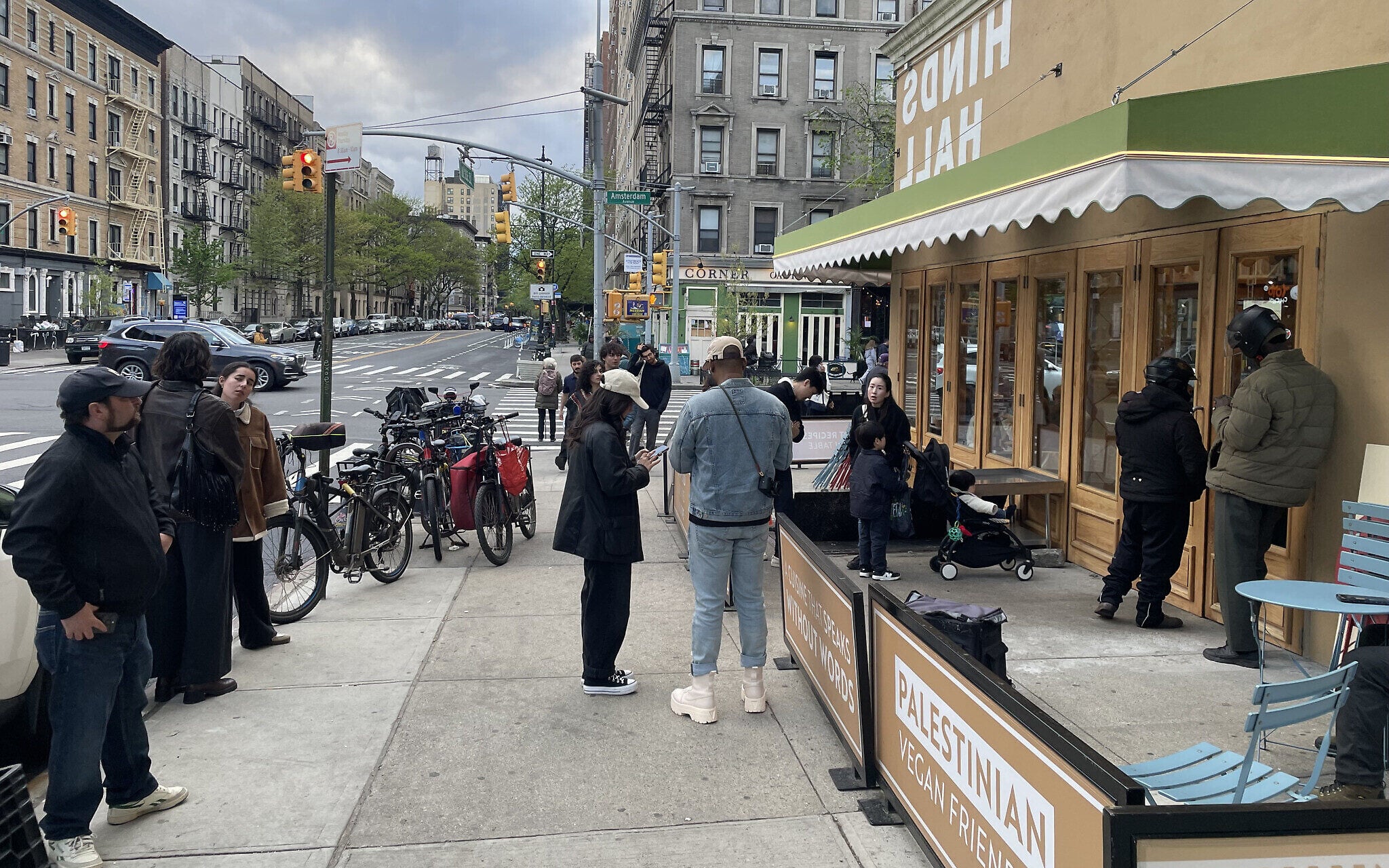
NEW YORK — Diners packed into Hinds Hall on the Upper West Side, munching on Middle Eastern dishes such as zahir, maklouba, and kibbeh. A line formed outside, as guests waited for seating in the April chill, and delivery drivers stopped by to pick up orders. Cooks toiled in the open kitchen behind the concrete bar, beneath jugs of Sultan olive oil lined up on shelves.
The Palestinian restaurant opened last month, the latest installation of the Ayat chain’s eight branches around the city and the first Palestinian restaurant in the neighborhood. The chain markets itself as a warm redoubt for Palestinians and their supporters, including Jews. A sign out front says, “Muslims * Jews * Christians. Whatever your belief is we are all human.”
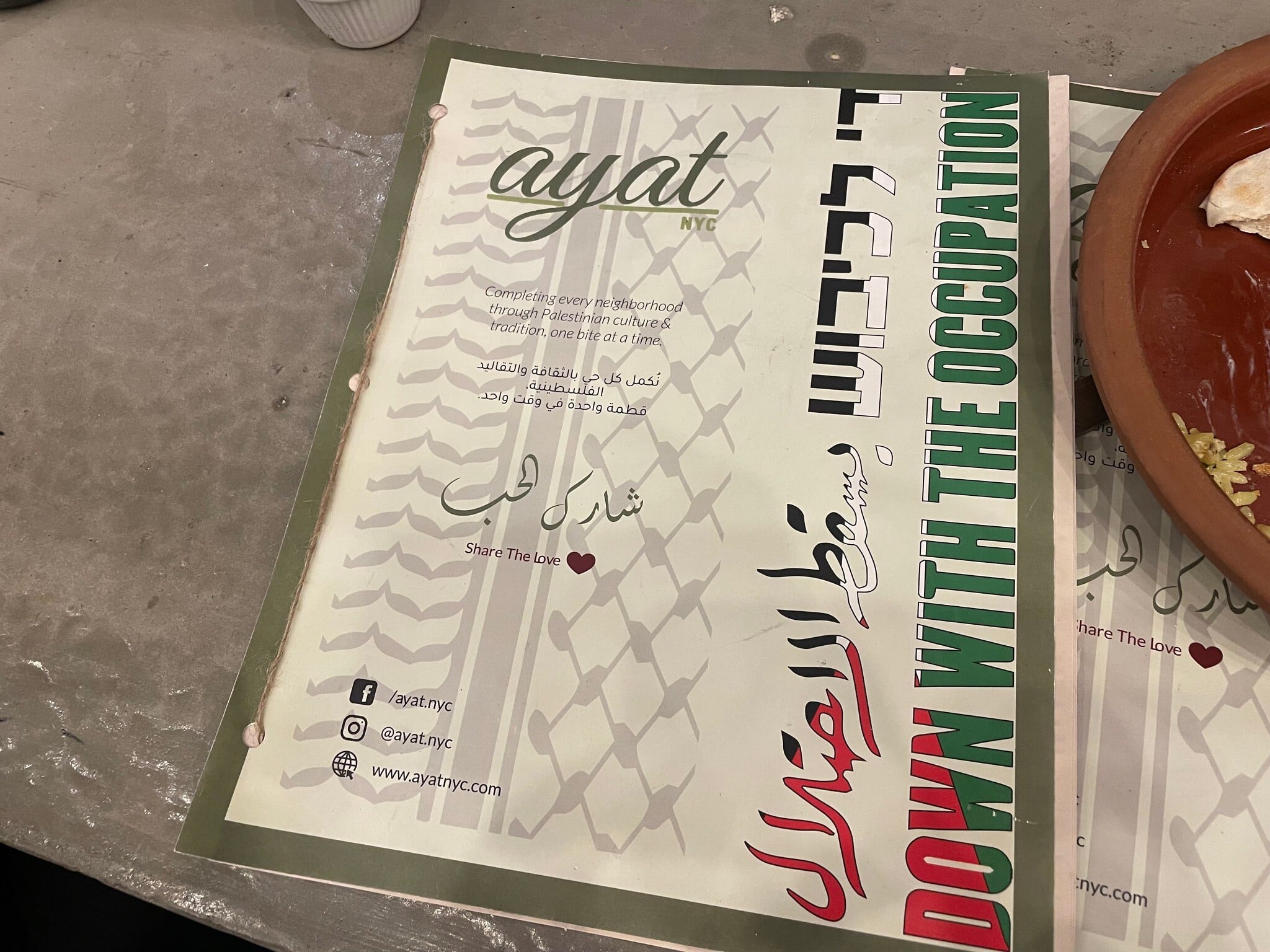
The menu’s front page reads, “Down with the occupation,” in English, Arabic, and Hebrew. Bold letters on the interior walls say, “Resilience,” “Freedom,” and “Save our children.”
“Community dinners, charitable initiatives, and creating spaces where everyone feels welcome are central to who we are,” the menu says. “At Ayat, the table is open to all.”
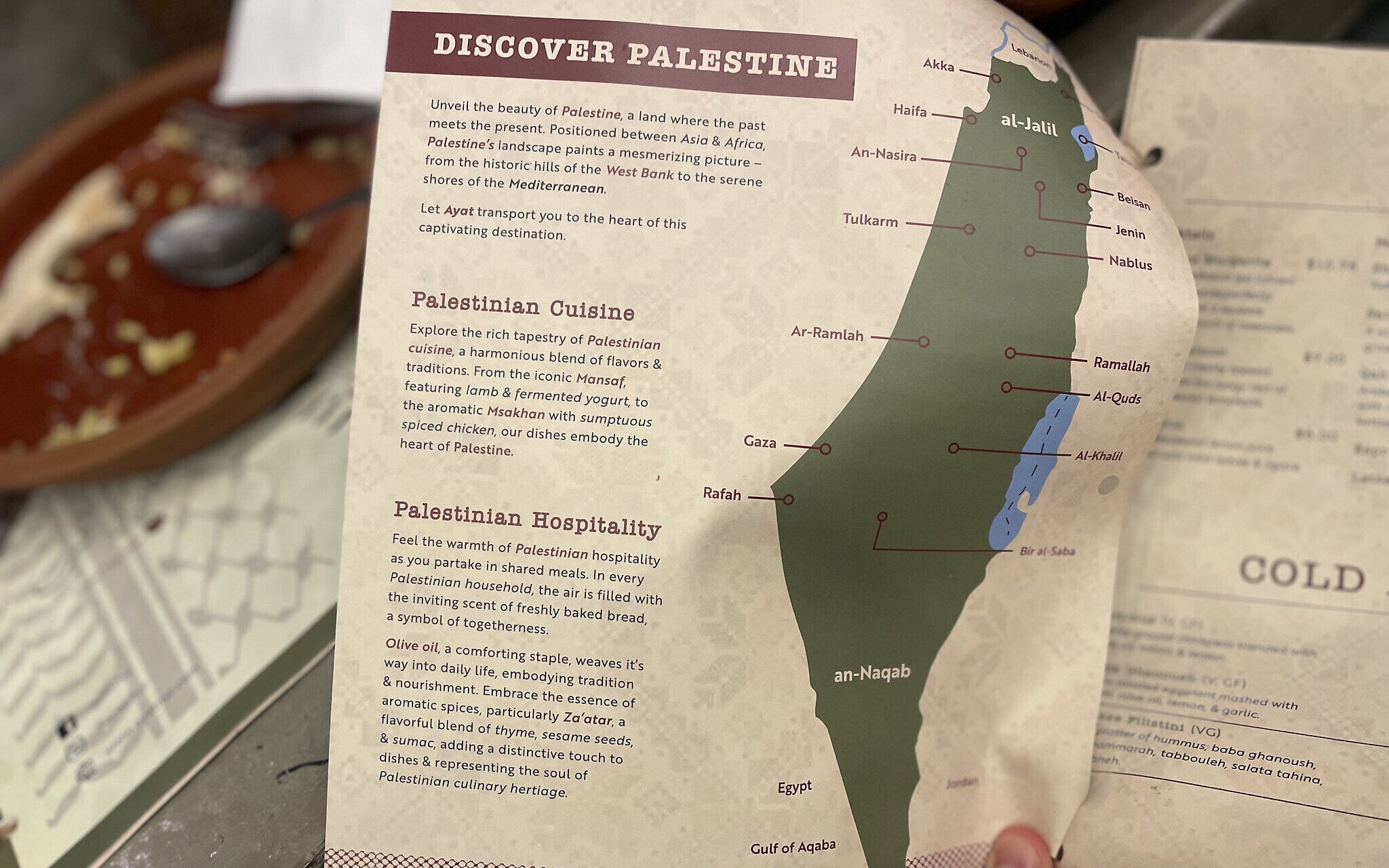
The menu also includes a map that brands the whole territory — the West Bank, Gaza, Jerusalem, and the rest of Israel — as Palestine. The cities are labeled with their Arabic names, and Jewish cities, such as Tel Aviv and Eilat, have been wiped from the map.
The seafood section of the menu is titled, “From the rind to the seed,” a play on the protest chant, “From the river to the sea, Palestine will be free,” itself a euphemism of the Arabic slogan, “From the water to the water, Palestine is Arab.”
However, the chain’s founder, Egyptian-American Abdul Elenani, has leaned into coexistence, organizing a free Shabbat dinner in 2024 that was attended by hundreds. The chain is named for Elenani’s wife, who is Palestinian-American.
The messaging has been a success. The expanding chain is planning two new locations, in Philadelphia and Washington, DC, according to its website, and the Upper West Side spot, in a neighborhood with a large Jewish population, is often packed. The crowd is mostly younger, the mood is upbeat, and the staff is friendly and attentive.
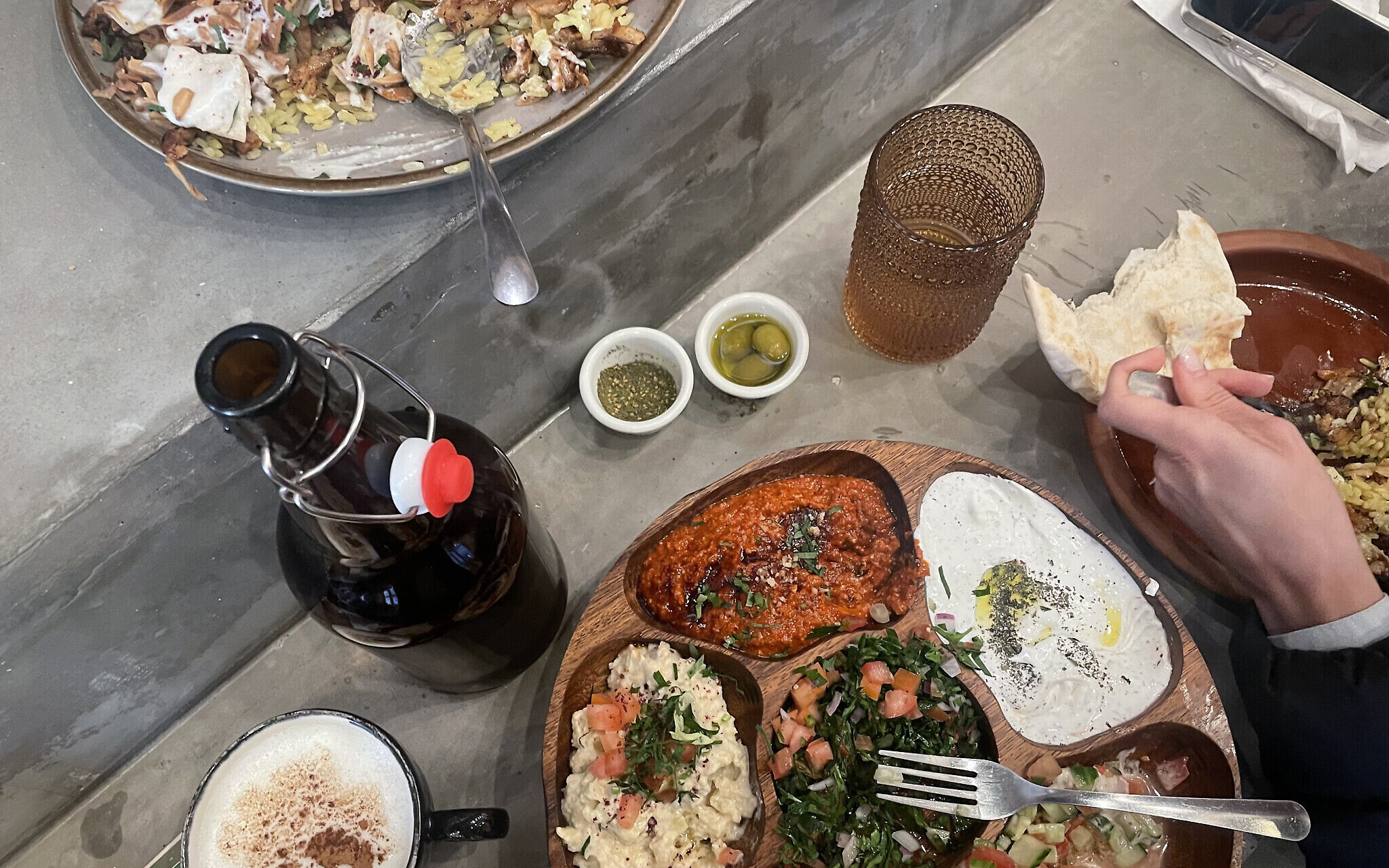
The offerings are also good — the sahlav, a chai-like drink, is soothing on a chilly day, and a platter called mezze Filistini serves up sizable portions of hummus, baba ghanoush, muhammarah, tabbouleh, and labneh. The fattat jaj entrée balances creamy mint yogurt and garlic sauce with the crunch of almond slivers and toasted pita bites, on top of roasted chicken, rice and chickpeas.
Hind Forever
The restaurant’s sunny demeanor, Middle Eastern seasonings, and outreach to Jews mark a more welcoming front for Palestinian supporters, including Jews, than other bastions of the anti-Israel movement in New York. At street protests against Israel, the mood is darker and more aggressive, and violent rhetoric and support for terror groups are common.
Despite those attributes, the restaurant is unlikely to break new ground when it comes to coexistence or host any hard conversations.

The Upper West Side branch, unlike the other locations, is named Hinds Hall, a reference to Hind Rajab, a 5-year-old Palestinian girl killed in Gaza who has become a symbol. “Hinds Hall” is on the building facade in bold letters and “Hind Forever” is written on the interior wall, alongside patterns that resemble a keffiyeh.
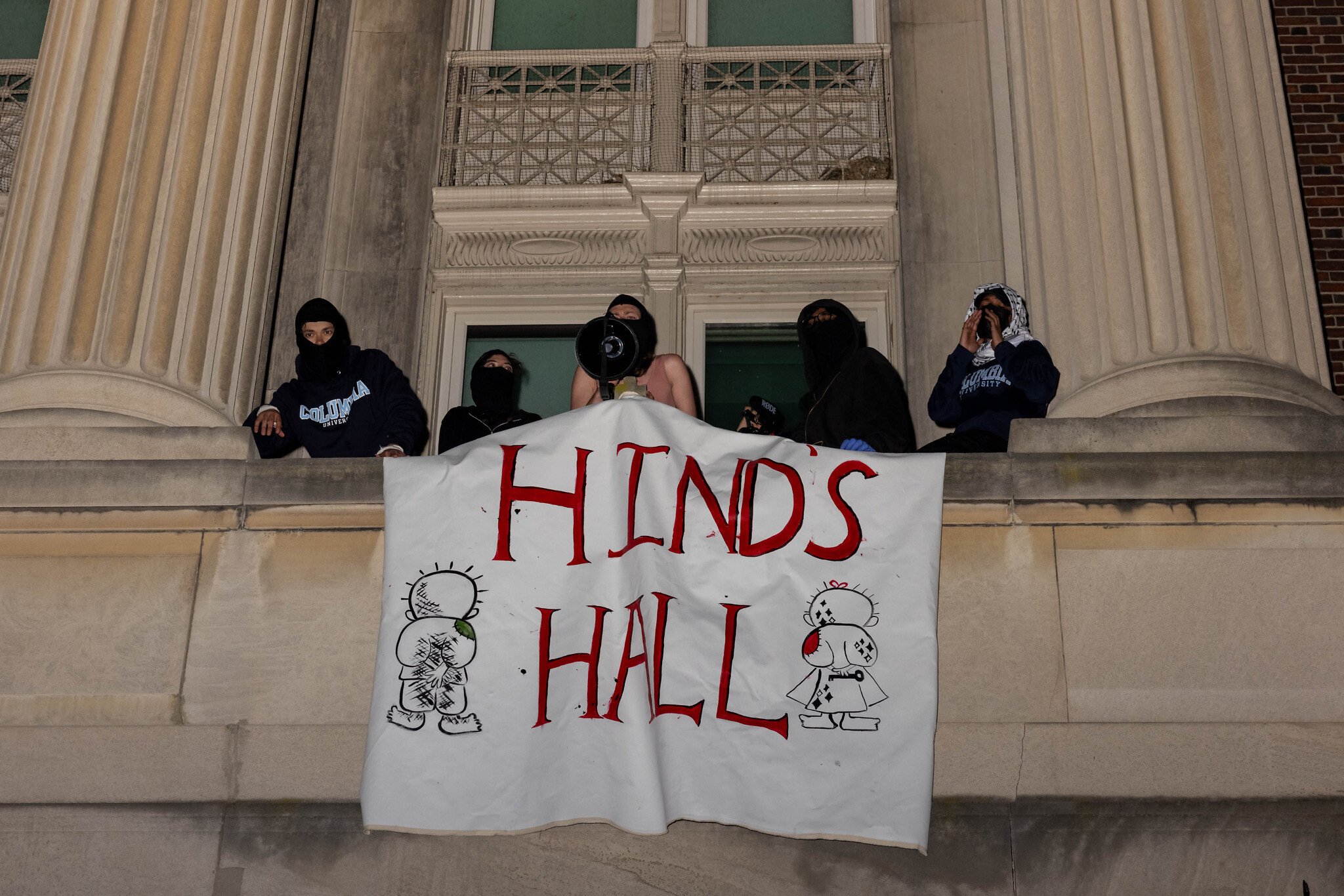
In 2024, when students at nearby Columbia University forcibly occupied a campus building, they named it Hind’s Hall, after Rajab. Masked demonstrators unfurled a banner with the moniker on the building’s facade.
The university called in police to remove the demonstrators, and maintenance workers in the building later said they had been held against their will and verbally abused as “Jew lovers” by the protesters.
Ayat donated food to the Columbia protesters, and Elenani told The New York Times that he named the restaurant after Rajab to “keep her name alive,” while criticizing the Columbia protesters’ property damage.
Announcing the name of the restaurant last year, Ayat said, “It stands right next to Columbia University where students stood up for Gaza and renamed Hamilton Hall, a campus building to Hinds Hall and we choose to stand with them and carry that name forward.”
Other protesters, in locations such as Berkeley, California, followed suit with Hind’s Halls of their own. Rajab is also the namesake of a foundation that attempts to prosecute Israeli soldiers when they travel abroad and the focus of a documentary. The restaurant spells the name without the apostrophe for reasons that were unclear; Ayat did not make Elenani available for an interview.
For centrist Jewish residents of the neighborhood, the name is likely to be distasteful. The protests are associated with turmoil in the neighborhood, discrimination against Jews, and disruptions on the campus. They are not viewed as a movement for peace and coexistence, but as hateful.
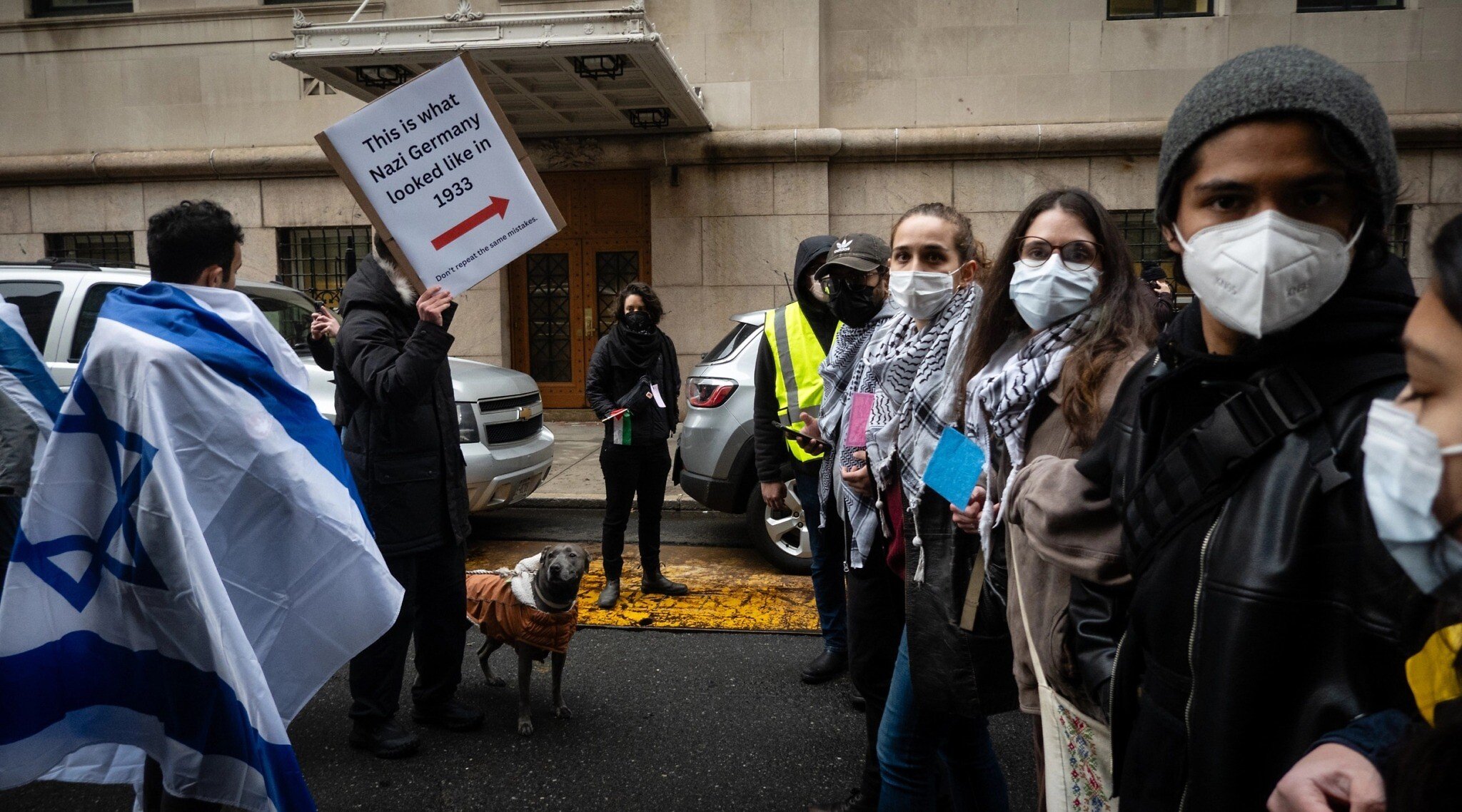
The Columbia protest leaders reinforced that view, repeatedly using violent rhetoric toward Israel and “Zionists,” and a university task force reported “crushing” discrimination against Jews.
The protests also drew hardline activists to the surrounding area, some of whom assaulted Jewish counter-demonstrators on Upper West Side streets. Krav Maga schools in the area saw a spike in attendance, as Jewish neighborhood residents, unnerved by the turmoil, took up self-defense.
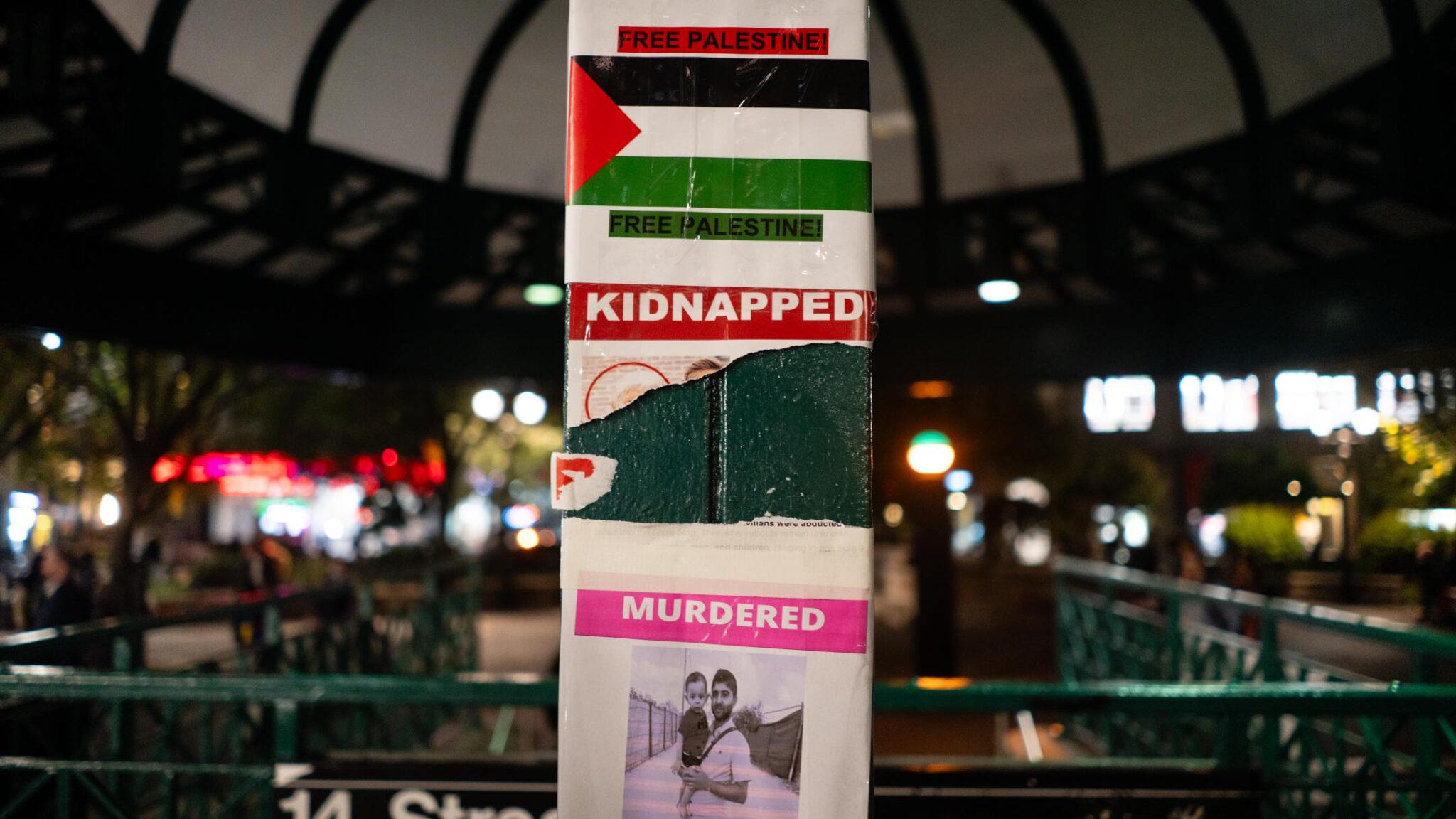
Posters for the Israeli hostages in the neighborhood, including for Kfir Bibas — like Rajab, a child casualty of the war — were defaced. Some Jews who intervened were assaulted.
Israeli restaurants in the city, unlike Hinds Hall, have been targeted for offenses such as donating to Israeli ambulances and joining Jewish food festivals. Vandals accused patrons of the Israeli Effy’s Cafe, blocks away from Hinds Hall, of “supporting genocide.”
There has not been any organized backlash against Hinds Hall, but centrist Jews who are attached to Israel are not likely to eat at a restaurant that they associate with that protest movement.
Anti-Zionist red lines
At a broader level, the proxy conflict in New York is not between Jews and Muslims, but between the anti-Zionist camp and the targets that it deems “Zionists.” Anti-Zionist and far-left Jews have always been allowed into the camp. The extremist, fringe Naturei Karta appear at nearly every protest, and on Ayat’s social media, along with other political messaging, including an AI image of killed Iranian children, a post disparaging Israel’s independence, and condemnations of antisemitism and violence against Diaspora Jews.
Ayat’s 2024 Shabbat dinner, while a positive gesture, also drew its support from the Jewish far left.
The anti-Zionist camp has red lines for its followers, including sympathizing with Israeli victims, condemning the “resistance,” and acknowledging Jewish sovereignty. Palestinian advocates who don’t toe the line are shouted down.
Hinds Hall does not cross those lines, but appears to be a softer edge of the anti-Zionist movement. The restaurant chain does not promulgate genocide or apartheid charges, common tropes for the movement, or actively seek to ostracize “Zionists,” but it doesn’t acknowledge Israel’s existence either.
This is all leaving aside controversies over the provenance and authenticity of Israeli and Palestinian cuisine, what actually happened to Rajab, and the Western world’s 900-year-old enthusiasm for accusing Jews of killing children.
At Ayat, the Jewish state just does not exist, except as “the occupation,” and for centrist Jewish and Israeli neighborhood residents, the restaurant will probably be ignored.
All that being said, if you just want to eat, the fattat jaj really is excellent.









The Times of Israel Community.