

Olmert denies he knew of cash transfers to his brother
In his second day of testimony in the Holyland corruption trial, former PM slams his ‘reckless’ sibling
 Add ToI as a Preferred Source on Google
Gavriel Fiske is a reporter at The Times of Israel
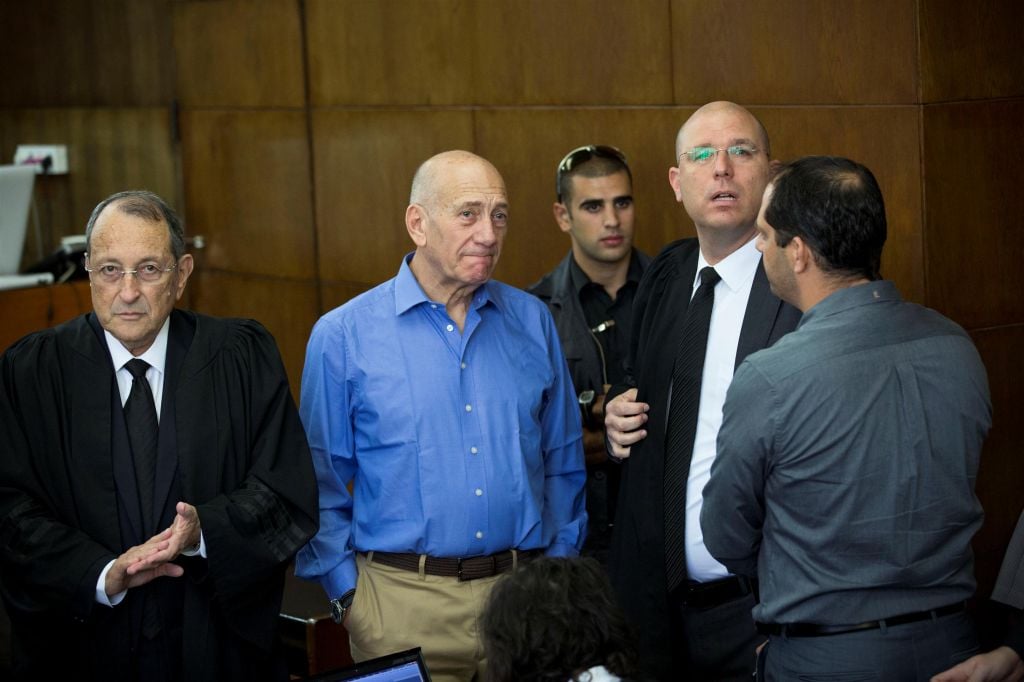
Former prime minister Ehud Olmert on Tuesday denied knowledge of money transfers between his brother Joseph (Yossi) Olmert and the late real estate developer Shmuel Dachner, a central point in the prosecution’s case against him.
It was Olmert’s second day on the stand as a defendant in the so-called Holyland case, which refers to crimes he allegedly committed during his tenure as mayor of Jerusalem.
Ehud Olmert said that his brother Joseph, a Middle Eastern affairs analyst who, according to Dachner’s testimony earlier this year, received half a million dollars from Dachner, acted “irresponsibly and recklessly” by involving Olmert in something he had no knowledge of.
Ehud Olmert said he was “not involved” in any transfer of money between the two men, despite Dachner’s testimony that he knew about and approved of the handover.
Joseph Olmert gave testimony in May in the case but provided a jumbled account of events, leading the prosecution at the time to accuse him of trying to cover for his brother. Ehud Olmert on Tuesday said that Joseph was “only trying to protect himself.”
His brother had caused him “unforgivable harm,” Olmert said, forcing him to become involved in a high-profile scandal in which “I stand here accused of something I did not do.”
On Sunday, his first day of testimony, Ehud Olmert said he supported the Holyland real estate project while he was Jerusalem’s mayor, but did not have a special relationship with, nor did accept any money from, Dachner, the star witness for the prosecution who, before his death in March, testified that Olmert and other city officials took money in exchange for favors.
From the first time he heard about the Holyland project, Olmert said, he knew it was “important.” Presented at a time when “we really wanted to develop the city,” he continued, the plan for a large luxury residential development in the south of Jerusalem was “exciting.”
Asked about his relationship with Dachner, Olmert said that it was similar to his relationships with other businessmen. Dachner, who Olmert said was “stubborn” during their dealings, was presented to the then-mayor as the project manager for the Holyland venture.
Dachner was suspected of funneling millions of dollars in bribes to municipal officials and other civil servants in order to expand the original Holyland project from a modest hotel to a huge multi-tower complex which critics have derided as a terrible eyesore. Much of the case against Olmert hinged on Dachner’s testimony, who before his death appeared in over 70 hearings on the affair.
Olmert stated on Sunday that he “never accepted a penny” from Dachner, and dismissed bribery allegations as empty “stories.”
Last year, Olmert lashed out at Dachner publicly, calling him a “dubious liar,” and on Sunday he said that “the Dachner we know today, from what he has said… was not the same” as the man who first presented himself as an entrepreneur seeking to build in Jerusalem.
The prosecution was set to cross-examine Olmert on Tuesday afternoon.

The Holyland affair, billed as one of the largest corruption scandals in Israel’s history, has entangled dozens of city officials, who are accused of accepting bribes in exchange for giving the go-ahead to developers to far exceed their original building mandate.
Olmert was sentenced in September 2012 to a suspended yearlong jail term and a NIS 75,000 fine ($21,000), following his landmark conviction for a separate, relatively minor breach of trust charge from his time as a government minister, and was cleared in two other, major cases against him. This left him technically free to return to political life pending the resolution of the Holyland case, for which a verdict is expected in 2014.
Times of Israel staff contributed to this report.





The Times of Israel Community.