

Record rainfall douses north, washing away 24-hour September record set in 1932
143 millimeters of rain recorded near Nahariya; Haifa beaches closed for swimming after downpours flood drainage systems, causing runoff to shore
 Add ToI as a Preferred Source on Google
Sue Surkes is The Times of Israel's environment reporter
More than 130 millimeters (5.1 inches) of rain fell Wednesday night and Thursday morning in and around the northern Israeli city of Nahariya, setting a new national record for the amount of rainfall measured in a single day during September.
Most of the rain fell within two hours, in what the Israel Meteorological Service described in a statement as “extremely abnormal” for September. It was the most rain to fall in September since measurements began, and broke a record of 95.7 millimeters (3.76 inches) recorded on a single day — September 12, 1932 — in Gush Etzion, near Jerusalem.
Large amounts of rain also fell in other areas of northern Israel, including the Golan Heights, the eastern Galilee, and the Gilboa region.
But it was in the Nahariya area that the record was smashed. At the weather station on Moshav Regba, 143 millimeters (5.6 inches) of rain fell, followed by 135 millimeters (5.3 inches) at Kibbutz Evron, and 132 millimeters (5.19 inches) at Moshav Shavei Zion. Local drainage problems in Nahariya saw the Ga’aton stream flooding as 118 millimeters (4.65 inches) of precipitation pounded down.
Acre registered rainfall of 87 mm (3.4 inches). Figures for other areas were: Kibbutz Afek, 65 mm (2.55 inches); Kibbutz Sha’ar Ha-Amakim, 45 mm (1.77 inches); Moshav Kfar Hasidim, 41 mm (1.6 inches); Kibbutz Ma’ale Gilboa, 32 mm (1.26 inches); and the community settlement of Harshim, 20 mm (0.78 inches).
Lighter rain, from one to four millimeters, fell in the center of the country. In the Jerusalem area, about one millimeter fell, while further south, it remained dry.
During the day, temperatures were forecast to drop to lower than the average for the season.
The rain was expected to weaken during the day and stop by the evening.
ההצפות בנהריה ממשיכות לאחר שכבר ירדו בעיר מעל 85 מ"מ, זה יותר מרבע מהכמות שירדה שם במהלך כל שנה שעברה. pic.twitter.com/kvO81T15Uq
— שלמה ⛈️ מזג אוויר (@MezgAvirIL) September 25, 2025
The Israel Meteorological Service warned about high seas that are dangerous for swimming, with waves reaching up to 2 meters (6.56 feet) in some parts of the country. Thunderstorms, lightning and strong winds were expected in northern Israel and northern and northeastern Samaria in the West Bank, into the early afternoon.
However, in the southern Judean Desert, the Dead Sea area and the northern Arava, the forecast was for hot temperatures during the afternoon.
The Haifa Municipality in northern Israel banned bathing in the sea due to dirty runoff water that typically ends up on the beaches after the first rain of the season.
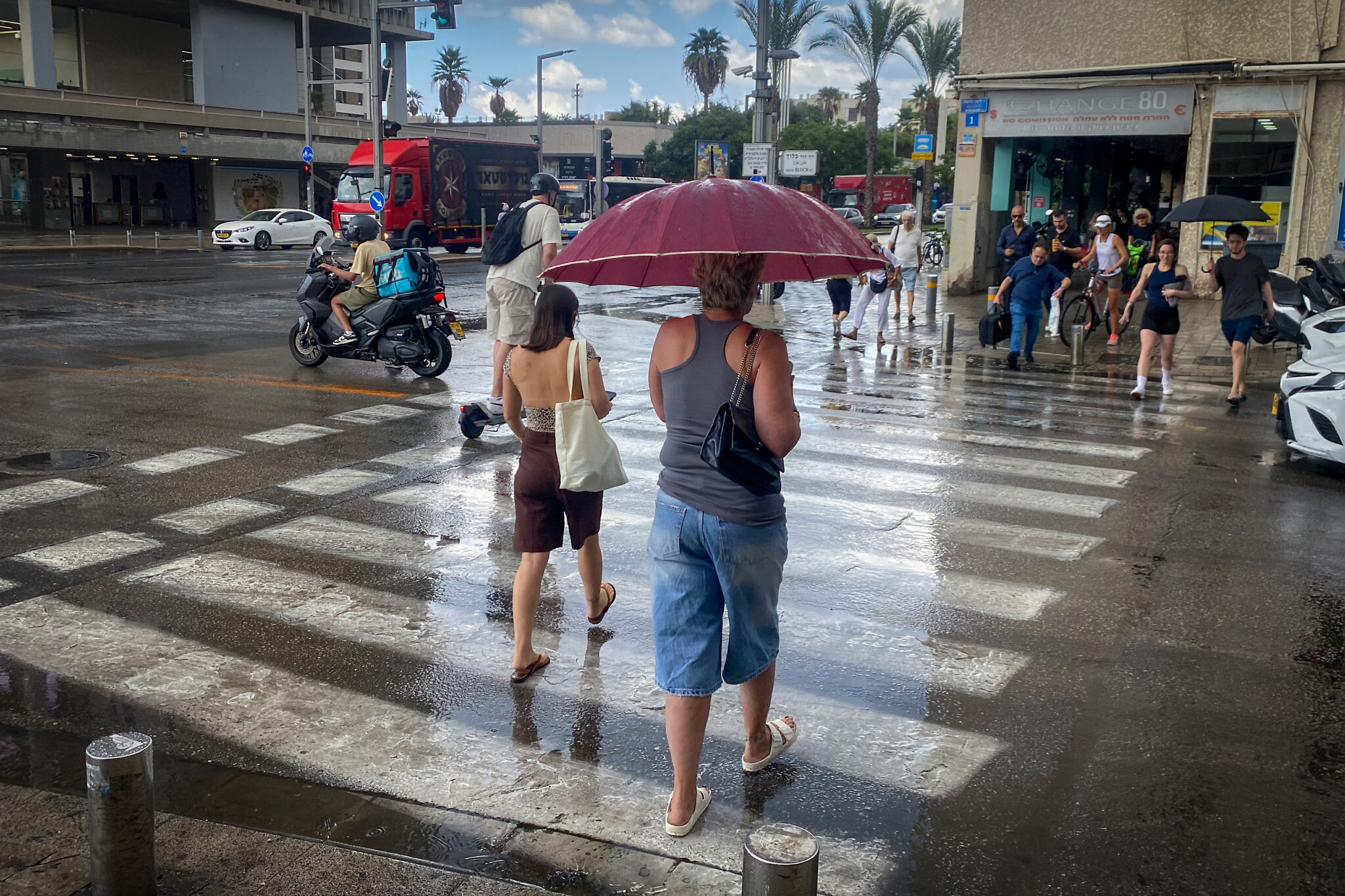
Asked whether such early rain, likely to be followed by more hot weather, could influence wildflower flowering this year, botanist Yuval Sapir of Tel Aviv University, who runs the university botanic garden, told The Times of Israel that September rain is not that unusual. He said the first rains do not always stimulate germination. Also, he said, where rainfall is very intense but short-lived, the ground is unable to absorb it all, and only part of the country has experienced heavy rain anyway.









The Times of Israel Community.