

Speed-walking toward war: 7 things to know for November 13
Israel and Gaza are at once egging each other toward all-out battle, and seemingly trying to make sure things don’t get out of hand. What could go wrong?
 Add ToI as a Preferred Source on Google
Joshua Davidovich is The Times of Israel's Deputy Editor
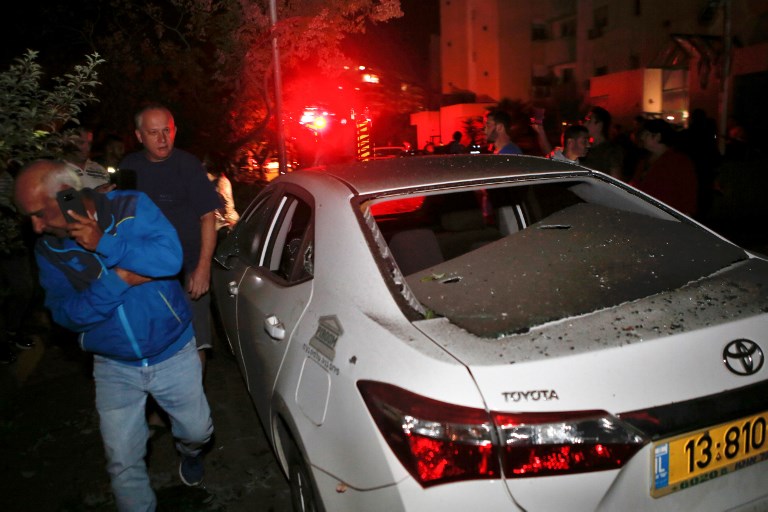
1. BRINK OF WAR: Monday’s Gaza rocket barrage on Israel is being called the single biggest one-day tally ever.
- That fact is made all the more horrifying in that the rocket fire from Gaza was concentrated in a relatively small area, and was likely also a preview of what may come should the sides decide to let things snowball into war.
- Both sides are talking big, but also seemingly making sure to keep the escalation in check. For Hamas, that means no rockets are being shot anywhere further than a dozen kilometers away, keeping the Tel Aviv region, Beersheba and Jerusalem out of range.
- For Israel, it means keeping the death toll low by issuing warnings before it bombs a building (using the roof knocking method of dropping a dummy bomb to signal to everyone inside to skedaddle) and not carrying out assassinations or targeting residences.
2. Playing by the rules: In a frankly rare move, Hamas announces exactly what cities it will target next if the fighting doesn’t stop: Ashdod and Beersheba. While the statement is meant to broadcast strength and be threatening, the constant warnings about making things worse (from both sides) also carry a more than tacit acknowledgement that neither actually wants to go the route of war and would rather turn back.
- “It seems both sides are trying to deal with the series of events within the framework of the rules of the game that have been drawn up more than once in recent months,” Channel 10’s Nadav Eyal writes.
- But Yedioth Ahronoth’s Alex Fishman notes that keeping to the rules means thinking the other side will too, which is not necessarily happening here: “This latest round of violence is much more dangerous, as both sides are convinced the other has gone crazy.”
3. No choice but war: But some see war as inevitable, even if it is unpalatable.
- “Hamas will not rest, and will not change,” ToI editor David Horovitz writes in an op-ed. “A murderous extortionist cannot be bought off. Sooner or later, therefore, Hamas must be faced down. And in the battle between a sovereign state that is obligated to ensure security for its citizens, and a ruthless, cynical terrorist organization, backed by Iran and committed to Israel’s destruction, there can and must be only one winner.”
- Hawkish Israel Hayom also gives a preview of what pressure from the right Prime Minister Benjamin Netanyahu is likely to face when he convenes the security cabinet Tuesday.
- A column by Dror Eydar in the paper is headlined “Hamas has broken the rules of the game” (literally “broke the vessels”). But it seems to be the work of an overzealous editor at the paper. While Eydar does say that Israel “has to respond,” he also writes very clearly the exact opposite: “Israel is keeping to the rules, and so is Hamas, at least when it focuses the fire on Gaza border communities and refrains (at least as of press time) from expanding it to more outlying places.”
4. Keep it copacetic: Others do not see war as inevitability. Haaretz’s lead editorial argues that the current flareup isn’t a sign of the need to smash Hamas, but to find a way to deal with it, and Gaza.
- “Any additional eruption in the south is liable to drag Israel into a war, or at least a violent confrontation, which will imprison Israelis in bomb shelters and rocket-proof rooms,” the editorial reads. “It must seek an arrangement and pay no attention to the political background noise.”
- Playing negative Nancy (or realist Ronald), former negotiator Aaron David Miller opines that nothing good will come of anything.
We’re on verge of another tragic wash rinse and repeat cycle which will end with no victor no vanquished. Any determinative outcome — destroying Hamas; Long-term cease-fire; PA returning to Gaza; or real peace process not in cards.
— Aaron David Miller (@aarondmiller2) November 13, 2018
5. Near miss: A video showing the an anti-tank missile strike on a bus shows either how things could have been much worse, or how Hamas meant it only as a warning shot, depending on one’s point of view.
- The video clearly shows whoever shot the missile watching the troops getting off the bus. At one point, it zooms in on soldiers getting out of vans like sitting ducks. In the end, though, the rocket is only shot when the bus is more exposed, and empty. The one person seriously injured was a soldier who happened to be standing next to it.
- One can see it as Hamas hoping the bus was full of soldiers and Israel simply getting lucky.
- Had it been filled with soldiers, though, which would have likely meant a high injury or death toll, it almost certainly would have represented a crossing of the Rubicon toward war, with Israel not able to just let it go.
- Those who think that Hamas is calculating enough to want to blow off steam and flex its muscles without descending into a repeat of Cast Lead, though, would see the many chances Hamas had to hit the bus or another target, and assume the shooter knew it was empty and meant it as only a proverbial shot across the bow.
6. Putting the Mem in memory: At the time of the bus attack, Israel was still reeling from Sunday’s botched raid and the death of Lt. Col. Mem, who may not be named.
- Despite the massive flareup, Yedioth Ahronoth covers most of its front page with a picture of his casket, the headline “Hero with no name,” and a poem by Yehuda Amichai titled “There are no anonymous soldiers.”
- Also writing about Mem in the same paper, twice-bereaved military mother Miriam Peretz uses a different poem, Zelda’s “To every person there is a name,” which is heavily associated with Holocaust remembrance.
- “These fighters without a name have loved ones, parents and kids, and usually don’t even know what kind of hero they are living with,” she writes.
- Haaretz’s Amos Harel notes how strange it is that even after his death, the military censor still refused to allow his name or any details about him to be published, something it seemingly has never done, and was likely futile anyway.
- “The sweeping prohibition is irrelevant, a case of shutting the barn door long after the horses have fled: The name, picture and personal details of the deceased were shared on social media, including in the Gaza Strip,” he writes. “It was clear by early Monday morning that the effort to protect this information had failed. It would have been better for the defense establishment to focus on keeping secret what is really important and what can actually be kept from the Israeli public, especially when the enemy already has the information.”
7. Who’s the boss? ToI’s Raoul Wootliff focuses on a mostly overlooked part of the whole affair, initial confusion over who was in charge as Israel was suddenly thrown into a war setting with the prime minister abroad Sunday night.
- Netanyahu’s office took over an hour to tell ToI that Culture Minister Miri Regev was the one in charge, though because she is not a member of the security cabinet, military matters had been left to Defense Minister Avigdor Liberman.
- Unlike other prime ministers, Netanyahu does not have a permanent deputy who takes his place when he goes abroad. Instead of he appoints different ministers each time, and doesn’t necessarily make an official announcement.
- “In the last two years alone, Tourism Minister Yariv Levin, Transportation Minister Yisrael Katz, Public Security Minister Gilad Erdan, Energy Minister Yuval Steinitz, Jerusalem Minister Zeev Elkin and Culture Minister Miri Regev have each been given the prized role, for various short periods of time. In addition to refraining from naming a deputy, Netanyahu has also forgone his former practice of filling the honorary positions of deputy prime minister and vice prime minister,” Wootliff writes.
- Even more interesting is why: “Perhaps due to the fear of creating a potential challenger within his own party, Netanyahu has prevented the emergence of any heir apparent by constantly rotating the position of temporary prime minister and avoiding the appearance of any favorite, even among his closest allies.”









The Times of Israel Community.