

Status quo with Palestinians won’t hold, Peres cautions
Netanyahu, speaking at same ceremony marking 18th anniversary of Rabin’s death, says peace can only be made with enemies who now truly seek reconciliation
 Add ToI as a Preferred Source on Google
Raphael Ahren is a former diplomatic correspondent at The Times of Israel.
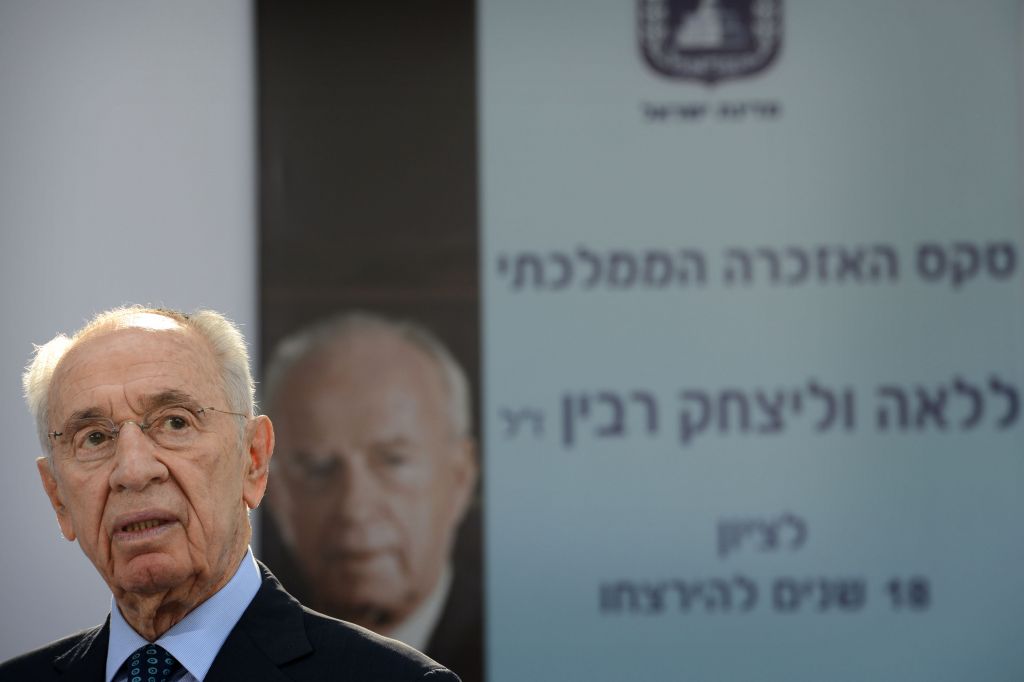
The status quo vis-à-vis the Israeli-Palestinian conflict is untenable, President Shimon Peres said Wednesday at a state ceremony for slain prime minister Yitzhak Rabin. “The two-state solution will maintain Israel’s moral character and its future as a Jewish democratic state,” he said. “Those who delude themselves that the status quo between us and the Palestinians will continue may become a victim of their delusions.”
Speaking at the same gathering, Prime Minister Benjamin Netanyahu said that peace could be achieved only if Israel held on to its military superiority. Later, in speeches at a Knesset ceremony commemorating Rabin, Netanyahu and opposition leader Shelly Yachimovich clashed bitterly over the handling of peace talks with the Palestinians.
Addressing the state ceremony on Mount Herzl, where Rabin is buried, Peres said: “Leaders are tested by the goals they set for the nation, by finding ways to achieve those goals even when reality seems daunting. Yitzhak Rabin understood this and had the courage to take hold of history and shape its direction.”
Rabin was assassinated by Jewish extremist Yigal Amir on November 4, 1995, “but the need to make the historical decision remains,” the president said. “Yitzhak believed that peace requires security and security was needed for our peace. The peace process is not a luxury. It is difficult and often heartbreaking. Until the last moment of his life he hoped that we could complete the process. He knew that the path to peace was not yet paved but that those who were willing to walk it anyway would pave the way.”
Peres warned of the dangers of extremism within Israel. “The unity of the Jewish people depends upon peace and democracy. And its fate depends on the existence of a Jewish state,” he said. “In today’s world lone murderers operate to destroy whole systems. Small organizations try to destabilize whole countries. They are a danger to the country. Yitzhak Rabin’s murder was the epitome, the worst of these actions. If we do not root out this phenomena at its core, dangerous and poisonous plants may grow in the future. Yitzhak’s murdered desecrated the commandment of the Torah, ‘Thou Shall Not Murder.’ There is no Jew who can wipe out the words of the Ten Commandments. There is no one who may forgive Yitzhak’s murderer for that.”
Speaking after Peres at the Mount Herzl ceremony, Netanyahu said he remains committed to Rabin’s quest for peace but indicated that the other side might not be sincerely interested in a historical reconciliation.
“Rabin worked toward achieving peace with our neighbors. And we remain committed to this goal until today,” the prime minister said. “President Peres, you rightly said that peace is made with enemies. But peace is made with enemies who desire peace. Enemies that do not desire peace, that desire to wipe us off the map — are not partners for peace.”
Israel must not allow its enemies to gain a foothold in areas adjacent to Israel’s borders, he added, apparently referring to Iran and its supporters from Hezbollah, Hamas and Islamic Jihad.
Netanyahu noted Rabin knew very well that peace is impossible to achieve without Israeli military superiority, a superiority that would deter its enemies from breaking the peace.”
“Only a strong Israel can provide its leaders with the necessary feeling of security they need to reach difficult and sometimes painful decisions to reach peace,” he said, quoting a statement Rabin made during his second term as prime minister in the 1990s. “In this turbulent Middle East – because of the terrorism that rears its head, or because upheaval in Arab countries, or because of Iranian threats to annihilate us – only a powerful Israel will guarantee the security and the peace.”
Speaking later at the Knesset, Netanyahu detailed that Israel must maintain a security presence in the Jordan Valley “precisely as Yitzhak Rabin insisted.”
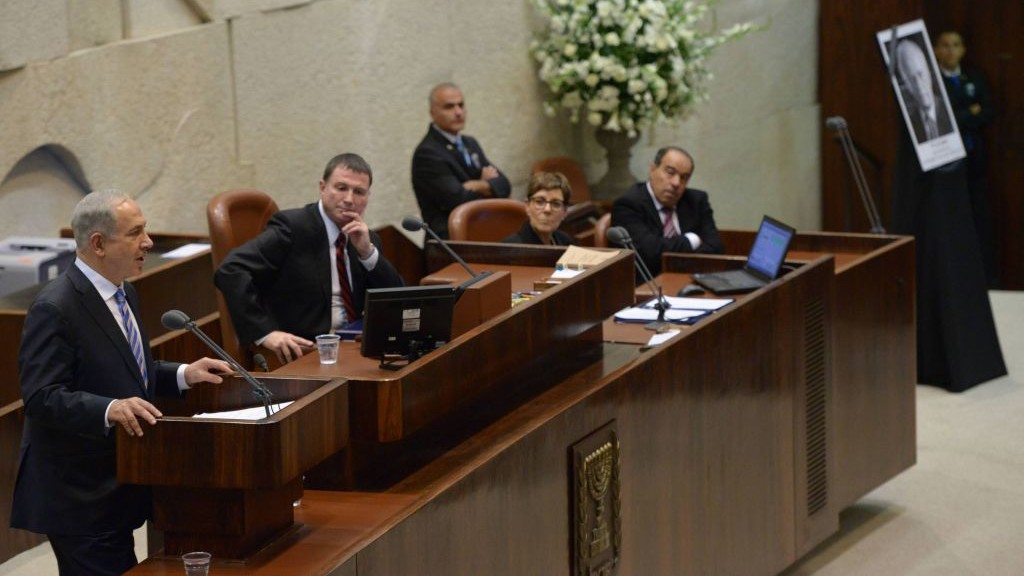
“What was vital then is even more vital today, given the rise of Islamic extremism and Iran’s takeover of territory we relinquished in the [South Lebanon] security zone and Gaza,” he said.
In an accord with the Palestinians, Israel needs terms that “enable us to defend ourselves” if there are forces that seek to breach the peace.
Netanyahu also said Rabin’s assassin would never be forgiven. “There is and won’t be forgiveness for the murder. The murder of prime minister Yitzhak Rabin is a crime for which there is and will not be any pardon – ever,” he said, later adding that “There is no pardon for the assassin. And there must never be a pardon for the assassin.”
Opposition leader and Labor party head Shelly Yachimovich, also speaking in the Knesset, attacked Netanyahu’s oft-stated demand that the Palestinians accept Israel as a Jewish state.
“It’s clear to most Israelis today that we won’t be able to educate the Palestinians, and to force them to welcome our wonderful Zionist enterprise, to celebrate its existence,” she said. “We don’t have control over their dreams. But we have control over our destiny,” she said.
Yachimovich vowed in her speech to continue to work toward a peace agreement with the Palestinians that would take into account the strategic and security risks.
Whenever Israel signed peace treaties with its neighbors, “we were never disappointed,” she said. But peace with the Palestinians was never tested, because Rabin was assassinated before he could reach a final-status agreement, she added. “You have the opportunity to embark on a historic process, Mr. Prime Minister, that would ensure Israel’s future as a Zionist, Jewish and democratic state. Take this opportunity. Enough with the threats and the fears.”







The Times of Israel Community.