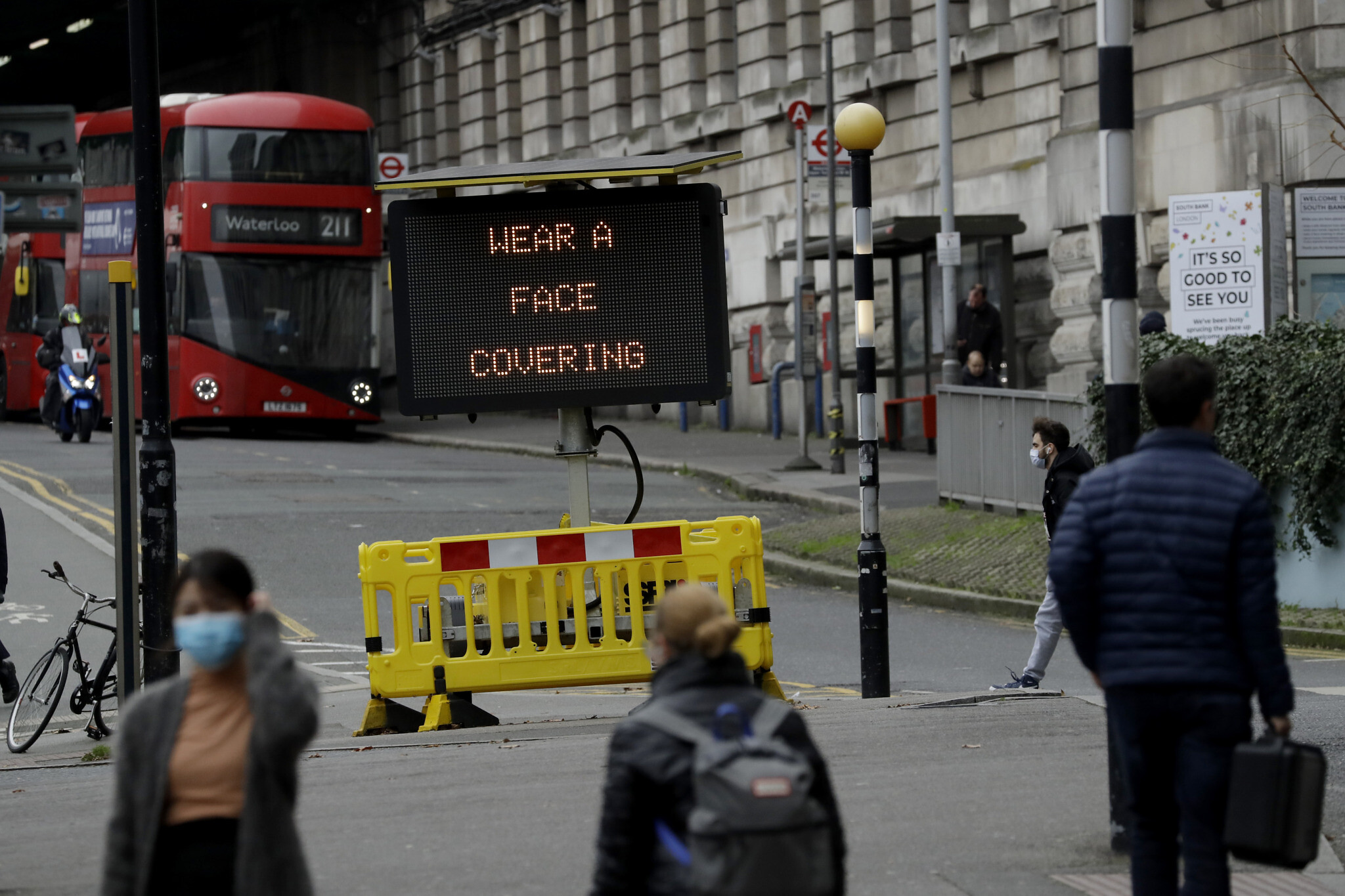
A sign is displayed outside Waterloo train station to remind people thy are required to wear face coverings inside the station and whilst travelling on trains during England's second coronavirus lockdown, in London, Friday, Nov. 20, 2020. Britain yesterday registered 501 daily COVID-19 deaths within 28 days of a positive test and is the fifth country in the world to record more than 50,000 coronavirus-related deaths. (AP Photo/Matt Dunham)
Individuals infected with coronavirus are unlikely to catch the illness again for at least six months, researchers at the University of Oxford said Friday.
The finding comes as part of a large-scale study into COVID-19 reinfection after observations from healthcare professionals that the phenomenon was relatively rare.
Oxford University Professor David Eyre, one of the authors of the study, said the findings were “really good news.”
“We can be confident that, at least in the short term, most people who get COVID-19 won’t get it again,” he said.
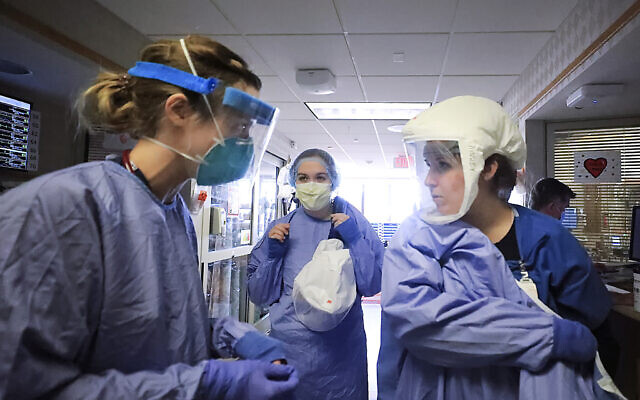
In this Nov. 5, 2020, file photo, medical staff attending to patients with COVID-19 wear protective equipment in a unit dedicated to treatment of the coronavirus at UW Health in Madison, Wis. Conditions inside the nation’s hospitals are deteriorating by the day as the coronavirus rages through the country at an unrelenting pace. (John Hart/Wisconsin State Journal via AP, File)
The authors highlighted they had not yet gathered enough data to make a judgment on reinfection after six months.
Get The Times of Israel's Daily Editionby email and never miss our top stories
However, the ongoing study has an end goal of verifying how long protection from reinfection lasts in total.
The director of infection prevention and control at study partners Oxford University Hospitals (OUH), Katie Jeffery, called the finding “exciting.”
It indicated “that infection with the virus provides at least short-term protection from re-infection”, she added.
Advertisement
US biotech firm Moderna announced this week its vaccine candidate was nearly 95 percent effective in a trial — a week after similar results were announced by pharma giant Pfizer and its German partner BioNTech.
The Oxford study into reinfection drew on data from regular coronavirus testing of 12,180 health care workers at OUH over a period of 30 weeks.
It found that none of the 1,246 staff with coronavirus antibodies developed a symptomatic infection.
Three members of staff with antibodies did test positive for the virus that causes COVID-19 but were all well and did not develop symptoms.
Help us report truthfully on social media
As a multimedia journalist, my job is to take the quality, fact-based journalism produced by The Times of Israel newsroom and make it accessible across every platform — from Instagram posts to podcasts to short-form videos.
This is how many, especially young people, consume news these days. But misinformation is rampant on social media. Our team at ToI produces accurate, responsible short-form reporting on Israel and the Jewish world.
If you believe in the importance of factual social media journalism, please consider joining our reader support group, The Times of Israel Community. Your financial support is essential to sustain responsible multimedia reporting.
We’re really pleased that you’ve read X Times of Israel articles in the past month.
That’s why we started the Times of Israel - to provide discerning readers like you with must-read coverage of Israel and the Jewish world.
So now we have a request. Unlike other news outlets, we haven’t put up a paywall. But as the journalism we do is costly, we invite readers for whom The Times of Israel has become important to help support our work by joining The Times of Israel Community.
For as little as $6 a month you can help support our quality journalism while enjoying The Times of Israel AD-FREE, as well as accessing exclusive content available only to Times of Israel Community members.
Thank you, David Horovitz, Founding Editor of The Times of Israel


 Add ToI as a Preferred Source on Google