

The media czar on Balfour: 7 things to know for December 3
Bribery suspicions against Netanyahu regarding his attempts to control the press sharpen the divide between his backers and detractors and throw biases into the spotlight
 Add ToI as a Preferred Source on Google
Joshua Davidovich is The Times of Israel's Deputy Editor
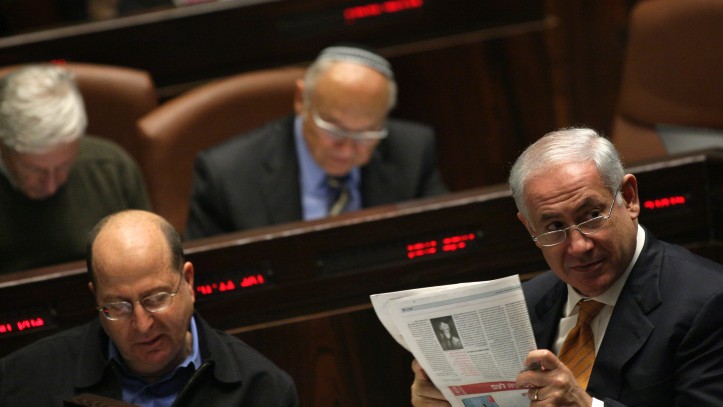
1. Prime suspect: The police recommended Sunday that Prime Minister Benjamin Netanyahu and his wife Sara be indicted for bribery over suspicions they traded political favors for positive press coverage, in what has come to be called Case 4,000. The recommendation, which still must be considered by Attorney General Avichai Mandelblit before a decision is made on indictment, is sharpening battle lines between Netanyahu’s detractors, who want to see him ousted from power, and his backers, who see a media/police coup taking place.
- “In the eyes of the public, even if he’s not criminal, he’s already guilty,” Haaretz analyst Mordechai Kreminitzer writes, calling on Netanyahu to resign.
- The suspicion, according to police: Netanyahu, while he was also serving as communications minister, advanced regulatory decisions benefiting Shaul Elovitch, the controlling shareholder in Bezeq, the country’s largest telecommunications firm — despite opposition from the Communication Ministry’s career officials — in exchange for positive press coverage from Elovitch’s Walla news site.
- Yedioth’s Nahum Barnea takes the suspicions and runs with them, painting Netanyahu as a corrupt media czar who only saw Walla as the first step in his quest for total supremacy. Barnea notes that when he formed his coalition in 2015, Netanyahu demanded that all coalition partners go along with all of his decisions as communications minister:
- “He didn’t demand this for anything else, not for greater Israel, not for security, not for protecting democracy or the sanctity of the Jewish nation-state. … Netanyahu would take the Communications Ministry not to manage it, but to use it as a cudgel. The enemy was the press and the solution was to conquer it by force. What Sheldon Adelson did for print he would do for online news sites and TV channels. Elovitch was the first. He would tie the site to his residence on Balfour Street and pay with regulatory favors under his authority in the ministry. Others would come after. Every tycoon would know, every oligarch: whoever acts nicely will get a taste.”
2. Poking holes, poking the chief: Israel Hayom, which is seen as outwardly pro-Netanyahu (if not his mouthpiece, ironically), plays up Netanyahu’s defense, and the fact that a recommendation is far from an indictment.
- “Ridiculous recommendations,” reads a top headline in the paper, quoting from the premier himself in a speech in which he jokingly dismissed the charges.
- Columnist Mati Tuchfeld claims the police document detailing the suspicions against Netanyahu doesn’t actually contain any allegation of bribery, writing that Netanyahu was right in his speech Sunday night to call the police probe a “witch hunt”: “There’s no meeting, conversation or messages passed via messengers — verbal or written — in which Netanyahu and Elovitch agreed that in exchange for positive coverage in Walla from Elovitz, Netanyahu will reach into his pocket for, in the form of various benefits, billions of shekels,” he writes.
- The paper also aims its opprobrium at outgoing police chief Roni Alsheich: “Respect for others isn’t even a crumb to the police chief, who on his last day had to throw this out into the public sphere so that the torturous media can blow it trumpets triumphantly,” columnist Haim Shine writes.
- Amnon Lord, another columnist in the paper, claims wildly that actually it’s Alsheich who is guilty of a quid pro quo to bring down Netanyahu in exchange for positive media coverage.
3. No mea culpa: Caught in the middle of all of this is in fact the media, with Walla accused of selling itself in Netanyahu’s favor and other suspicions that Yedioth Ahronoth nearly did the same sort of deal.
- There’s no mea culpa or anything of the sort in Walla, which baldly plays down the whole affair despite its wide-ranging implications. Yedioth too doesn’t exactly play up the suspicions against it, which will now be reconsidered.
- In Haaretz, Nati Tucker goes through Netanyahu’s long history of trying to control the media, though he calls this the most serious case yet: “As has been exposed in the past, during the previous decade Netanyahu worked to bring in Arnon Milchan and Ronald Lauder as investors in Channel 10; later, U.S. gambling magnate Sheldon Adelson arrived in Israel and invested massive sums in launching the free newspaper Israel Hayom, which is considered Netanyahu’s personal mouthpiece. Along the way, Israel Hayom delivered a blow to Netanyahu’s bitter enemy, Israel’s largest tabloid newspaper, Yedioth Ahronoth.”
- Looking at why journalists at Walla, Yedioth and elsewhere go along with their bosses’ ridiculous demands, Shachar Ben-Meir writes in the Seventh Eye that the problem is that the Supreme Court has never quite given more than tacit backing for “freedom of journalism,” an enhanced form of freedom of speech to protect journalists from such demands.
- “It’s a bit much to expect them to carry the burden of something that the court, with all its authority, has not bothered to anchor [in precedent],” he writes.
4. Full disclosure: The idea of “freedom of journalism” is very pertinent in Israel (and many European countries), where news sites have a pronounced slant they wear on their sleeve.
- A tweet showing side-by-side images of how Yedioth and Israel Hayom treated suspicions against Netanyahu and former prime minister Ehud Olmert provides a case study in how much those outlets filter the news through those biases (and could easily be extrapolated out to other sites as well.)
ובפינתנו pic.twitter.com/tJCAvR4EYd
— ישי שנרב (@IshayShnerb) December 3, 2018
- In 2008, Yedioth Ahronoth made sure to include “There’s no proof” on the front page, words that were missing from Israel Hayom’s coverage that same day, with only the word “bribery” writ large on its front. On Monday, the positions are exactly reversed with Yedioth writing only “bribery,” and Israel Hayom making sure to include Netanyahu’s defense that “the timing is transparent, the game is well-known.”
- In left-wing Haaretz, Noa Landau writes that there’s no problem with papers having biases, so long as one knows what they are.
- “We must not become confused: Having a political agenda, on whatever side of the political spectrum, is not the same as bribery. And not only in the political party context; economics is also a political issue, as is well known, as are social welfare, gender and the environment. Everything’s political,” she writes. “Heightened public awareness on every front is necessary to understand these interests, but that doesn’t mean that they are inappropriate. The public must also learn to make the distinctions.”
5. Communing with a killer: Walla may not have much self-introspection, but it does criticize right-wing Channel 20 for an hour-long roundtable discussion about quotes from Yitzhak Rabin assassin Yigal Amir.
- The program, which was the first installment with former Walla editor (and former MK) Yinon Magal sitting in the anchor chair, featured a number of other figures, including a former Shin Bet anti-Jewish terror chief, right-winger Moshe Feiglin, former peace now head Yariv Oppenheimer, Rabbi David Stav and others, to discuss not an interview with Amir, but excerpts of conversations he had with “associates.”
- Included in the quotes were Amir saying he killed Rabin of his own volition, rejecting the idea that he was set up by the Shin Bet, or incited by the right or rabbis. With the channel fresh from criticism over its friendly interview with a Jewish arsonist who burned down a Jewish-Arab school (Magal was filling in for Erel Segal, who quit over that affair), Walla TV critic Nadav Menuhin notes that the station tried to manage this more tactfully, but notes that it was still problematic because it seemed to be trying to use his words to exculpate the right, and even Magal seemed unhappy, “sulking” throughout the program.
- “Amir was brought on to exorcise demons. The things ‘he said to associates’ were brought up in this seance so that everyone could be excused from responsibility: The Shin Bet representative, someone from the settlers, someone from [right-wing] Zu Arzenu, someone from the national-religious rabbis — everyone came to strengthen the message that they finally got from the ultimate source, the killer acted alone, totally cut off from the world,” he writes.
6. The city and the city: Another view of society’s polarization was on display for ToI’s Jacob Magid, who joined dovish group Breaking the Silence in a tour of Hebron, as they brought 300 people to the divided West Bank city in one of their largest events ever.
- While many came to Hebron, they were almost all older Ashkenazi leftists, meaning the group was pretty much preaching to the choir. Beyond that, the overall takeaway, at least from someone on the tour’s perspective, is that the group is fighting a losing battle against the army and settlers, working in tandem.
- After some tour participants were doused with water and other protesters tried to drown out the tour with whistles and vuvuzelas, the army decided to take action and kick out the leftists, Magid reports.
- “The tours were unable to reach their final stop at the home of a Palestinian activist, but the guides appeared to take solace in the fact that the mob scene and subsequent IDF order had reinforced their perception of the skewed dynamic in the city between settlers and the army,” he writes.
7. Taking the bomb out of the basement: Amid persistent tensions with Iran and fears of it arming Hezbollah, Bar-Ilan University’s Begin-Sadat Center for Strategic Studies makes an unusual call for Israel to give up its policy of nuclear ambiguity that has kept it from disclosing its alleged nuclear stockpile for decades.
- Prof. Louis René Beres writes that “specific and valuable security benefits would likely accrue to Israel as a result of a selective and incremental end to deliberate nuclear ambiguity,” noting that if Iran knew more about Israel’s arsenal it might be less likely to act or smuggle nuclear knowledge to Hezbollah, under the doctrine of Mutual Assured Destruction.
- “Any Iranian judgments about Israel’s capability and willingness to retaliate with nuclear weapons would depend largely upon prior knowledge of these weapons, including their degree of protection from surprise attack as well as their capacity to punch through Iranian active and passive defenses,” he writes.
- “Removing the bomb from Israel’s ‘basement’ could enhance Israel’s strategic deterrence to the extent that it would heighten enemy perceptions of the severity of the risks involved. This would also bring to mind the so-called Samson Option, which could allow enemy decision-makers to grasp that Israel is prepared to do whatever is needed to survive.”









The Times of Israel Community.