

This Pittsburgh rabbi lost 3 congregants. Here’s how he is observing Shabbat
Congregations will pray and come together for a communal service outside the Tree of Life for the first time since the massacre; and hopefully have a day of rest
 Add ToI as a Preferred Source on Google
Ben Sales is a news editor at The Times of Israel
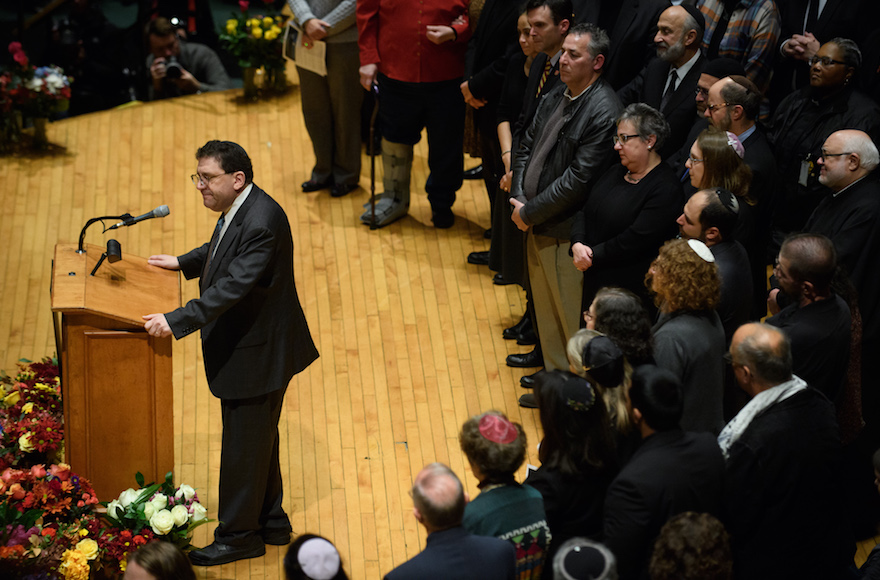
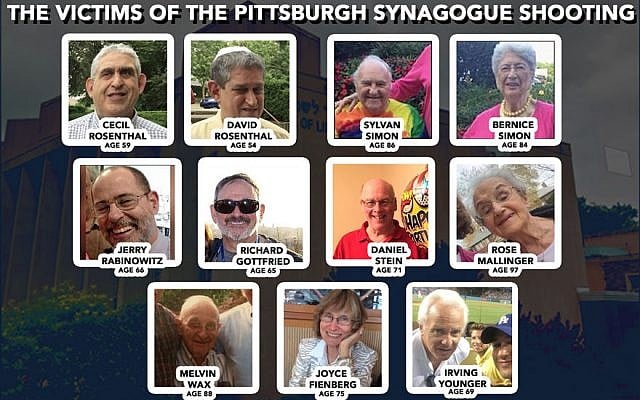
JTA — Six days ago, on Shabbat, Rabbi Jonathan Perlman was hiding in a pitch-black storage closet as one of his congregants was shot dead in front of him. The time since has been filled with funerals, counseling congregants and figuring out how to move forward as a community, a city — and a rabbi.
Now, for the first time since the massacre that killed 11 Jews in a Pittsburgh synagogue, Perlman and his small congregation, New Light, will welcome Shabbat. It will be in a different building, with an armed guard outside and without three of the Conservative congregation’s most active members.
New Light will be meeting on its own Friday night. But on Saturday morning, Perlman and the leaders of the two other congregations that shared the targeted building, Tree of Life*Or L’Simcha and Dor Hadash, will preside over a combined service in the large sanctuary of another local Conservative synagogue, Beth Shalom, that is expected to draw hundreds of worshippers.
The Tree of Life building is closed for an investigation of the shooting, so its congregations must meet elsewhere.
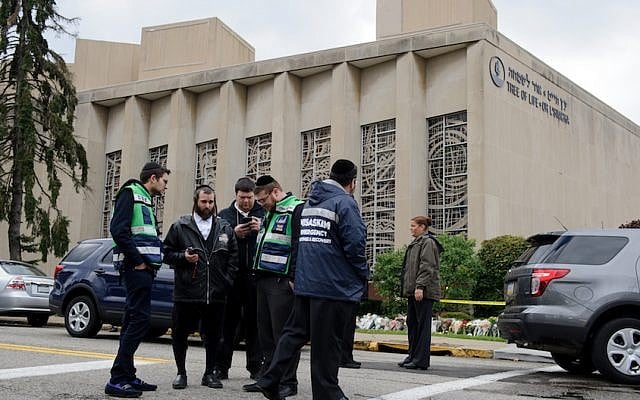
“Hopefully when I get there, I’ll be feeling strengthened by everyone else around me,” Perlman told JTA on Friday afternoon.
How did he feel going into Shabbat?
“I’m pretty shaky,” he said.
For the past week, the diverse and tightly knit Jewish neighborhood of Squirrel Hill has been coping with the aftermath of the mass shooting through funerals, a presidential visit, an outpouring of love from around the world and a swarm of media attention. But Friday night and Saturday morning will mark the first time that the neighborhood’s Jews will be gathering in the very setting where the massacre took place: Saturday morning services in a sanctuary.
Perlman and other Squirrel Hill rabbis told JTA that they were looking forward to Shabbat. They expected a mix of contradictory impulses and emotions: fear and defiance, mourning death and celebrating life, knowing that this Shabbat will be different while showing that tradition must be sustained and they will would not be cowed.
“This Shabbat I hope to be the opposite of last Shabbat: We’ll get some rest,” Perlman told JTA, noting that Beth Shalom also would be celebrating the recent marriage of one of its clergy on Saturday. “There’s celebrations and tragedies, and we’re pulled — our emotions are pulled every which way. But it’s a renewal.”
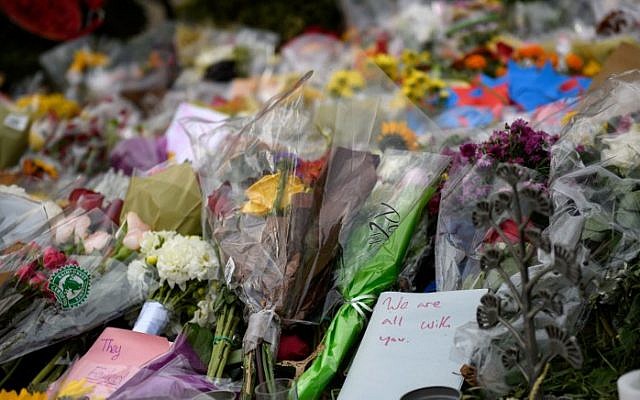
The rabbis said that in general, they hoped to conduct services much like they do every week, to show the world that the massacre did not stop Jewish life in Pittsburgh. But several congregations will be changing or adding to their services to commemorate the tragedy.
At New Light, in place of a short Friday night sermon, Perlman will create space for congregants to share memories of the victims. At the Reform Rodef Shalom Congregation, which will be hosting Tree of Life*Or L’Simcha services on Friday night, Rabbi Aaron Bisno plans to skip the traditional English-language readings and instead share poems written about the shooting.
“It’s an opportunity to create an experience where the community can gather,” Bisno told JTA. “We want people to feel like they’re given expression, that the emotions they’re feeling this week have been given voice.”
For more traditional synagogues that prefer to react to current events through age-old prayers, this Shabbat presents a conundrum. A prayer commemorating Jewish martyrs, “Av Harachamim” (Hebrew for “Father of mercy”), is said weekly in many synagogues. But it’s usually skipped this week because those synagogues will be reciting a blessing for the coming Hebrew month.
Two Pittsburgh Orthodox rabbis who spoke to JTA said that despite the new month’s blessing, they are considering saying the martyrs’ prayer in memory of the shooting victims.
“If you’re not inspired by davening, don’t blame davening,” said Rabbi Daniel Wasserman of Shaare Torah Congregation. “It just means you haven’t looked carefully at it. … Even if we don’t say [Av Harachamim], I’ll ask people: Look at what we don’t say, but still read it, understand it, stop taking it for granted.”
Another change is that all of the area’s synagogues will have beefed-up security — in many cases, if not all, an armed guard. Rabbis said that while it’s an unfortunate measure to take, safety is paramount, and they believe that people will still be able to feel welcome.
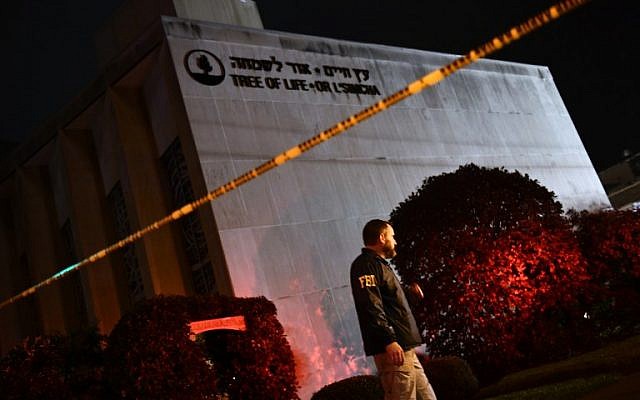
“It’s as much a deterrent as a sense of reassurance, that we’re mindful of the fear that’s out there,” Bisno said. “We want ours to be a welcoming place, and we have to take safety and security seriously.”
All the synagogues are expecting more people to come than usual. The American Jewish Committee has launched a campaign for this week called #ShowUpForShabbat, encouraging people around the Jewish world to attend synagogue this week to commemorate the victims and show solidarity.
The anti-Semite who killed 11 Jews in Pittsburgh — and who’s being treated for his wounds by a Jewish doctor! — needs to know:
He won’t scare us.
He won’t shake our faith.
He won’t divide us as Americans.
Let’s all go to a synagogue tonight or tomorrow a.m. #ShowUpForShabbat pic.twitter.com/03GdJTeEa2
— David Harris (@DavidHarrisNY) November 2, 2018
At Rodef Shalom, public figures will be speaking Friday night in addition to the prayer service. The synagogue will hear from Dani Dayan, Israel’s consul general in New York, and Wasi Mohamed, executive director of the Islamic Center of Pittsburgh.
“Our goal is to have a full Shabbat, larger than usual — many people that aren’t necessary regular shul-goers,” said Rabbi Yisroel Aitman of Chabad of Pittsburgh, which is expecting 100 worshippers, double the usual number. “On one hand we mourn, we grieve and it’s hard for us. On the other hand, when it comes to action, we need to be there.”
As to what’s going to happen after this Shabbat, Perlman doesn’t know. But even with all of the attention focused on his neighborhood, he is hoping for a Shabbat that can be as restful and, well, ordinary as possible.
“It’s not going to turn into a rally,” he said, referring to the Saturday morning service. “We’re going to follow the liturgy of the service and be with one another.”



The Times of Israel Community.