

Trump’s year of peace: 6 things to know for September 3
US envoy defends Trump administration efforts to re-start peace process and insists Arab world increasingly seeing Israel as ‘part of the solution’
 Add ToI as a Preferred Source on Google
Tamar Pileggi is a breaking news editor at The Times of Israel.
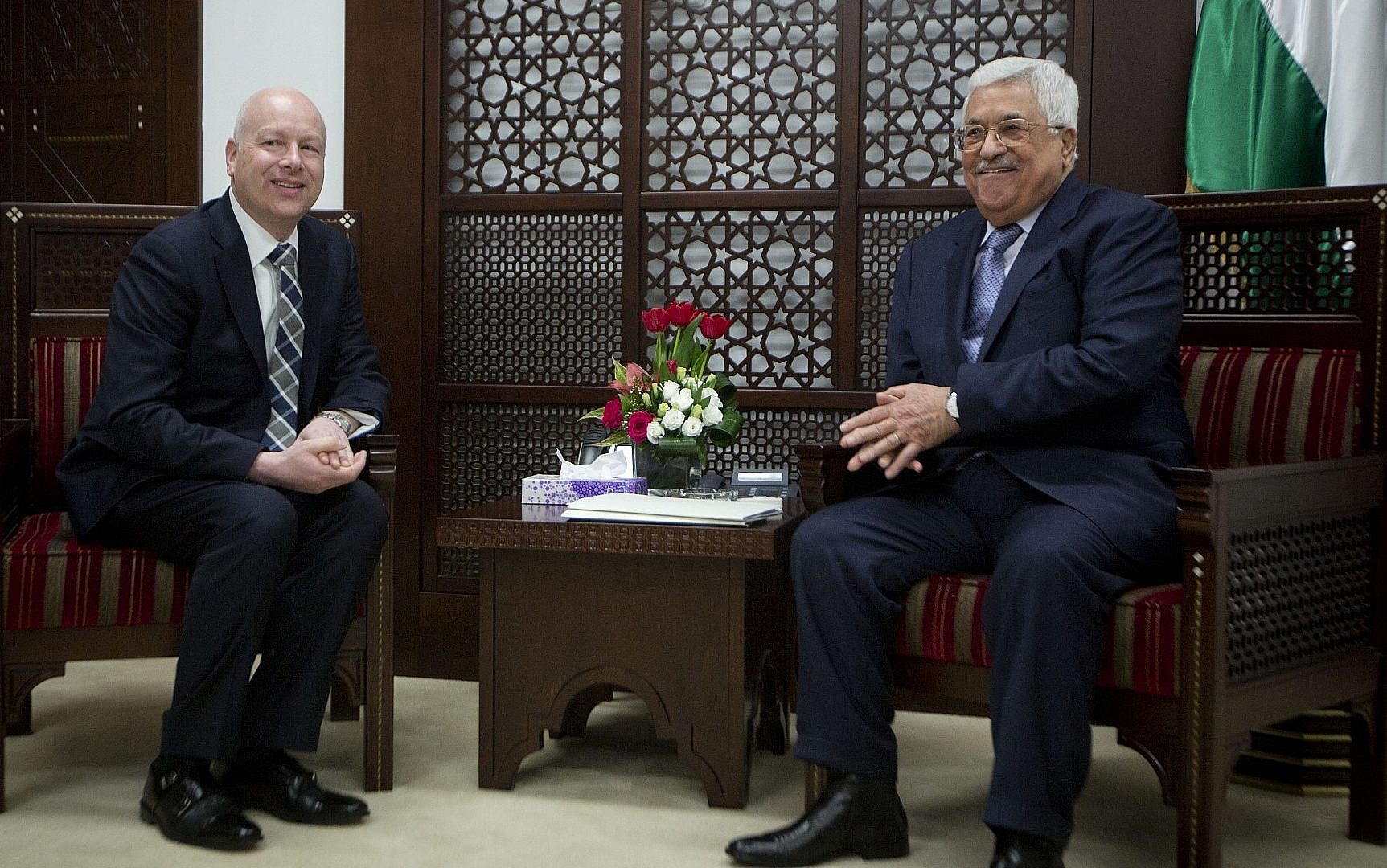
1. The revelation Sunday by PA President Mahmoud Abbas that the Trump administration floated the idea of a Palestinian-Jordanian confederation as part of its wider Middle East peace plan has most of the Hebrew-language media outlets preoccupied on Monday.
- Israel Hayom leads its Monday paper with a special op-ed by US Middle East Peace envoy Jason Greenblatt, who conveys to the Israeli and Palestinian people that “Trump wants this to be a year of peace.”
- “People approach me and ask me to thank President Trump for bringing back hope that peace can be reached and for bring back the [conflict] to everyday discourse,” he writes in the right-wing, pro-Netanyahu daily.
- Greenblatt says the Arab world has changed significantly in recent years, and much of the traditional hostility toward Israel has subsided in light of other regional threats. “Facing a growing and increasingly aggressive Iran that is encroaching on their borders — including in the West Bank and Gaza Strip — [the Arab world] is eager for economic opportunity in their countries, and are now realizing that Israel is not the problem… but can be part of their solution.”
- He goes on to express “disappointment” that Palestinian Authority remains unwilling to cooperate with the Trump administration over its decision to recognize Jerusalem as the capital of Israel last year. “This approach will only lead the Palestinians to be increasingly left behind compared to their neighbors.”
2. In Haaretz, Zvi Bar’el questions whether the revived attention to the decades-old idea for a Jordanian-Palestinian confederation is dead on arrival. Though he says the idea is not unacceptable per se, Bar’el thinks its highly unlikely that all three sides could ever agree on the parameters of such an agreement.
- “With the Palestinians still refusing to give up their aspirations of national independence, Israel waging an all-out war on the idea of an independent Palestinian state, and Jordan fearful of losing its national identity within the salad of a confederation, this vision seems more like a cluster of colorful soap bubbles,” he writes.
3. The US decision to end its longtime funding for the UN agency for Palestinians on Friday was still making the rounds in Hebrew-language media this week. On Sunday, Israel’s Channel 10 news reported that Prime Minister Benjamin Netanyahu sent a secret message to the White House urging US President Donald Trump to cut all funding for UNRWA, without consulting first with his own cabinet or defense officials.
- In a Yedioth op-ed, Ben Dror Yemini praises Netanyahu’s move, calling the complete defunding of UNRWA “a step in the right direction” and saying that after 70 years of the “big refugee scam, the time has come for a change.” He says that UNRWA was “the main instrument” for perpetuating the Palestinian refugee issue, and says the actual number of Arabs who lost their homes during the 1948 War of Independence is far less than claimed by the agency.
3. Philippine President Rodrigo Duterte, who has been accused of condoning human rights abuses in his deadly drug crackdown and who once likened himself to Hitler, received a warm welcome in Israel when he arrived Sunday for an official visit. But not everyone is excited about the visit: Israeli human rights groups and at least one MK have expressed opposition to his visit citing Duterte’s human rights record.
- Haaretz’s Monday editorial calls the Netanyahu government’s embrace of the controversial leader “a diplomatic stain” for the Jewish state. “The economic interests that legitimize this moral embarrassment are also linked to Netanyahu’s diplomatic worldview, under which it’s necessary to bolster ties with leaders of countries where liberal values aren’t high priority, to say the least, in order to shatter the Western consensus against the occupation.”
4. Netanyahu met with a US envoy for Syria to discuss ways to “stop Iran’s terror and aggression” in the war-torn country. The State Department said Netanyahu and envoys James Jeffery and Joel Rayburn would discuss “maintaining Israel’s security while countering Iran’s destabilizing activity throughout the region.”
- Meanwhile, the Syrian Observatory for Human Rights reported a mysterious airstrike near a US base in southeastern Syria has killed at least 8 pro-regime fighters. The war monitor said four Syrians, one Iranian national and three other non-Syrian fighters were among the casualties of the strike near the Al-Tanf base.
5. Foreign Minister Mohammad Javad Zarif has arrived in Syria to meet with President Bashar Assad as Syrian forces and their allies prepare for an assault on the last opposition stronghold in the country.
- Iran’s IRNA news agency says Zarif landed in Damascus on Monday for a one-day visit. He was received by Deputy Foreign Minister Faisal al-Meqdad.
6. The anti-Semitism scandal rocking Britain’s Labour party shows no signs of abating, as Britain’s former chief rabbi Jonathan Sacks told the BBC Sunday that “when people hear the kind of language that has been coming out of Labour, that’s been brought to the surface among Jeremy Corbyn’s earlier speeches, they cannot but feel an existential threat.”
- In the interview, Sacks said that Jewish people in Britain were thinking about leaving the country because of anti-Semitism.
- Meanwhile, Arab Israeli lawmakers expressed their support for Corbyn in a letter published by the Guardian. Unlike their Jewish colleagues who have largely condemned the party and its leader for failing to tackle anti-Semitism, MKs from the Joint (Arab) List praised Corbyn for his “unflinching” support of Palestinians, and asserted he was “and is opposed to all forms of racism, whether directed at Jews, Palestinians, or any other group.”







The Times of Israel Community.