

‘United with Israel’ almost at 1 million Facebook fans
A global Israel-advocacy social media venture has built a vast ‘Friends Network’
 Add ToI as a Preferred Source on Google
Deputy Editor Amanda Borschel-Dan is the host of The Times of Israel's Daily Briefing, What Matters Now and The Reel Schmooze podcasts, and heads up The Times of Israel's features.

It’s the rare website that can boast 170,000 views of a particular article, all the more so one with a tiny multi-tasking staff of 10, and no editor-in-chief. But as United With Israel reaches one million Facebook fans from 100 different countries, such resonance is almost to be expected.
The brainchild of tech-businessman Michael Gerbitz, the Israeli not-for-profit is almost an accidental venture. Gerbitz, who made aliya to Beit Shemesh in 2007, originally opened three online businesses with the idea of selling meaningful Israeli-based products to people who care about the country.
As he began selling the three lines of products as a commercial start-up (including Rockets into Roses, which turns Kassams fired on the Negev into art and Judaica and supports building bomb shelters), “The marketing of the products was really selling Israel itself, showing that we were creating beauty and growth from destruction. It was showing the Jewish people bouncing back with a positive message from something destructive.
“We soon found it was not just about buying our product, but the deeper message that was important,” explains Gerbitz in rapid, passionate, staccato sentences, matching pace with the rain falling on this winter afternoon.
While getting the businesses up and running, Gerbitz began to realize Israel’s real need was in selling Israel itself and he started creating a global movement via social media to support the country. Later this movement overcame the business ventures (which still exist as for-profit companies based in the United States; much of the proceeds are donated) and he created the Israeli not-for-profit United With Israel.

The Facebook page went up in October/November 2010 when Gerbitz’s prime focus became to utilize social media “to unify people all over the world to support Israel.”
The most common denominator among the page’s fans is their diversity. They come from 100 different countries, speak dozens of languages, are of all religions and political backgrounds. In fact, the only thread binding them together is their support for Israel.
‘The best way to reach people is through friends, and social media gives people access to information about Israel from a source that’s a “friend”, not propaganda’
“The best way to reach people is through friends, and social media gives people access to information about Israel from a source that’s a ‘friend’, not propaganda,” explains Gerbitz. “These people do believe what is said on mainstream anti-Israel media such as CNN, but believe more what their friends tell them, people they trust. When they get information from friends, it rings true more than any other outside source.”
An organization such as United With Israel is poised to disseminate information much more effectively than the State of Israel, says Gerbitz. “People recognize hasbara as propaganda, because it comes from an official source. The friend isn’t doing it in a way that’s trying to convince them of something, it’s a very non-confrontational, non-threatening way to expose pro-Israel content.”
United With Israel has built a vast base core of pro-Israel supporters, who, by sharing content, penetrate the consciousness of those who are in the middle when it comes to the Holy Land.
The Facebook page has what Facebook analytics calls a “friends network” of 206 million unique people who are connected to its fans. “If you think about it, there are about 800-850 million people on Facebook across the world. We have a quarter of that population. When they share, comment, like, it potentially drives the exposure to the 206 million. And we have a very engaging audience.”
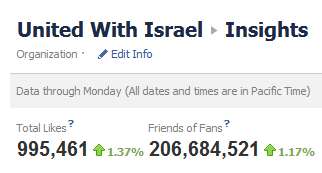
United With Israel tends to highlight a mix of photos, videos, news (“This can be their only exposure to what’s going on”), hot topics such as Iran, and also focuses on technology, “How Israel is a blessing to the world.”
The story that garnered 170,000 likes was about a new Israeli vaccine against cancer. “We mix it up, cool off from a lot of Iran with a funny video. We try to keep people interested and not be too intense.”
The organization wants to start producing more videos, highlighting residents in a town a week with everything from settlers in Hebron, to secular in Tel Aviv, to Israeli Arabs. “One of the messages that is really important to get out is that we are a democratic country, with full rights, that most Israeli Arabs would prefer living in Israel than a Palestinian state,” says Gerbitz.
Another challenge is getting the site’s content translated into some of the dozens of languages its readership speaks. It is currently starting with Spanish through the help of volunteers, but that’s “just the tip of the audience. There is a massive untapped market of Israel supporters that Israel itself is not aware of, and certainly not tapping into.”
‘The next level is to actually do things and figure out how they can be active in their local areas’
“It’s not just about promoting what’s going on, or the truth (that’s step one). Step two is getting people to act and advocate. Now, with a few clicks, they’ve sent info to a hundred of their friends. The next level is to actually do things and figure out how they can be active in their local areas.”
As far as local areas, they’re about as far-flung as possible. Within the 100 countries, about 40% of the readership is from the US, “and then it’s just all over,” including Africa, Australia, Thailand, India, Malaysia.
“We have a strong following in Europe, especially in the anti-Israel countries like Norway. Norway as a country is incredibly anti-Israel, but that’s probably our strongest group.
“Through proxies we know we’re even reaching people in Iran. Just because the government is anti-Israel doesn’t mean the people are.”
Gerbitz stresses that while the site is clearly Zionist and content is from a Jewish point of view, it is non-political and welcoming to everyone across the spectrum that is pro-Israel, whether they are secular, religious, Jewish or non.
So how does it feel to be on the cusp of reaching a million Facebook fans?
Gerbitz qualifies: “We like to refer to them more as supporters than fans.”







The Times of Israel Community.