

VAT and Syria wars
The possibility of a military escalation with Syria, along with across-the-board criticism of Lapid, push the new IDF draft bill to the inner pages
 Add ToI as a Preferred Source on Google
Aaron Kalman is a former writer and breaking news editor for the Times of Israel
The front pages of the Hebrew dailies are split between those emphasizing the dangers awaiting Israel on the Syrian front and those highlighting the country’s domestic and economic issues. Surprisingly, coverage of the recent decision by a ministerial committee to allow the targeting of ultra-Orthodox draft dodgers with criminal sanctions is harder to find.
“Syria: We’ll respond immediately if Israel attacks again,” yells the headline on Yedioth Ahronoth, as the paper reports there is growing concern in Damascus that Israeli military action is on the way.
“We’ve declared to the world that we will retaliate immediately if Israel attacks again,” Syrian Foreign Minister Walid al–Moallem said in an interview with the Lebanese TV station Al-Mayadeen. ”Any aggression will be met with a response of a smiliar magnitude.”
Bringing together recent remarks by White House press secretary Jay Carney, who said President Barack Obama was open to the idea of enforcing a no-fly zone, and Wednesday’s demand by the State Department that Hezbollah remove all its people from Syria, the tabloid paints a picture of impending war. If indeed war erupts, “Israel will know what to do,” Defense Minister Moshe Ya’alon is quoted as saying.
Statements by National Security Adviser Yaakov Amidror about Israel’s “red lines” regarding the transfer of S-300 surface-to-air missiles from Moscow to Syria leads Haaretz‘s front page. According to the report, last week Amidror laid down Israel’s red lines in a discussion with the 27 ambassadors of EU member states. Israel will act to “prevent the missiles from becoming operational on Syrian ground,” he said. Usually, the reporter noted, it takes between three and six months for such systems to become operational.
One of the ambassadors present told the Hebrew paper it was clear from Amidror‘s words that Israel didn’t believe it could stop Russia from transferring the advanced weapons to President Bashar Assad’s army, for reasons unrelated to Israel. The rivalry between Russia and the US was dictating Moscow’s moves, he explained, which is why Israel felt it would have to act against the missiles after they’d reached Syria.
But Maariv pushes Syria and the missiles to the sidelines, choosing to feature Wednesday’s Knesset decision to raise VAT by one percent, so now people will pay an 18% sales tax on purchases. More precisely, it highlights the fact that Finance Minister Yair Lapid, the man behind the decision, chose not to be present at the time of the vote — and boarded a flight to Paris soon after.
“The finance minister fled the country while the Knesset raised VAT for all the country’s citizens — because he’s afraid of the criticism,” opposition sources were quoted as saying. “Where art thou?” MK Yitzhak Herzog (Labor Party) asked Lapid.
But it wasn’t only the that opposition felt Lapid had made a mistake. Members of the ruling Likud party also expressed their frustration toward the Yesh Atid head. “It’s a shame and disgrace that Lapid dared to be absent from the vote,” an unnamed Likud official told the paper. A Likud minister was even more blunt, saying coalition members almost rebelled and were close to voting against the plan.
Israel Hayom does the best job of all Israel’s papers ignoring Syria, at least on the front page. In addition to the post-VAT-vote bickering, the paper features Energy and Development Minister Sivlan Shalom’s plan to tackle Israel Electric, a public corporation that’s one of the largest and least efficient monopolies in the country.
In an interview with the paper scheduled for publication Friday, Shalom recalls his time as a director on the company’s board, and how he plans to reform the place. “When I entered office I discovered that the company had a debt of NIS 76 billion… In a commercial company the owner would have fired the manager and the board.”
Reform, Shalom said, “is necessary.” The steps the minister plans to enact include firing up to 2,000 workers and canceling the free supply of electricity given to company employees.
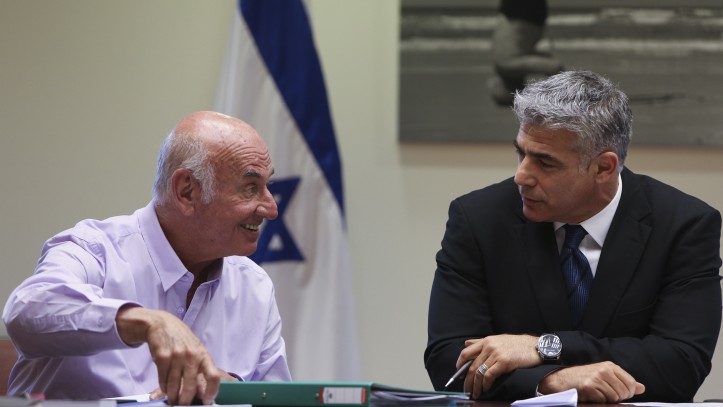
While it wasn’t a prominent story, all the papers reported on Wednesday’s decision to empower the defense minister, who will be allowed to wield criminal sanctions against ultra-Orthodox draft dodgers. While Lapid hailed the new conscription bill “historic change,” some of Israel’s veteran analysts disagree.
In Israel Hayom Dan Margalit charges that the Peri Committee recommendations are not serious or binding, and are “at most, the will of the public.” After listing his many points of contention with the bill, he writes that the idea of pushing mandatory conscription off by four years “is almost like selling plots on the moon.”
Margalit writes that four years down the road Israel will face a new geopolitical arena in which three of today’s burning questions will have been answered, one way or another: the civil war in Syria will have ended, the fate of Iran’s attempt to reach nuclear weapons will have been determined, and the US’s recent push toward peace between Israel and the Palestinians will be over. In addition, there will be a new Knesset and new government that could overturn the decision.
After the bombastic statements from politicians, “does the law herald great change?” asks Ma’ariv’s Amir Rapaport. “Not really,” he says.
The number of ultra-Orthodox soldiers in the army won’t be drastically higher than without the bill, Rapaport writes, adding, “It won’t bring real equality,” because, even if it’s fully realized, the plan will exempt half the adult population — mostly Arabs and ultra-Orthodox — from serving the country.
In another preview of a weekend feature, Maariv‘s front page sheds light on the results of the tabloid’s J100 project, in which it chose and ranked the 100 most influential Jews in the world. Spoiler alert: Mark Zuckerberg, Facebook’s founder and CEO, ranks first. Behind him are Prime Minister Benjamin Netanyahu and President Shimon Peres. In what could be construed as cheating, they ranked Google founders Larry Page and Sergey Brin together at fourth, allowing Steven Spielberg to round up the top five.







The Times of Israel Community.