

And then there was sand
A massive sandstorm covering Israel defies scientific explanation while soccer games on Shabbat bite the dust, though minister says talks ongoing
 Add ToI as a Preferred Source on Google
Marissa Newman is The Times of Israel political correspondent.
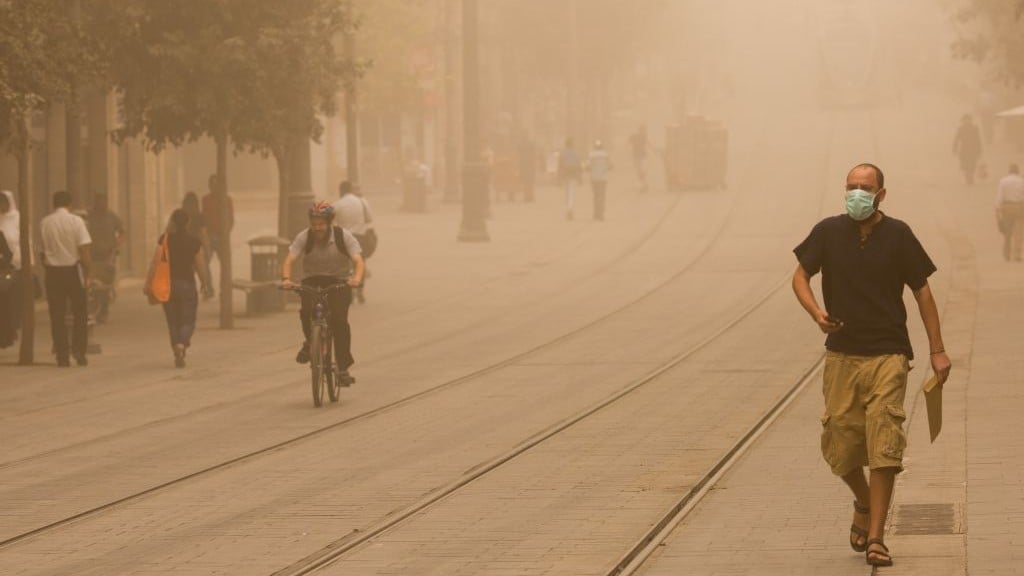
A sandstorm swept into the region on Tuesday, painting the front-pages of Israel’s Hebrew dailies on Wednesday in fifty shades of gray and mustard yellow.
“Meteorological services have not seen an attack like the one from the eastern front yesterday in 75 years – a heavy sandstorm covered the Middle East, blocked the sun, entered our lungs, and reminded us, at the end of a hot and oppressive summer, that it can always get worse,” Yedioth Ahronoth reports.
“Today the sandstorm will still be felt, but it will peter off by evening and likely disappear by tomorrow,” it reports. “But this is no cause for celebration: the high temperatures are not expected to disappear along with it.”
Over in Israel Hayom, which like Yedioth, features a spread of sand-covered Israeli cities, the paper points out that a summer sandstorm is an unlikely occurrence.
“By yesterday morning, when we weren’t able to locate the sun in the brown skies, we understood that we have a difficult day ahead,” it writes. “Later, after hours of suffocating air pollution, and failed attempts to breathe without coughing, the facts came in confirming what our lungs already knew: we haven’t experienced this kind of sandstorm for many years. This is an unprecedented incident for this time of the year,” it reports.
Haaretz, meanwhile, emphasizes that the sudden sandstorm has scientists stumped.
“I don’t remember such an incident in which so much sand came from the direction of Syria, and without strong winds,” Professor Daniel Rosenfeld of Hebrew University tells the daily. “The large sandstorms generally come at the beginning of winter from north Africa and are accompanied by powerful winds.”
“Rosenfeld noted that scientists currently have no explanation for the phenomenon,” it reports.
Along with scorching temperatures, Haaretz also focuses on another battle heating up – over soccer games on Shabbat.
“No soccer matches will take place next Saturday unless Economy Minister Aryeh Deri issues a Shabbat employment permit, the Israel Football Association decided on Tuesday,” it reports.
Culture and Sports Minister Miri Regev, however, said the issue was far from over and was seeking a compromise, it reports. She said she was in consultations with the attorney general over the issue, which came after a Labor Court ruling that soccer games on Shabbat, without the permission of the economy minister, are illegal.

“Teams that don’t want to play on Shabbat won’t play on Shabbat. And those than want to play will play,” she said. “If more than seven players say that they don’t want to play on Shabbat, it seems to me to be fair that the team won’t play on Shabbat… But the club needs to find a solution. Once there’s a decision it has to be binding on all the teams as well as the soccer association and the directorate.”
Over in Yedioth, the paper also highlights that President Reuven Rivlin and Prime Minister Benjamin Netanyahu have not met in two months, with the president saying the two were divided over the prime minister’s head-on approach to the Obama administration. According to the report, which cites an Army Radio interview, Rivlin was opposed to Netanyahu’s Congress speech in March, and criticized the prime minister for refusing to discuss a defense package in compensation for the Iran nuclear deal.
“It’s no secret that there is no love lost between President Reuven Rivlin and Prime Minister Benjamin Netanyahu,” it continues, pointing to the prime minister’s attempts to thwart Rivlin’s presidential bid and longstanding rivalry. “In a past interview, Rivlin was asked if he meets the prime minister for dinner, which Peres did during his presidency. The president, with his characteristic humor, replied: ‘I eat with my friends.’”
Meanwhile, Haaretz dedicates its editorial to the Shin Bet’s failure to apprehend the perpetrators of the July 31 Duma attack, which left three members of the Dawabsha family dead.
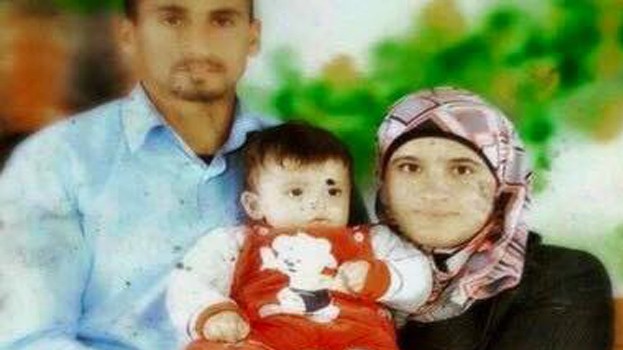
“This is an unreasonable and intolerable situation. The more time passes, the greater the suspicion grows that the security agencies, first and foremost the Shin Bet security service, aren’t doing enough to capture the murderers. The killers are roaming free, thumbing their noses at the authorities and destined to perpetrate additional horrifying crimes,” it writes.
“The people who burned an entire family to death and sentenced the one member who remained alive, a 4-year-old boy, to orphanhood, are extremely dangerous — not just to the Palestinians, but also to Israeli citizens. People who burned babies alive are walking around free. And there is no greater shame for those who should have caught them long ago.”








The Times of Israel Community.