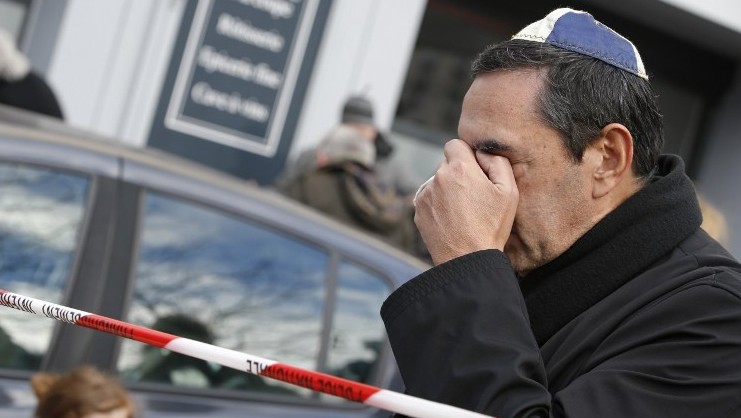
A man wearing a kippa cries near a kosher grocery store in Porte de Vincennes, in eastern Paris, on January 10, 2015, a day after four people were killed at the Jewish supermarket by jihadist gunman Amedy Coulibaly during a hostage-taking. (Photo credit: AFP/ KENZO TRIBOUILLARD)
Prisons chiefs and justice officials of 47 countries met in Bucharest Wednesday to look at ways to fight radicalization in prisons after the January terror attacks in Paris.
The 20th Council of Europe Conference of Directors of Prison and Probation Services was held under the theme of “Strategic Challenges for Prison and Probation Services,” according to the conference website.
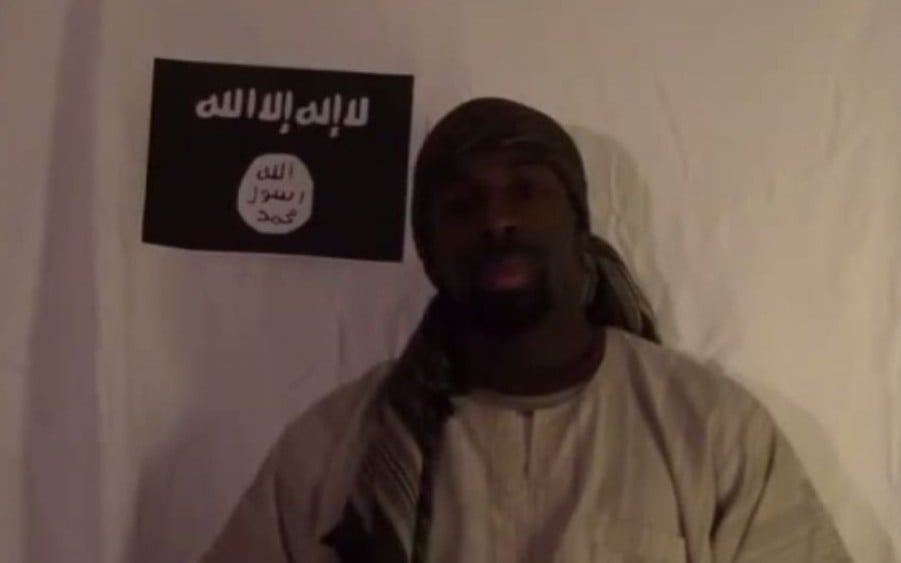
Prisons face a problem “of the utmost importance,” said Philippe Boillat, human rights and rule of law chief for the European Council, who cited the case of Amedy Coulibaly, the jihadist who killed four Jewish hostages and a police officer in the Paris attacks that earlier this year left a total of 17 dead.
Coulibaly is believed to have been radicalized during a stint in prison.
Amedy Coulibaly, who was shot dead by French police on January 9, 2015, is seen in a video clip pledging allegiance to the Islamic State. Photo credit: YouTube screenshot)
Boillat warned that “the most dangerous extremists learn to hide their beliefs and intentions.”
Get The Times of Israel's Daily Editionby email and never miss our top stories
Attendees were a medley of justice ministers, prison system administrators and counterterrorism experts.
Among the presenters were Romanian Justice Minister Robert Marius Cazanciuc, Director General of Romanian Prisons Claudiu Cătălin Bejan, Council of Europe counterterrorism coordinator Ivan Koedjikov and Professor Mark Hamm who is researching so-called “lone wolf” attacks.
The Bucharest meeting aimed to draft “guidelines” defining the role of prison services in the fight against radicalization and violent extremism, which will be submitted to the Committee of Ministers in December.
Advertisement
Help us report truthfully on social media
As a multimedia journalist, my job is to take the quality, fact-based journalism produced by The Times of Israel newsroom and make it accessible across every platform — from Instagram posts to podcasts to short-form videos.
This is how many, especially young people, consume news these days. But misinformation is rampant on social media. Our team at ToI produces accurate, responsible short-form reporting on Israel and the Jewish world.
If you believe in the importance of factual social media journalism, please consider joining our reader support group, The Times of Israel Community. Your financial support is essential to sustain responsible multimedia reporting.
We’re really pleased that you’ve read X Times of Israel articles in the past month.
That’s why we started the Times of Israel - to provide discerning readers like you with must-read coverage of Israel and the Jewish world.
So now we have a request. Unlike other news outlets, we haven’t put up a paywall. But as the journalism we do is costly, we invite readers for whom The Times of Israel has become important to help support our work by joining The Times of Israel Community.
For as little as $6 a month you can help support our quality journalism while enjoying The Times of Israel AD-FREE, as well as accessing exclusive content available only to Times of Israel Community members.
Thank you, David Horovitz, Founding Editor of The Times of Israel


 Add ToI as a Preferred Source on Google