

I can haz mat?
While assuring readers that Ebola isn’t about to knock on Israel’s doorstep, papers still play up the fear; plus, a mawkish letter from a sad Iranian
 Add ToI as a Preferred Source on Google
Joshua Davidovich is The Times of Israel's Deputy Editor
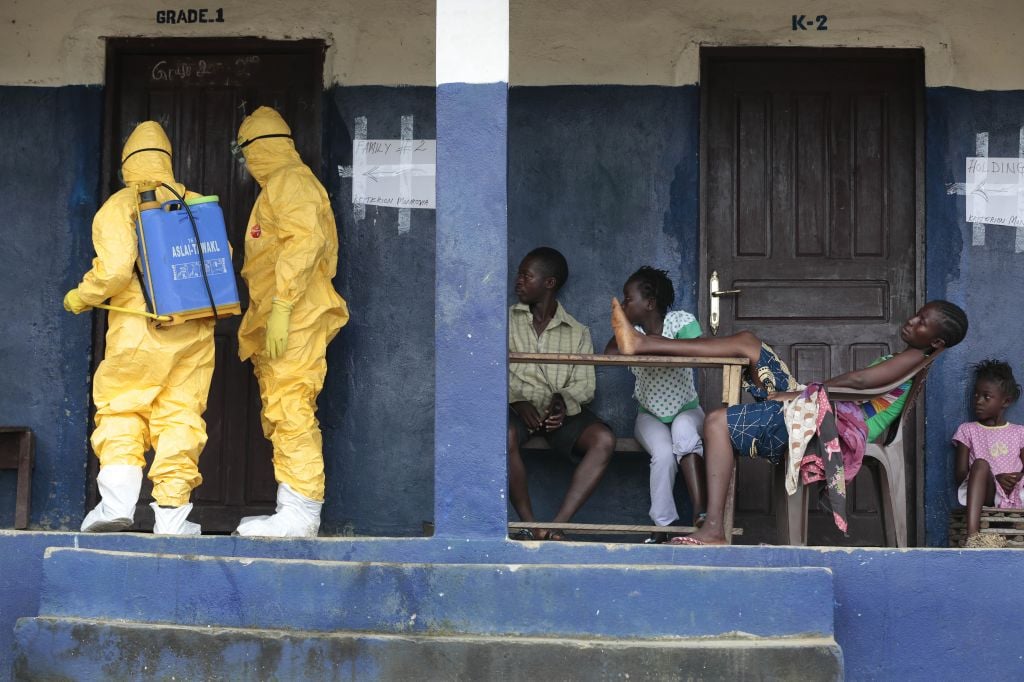
One could be forgiven for accusing the Israeli Hebrew-language print press of the three journalistic sins of fear-mongering, exaggerating and shmaltzifying the news.
At first glance, Monday morning’s newstand pictures of hazmat suits and an “exclusive” letter of woe from Iran may seem to fit the bill of all three. However, with international health figures, people not normally given to hysterics, warning of Ebola as the world’s worst modern health crisis, and with the effects of Iranian arms trafficking in the face of sanctions fresh in people’s minds, one might lean toward giving Yedioth Ahronoth, Israel Hayom and Haaretz a pass this time around.
Yedioth isn’t going to win any nuance awards for its headlines and gratuitous use of pictures of children in its exclusive printing of a letter of a young Iranian critical of the regime, but the story still offers a little seen window, especially for Hebrew-readers, into life in sanctions-ridden and anti-Zionist Tehran.
The letter, printed courtesy of Haifa University’s TehTel project, which attempts to culturally link Israelis and Iranians, promises a “virtual tour of Tehran” from a recent al-Quds Day, when the city becomes awash in especially virulent anti-Israel rhetoric in service of the Palestinian cause.
While letter-writer Ali takes readers from stop to stop, each with more anti-Israel bombast than the last, he also fills his note with personal musings on the crippling poverty the sanctions regime has brought onto the country, wondering how they can send missiles to Hamas that can harm children (the paper helpfully runs a picture of Daniel Tragerman, a 4-year-old killed by a (likely non-Iranian) mortar over the summer), while kids in Iran can’t eat.
“A small child, still not 10, walks around the street in the morning to make some money. I can’t think about what would happen if they invested the large sum of money wasted on anti-Israel protests on education of kids,” he writes. “I feel embarrassed next to Israelis, embarrassed and shameful that some of my countrymen are involved in the heart of the war between [Israel] and the Palestinians, and their hands are soiled with the blood of innocent children in Israel and Gaza.”
If the sentimentality isn’t for you, Israel Hayom skips over the mushy stuff to offer what it says are the cold hard facts of Ebola: we’re all going to die.
No, not really, but the paper takes the latest precautions adopted by Israel and runs with them, with a big honking front page headline noting Israel is “Preparing for Ebola.” As the preparations thus far only include a questionnaire for visitors from Sierra Leone, Guinea and Liberia, the paper has to look abroad to find actual precautions being taken. Nonetheless, Israel Hayom reports that “Israel is not taking any risks, even if the chances of Ebola getting here from the three African nations are slim.”
Buried in the bottom of a Q and A, the paper notes that “there is reason to worry, since when the first patient gets here, we will need to deal with an extremely deadly disease. That being said, the chances of it spreading are very small, if at all, since the system is stable and good and there are methods for isolating the sick.”
On the other hand, the paper runs a commentary from Prof. Eli Schwartz, the head of an Israeli tourist medical center, peeved that the world’s response seems to have been too little too late. “The late response of government to its spread… contributed to the fact that the plague is continuing in these three countries.”
Ebola may seem a far-off threat, but Egyptian President Abdel-Fattah el-Sissi’s prediction of a plague on both Israel and the Palestinians houses if they don’t find a way to peace makes Haaretz’s front page as a more pressing matter.
The paper leads off with Sissi’s address to a Gaza donors conference in Cairo, specifically his call to Israel to make peace based on the Arab Initiative. “I turn to every infant, man and woman, and Palestine and Israel, to work toward the actualization of the dream of coexistence based on the Arab Peace Initiative,” he is quoted as saying.
Reading between the lines, diplomatic correspondent Barak Ravid writes that Sissi’s message was that peace with the Arab world will only come after peace is made with the Palestinians, and not vice versa, as Prime Minister Benjamin Netanyahu has proposed.
“Sissi reminded Netanyahu that there are no free lunches or end-of-season bargains in the peace process. If Netanyahu wants to continue conducting relations with Saudi Arabia, the United Arab Emirates, Egypt and Jordan under the table, via senior defense and intelligence officials, as he does now, fine. But if he wants normal relations, he must understand that the road to Riyadh, Abu Dhabi, Cairo and Amman passes through Ramallah,” he writes.
Israel Hayom notes prominently that Israel wasn’t even invited to the donor’s conference, a blow to its demand that reconstruction be tied to Hamas’s disarmament, and editor Boaz Bismuth writes that rehabbing the Strip is tantamount to funding terror.
“The problem is that after 51 days of harsh summer fighting, our Palestinian neighbor does not understand that rehabilitating Gaza does not go through the bank ($4 billion) but through removing Hamas from the picture,” he writes. “This is indeed not simple, but we would expect to see the PA to show signs of avoiding the recalcitrant movement, instead of hugging leader Ismail Haniyeh.”
Yedioth reports that the conference managed to garner $5.4 billion (well above Haaretz’s figure of $3 billion) and notes the next step will be to create a system to oversee how the funding is disbursed. The paper also gives a smidgen of space to Monday’s British parliament vote on recognizing a Palestinian state, writing that the measure is mostly symbolic.
“Even if it passes, the proposal does not obligate the British government. However, if there are elections next year and Labour forms the new government, its members may demand that the new administration unilaterally recognize the state of Palestine.”
Anshel Pfeffer writes in Haaretz that the vote is much ado about nothing, but opponents of the proposal have blown it out of proportion, even though it’s mostly just symbolic of local political glad-handing.
“British and European Jewish organizations have further complicated things by launching their own initiatives, calling on MPs to either oppose the motion or support the amendment. This lobbying was not coordinated with the Israeli Foreign Ministry, which preferred to play down the vote rather than fight it,” he writes.
“A passed motion would have very little impact on Britain’s foreign policy, if at all, but it would have a whole lot to do with local politics. At Britain’s general election in seven months, the political future of dozens of Labour MPs who hold slim margins in their constituencies could be in the hands of Muslim voters. They fear that not voting to recognize Palestine could keep these voters at home or shift them to other parties.”






The Times of Israel Community.