

Same spate, different day
With a wave of terror showing no signs of abating, papers press repeat, while offering a torrent of advice and commentary on the security situation
 Add ToI as a Preferred Source on Google
Joshua Davidovich is The Times of Israel's Deputy Editor
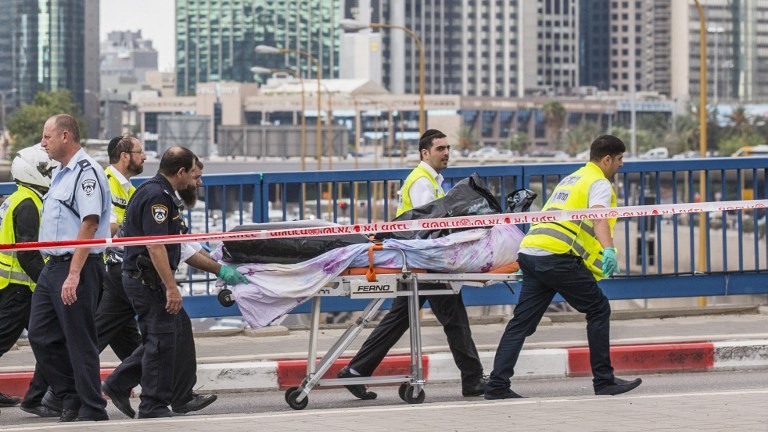
It was a running (bad) joke during last decade’s Second Intifada that journalists could just change the dates and places and rerun the same news stories again and again, day after day. Not to say that Israel is embroiled in another intifada, but at least for the press — after a day that saw four terror attacks, matching four attacks a day earlier — the black humor may find its way back into vogue.
Indeed, Friday morning’s papers look eerily similar to Thursday’s, with minute-by-minute accounts of nearly nonstop stabbing attacks and other general unrest. Yedioth Ahronoth‘s front-page headline, “Nonstop terror,” telegraphs as much, and both it and Israel Hayom feature near-never ending timelines of Israel’s no-good, very bad, terrible day.
It’s not only the news that seems to be on repeat mode, but also the plethora of commentaries on the situation encroaching on every page trodding the same, tired territory of handicapping whether or not we are intifada, peering into what the future holds and offering advice on how to handle it.
Haaretz dispenses with the news altogether, instead offering a stream of news and analysis on the situation, together with a dramatic front-page picture of a cop running, sub-machine drawn, down a busy Tel Aviv street Thursday, above the headline “Turning point.”
In the accompanying story, military analyst Amos Harel notes that the wave of terror attacks seems to be coming from the ground up, with no organizational structure or support from Hamas or the Palestinian Authority. With each passing day, though, chances increase that they will begin to get involved as Israel brings the hammer down, he argues.
“It’s a matter of days, if not hours, until ministers call to place a full closure on the West Bank and stop over 100,000 Palestinian workers from crossing the Green Line or going to settlement industrial zones. The result, senior IDF officials warned yesterday, could be the opposite from what is intended, and could bring thousands more Palestinians to the frontlines of the fighting, who until now have avoided it,” he writes. “Every step toward normalization, which was built in stages and with much hard work since the end of the Second Intifada (and with Gaza after last year’s war), could be undone in one fell swoop, as if it never existed.”
In Yedioth, Nahum Barnea warns that the wave of terror has turned into a tsunami — employing Israelis’ two favorite metaphors for periods of increased anything — but still somehow maintains that it’s not so bad.
“The feeling is that the whole country is a frontline, and the whole nation is a candidate to be stabbed. That’s exaggerated. It’s still better to live here than in most other countries, but there is still something to that feeling,” he writes.
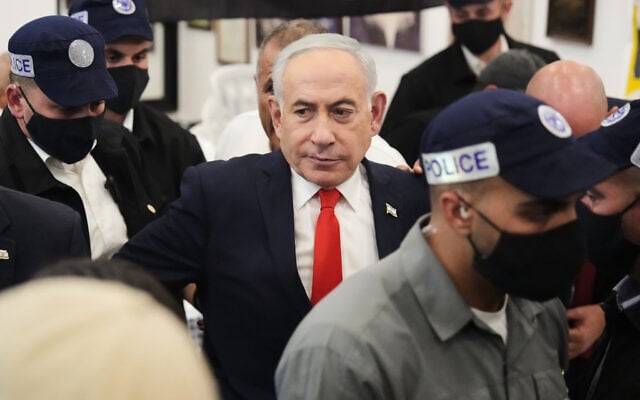
Much of the coverage focuses not on what happened, but what should or shouldn’t be done about it, pegged to a press conference given by Prime Minister Benjamin Netanyahu and a gaggle of security chiefs Thursday night.
Israel Hayom leads off with the news conference, and with Netanyahu’s call to ban the Islamic Movement, an Arab-Israeli Islamist organization, which seems oddly besides the point.
The paper’s Dan Margalit takes heart in the leadership’s calming words, and what he describes as their smartly considered balance between the use of force and policy limitations.
“It’s easy to agree with the words of five out of the six security chiefs in the country that the situation is bad, but Israel will emerge from the battle with the upper hand. That’s how it was and how it will be…. The statements are totally routine, but needed to be said, even if there was nothing new in it,” he states. “The group came to assure and calm us. They know that an accounting of gains and losses will come when this ends. Just like Operation Protective Edge, which has already given Israel a year of calm, and everyone knows that operations like this are only supposed to gain time as much as possible. In a few months, will the group of five be able to stand with a straight back — as Netanyahu said — before the public, or will the opposite be true?”
Commentators in other papers, though, seem to say that they already know the answer, and it is a big, fat “no.”
Barak Ravid writes in Haaretz that Netanyahu’s press conference offered the public little more than a list of ways to fight the spate of terror, with nothing more comprehensive in terms of policy going forward.
“It seems that beyond the here and now, the prime minister doesn’t know where he wants to go or what he wants to achieve. At Thursday’s press conference, he didn’t offer Israel’s citizens anything except metal detectors, Ruger rifles, cameras and incursions into Palestinian towns. There was no goal, no vision of how he wants our relationship with the Palestinians to look at the end of his term,” he writes.
Netanyahu’s speech also included a special message to mothers, that their fears are justified, but the security forces are doing everything they can to quell the violence. But in Yedioth, Shir-Li Golan, a mother of three girls, pens a response to the prime minister that the situation as it stands is insufferable and getting worse.
“My instructions to my girls not to travel on the bus or the Jerusalem Light Rail, and to treat me as a backseat driver, were expanded yesterday to include requests not to take out the dog, not to take out the trash, and to stay at home…. There’s no safe place these days except at home. That’s why our door is double-locked to give a sense of relative security,” she writes. “In the meantime, we are in a state of blockade, everyone in their home, latching on to the primeval need to protect our children from danger that lurks outside. And that is isolating, choking and insufferable.”




The Times of Israel Community.