

The election connection
Palestinian diplomatic bids and rising Gaza tensions are seen through campaign-colored glasses in the press
 Add ToI as a Preferred Source on Google
Joshua Davidovich is The Times of Israel's Deputy Editor
It’s hard to find a subject these days that can’t be tied to elections. From Palestinians diplomatic efforts to Gaza tensions to the price of rice in China, it seems the upcoming vote can be found anywhere you look.
So it is that the return to the polls lurks in both major news stories that dominate press coverage Sunday morning: Israeli politicians’ attempt to enlist Washington to push off an Israeli statehood bid as a way of weakening Netanyahu; and less obviously, a reappearance of Gaza tensions, including an exchange of fire for the first time since August.
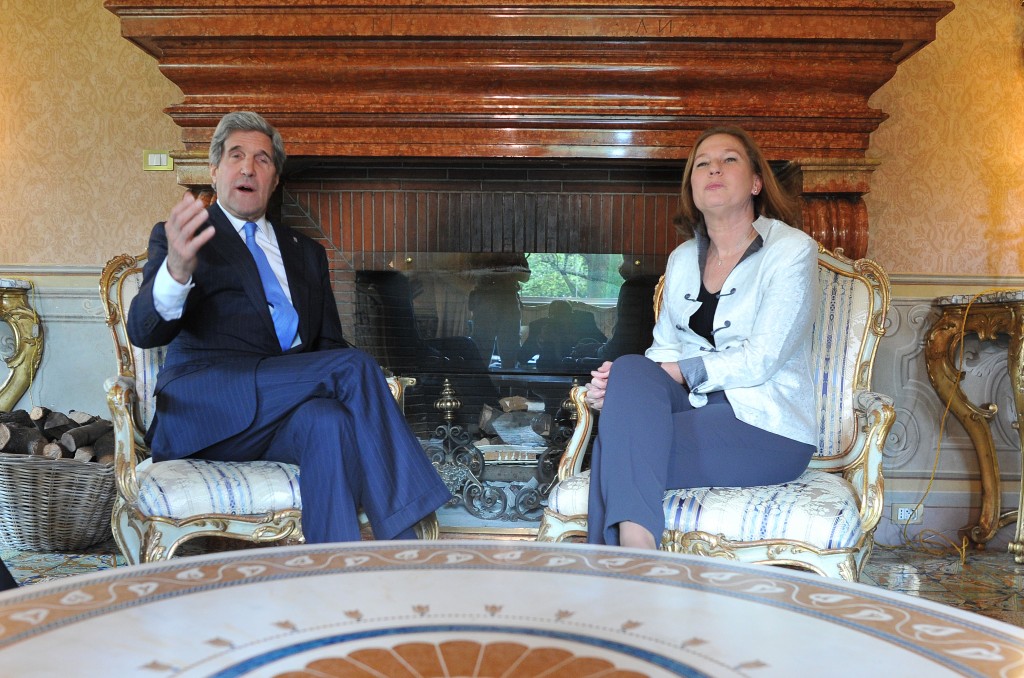
Haaretz leads off with the report that US Secretary of State John Kerry told European envoys to help him quash the Palestinians’ statehood bid at the United Nations, after Hatnua party head Tzipi Livni and former president Shimon Peres pleaded with him and told him that helping the Palestinians would also help Netanyahu stay in office. Haaretz was citing US magazine Foreign Policy, which broke the story on Saturday.
The paper takes the affair forward a bit, quoting a senior Palestinian Authority official who tells them that Ramallah is considering holding off on its Security Council statehood bid in the wake of pressure from Washington, seemingly for the very reason cited by Kerry.
“There are those in the UN pushing to postpone the vote at least until the beginning of the year, when the Security Council makeup will change,” the official is quoted saying. “Others, especially the United States, are requesting a longer postponement until after the elections in Israel, since such a step could strengthen the Israeli right. Some of the pressure is also being directed at Arab states, so they will influence the Palestinians.”
Israel Hayom moves the story in another direction, playing up the anger among Israel’s right over Livni and Peres’s move. The paper’s main headline on the story puts “Livni crossed all the red lines” in quotes, though the quote is not actually said by anyone in the story.
The closest approximation is Likud apparatchik Ofer Akunis: “All the red lines are being crossed in this election campaign. Ms. Livni, whose failure in talks with the Arabs has continued for several years, gives advice to the American secretary of state just to further her own political interests. This is yet another proof that the union of Livni and [Labor head Isaac] Herzog puts its political interests over Israel’s interests, and is dangerous for Israel.”
The paper’s Haim Schein characterizes the matter as “subversion,” borrowing a term from Jewish Home head Naftali Bennett’s response, a word which also happens to be plastered across the tabloid’s front page. In his column, Schein intimates no less than that Livni and her goons are out to help the Islamic State take over Israel.
“[Palestinian Authority President Mahmoud Abbas] prays five times a day that Tzipi Livni and Isaac Herzog will win the elections. He is convinced that with their proven record… he will be able to return to the 67 lines in the framework of his staged plan. A terror state that will ruin the lives of citizens and turn it into a central goal for the Islamic State organization,” he writes, in less than complete or cogent sentences.
Yedioth is the only paper to lead off with the exchange of fire in the south, starting with a single rocket shot out of Gaza Friday morning, leading to an airstrike from Israel, the first serious sally since August.
And just as the Livni-Kerry meeting ties elections to diplomatic moves, so does Yedioth Ahronoth’s Alex Fishman. The columnist notes Israel’s out of the ordinary response to the solitary rocket –hitting a Gaza cement factory — leading to the worry that politicians with their finger on the trigger are acting with polling data on the brain.
“Since the fighting ended in late August, Israel has preferred quiet around Gaza over taking care of Hamas’s rearming. Nobody here is dumb: Israel sees that Hamas is building up its forces, but prefers quiet over restarting the fighting. So one only needs to hope that the change in Israeli policy we saw over the weekend isn’t connected to elections, but comes instead from clear security considerations,” he writes.
As for Hamas rearming, the paper reports that the terror group has begun rebuilding tunnels used for cross-border attacks. Citing only an “Israeli assessment,” the paper writes that Hamas is preparing for the next round, when it will attempt to send large numbers of fighters through the tunnels and into Israel.
In Haaretz, Amos Harel notes that the situation in Gaza today is not all that different from how it was before the last round of fighting, but he leavens his fears that things can easily spin out of control like last time with the analysis that Gaza isn’t quite ready for another round yet.
“The restraining factor in the equation – which is stronger than it was last July – is connected to the suffering that the Palestinian population in Gaza has already endured: the destruction left by the last round of fighting there is the worst ever. Despite anger at Israel and Egypt, Gazans are not likely to be eager for another round of fighting,” he writes.
“On the other side of the equation is Benjamin Netanyahu, a prime minister on the way to elections. As usual, there is a gap between his hard-line rhetoric and his actions on the ground. … It may be assumed that, as far as it depends on Netanyahu, he will avoid another flareup in Gaza during an election campaign, for fear he will not be able to control events. Yet a direct challenge by Hamas (which would cast doubts on the achievements of last summer’s war) could lead to escalation.”






The Times of Israel Community.